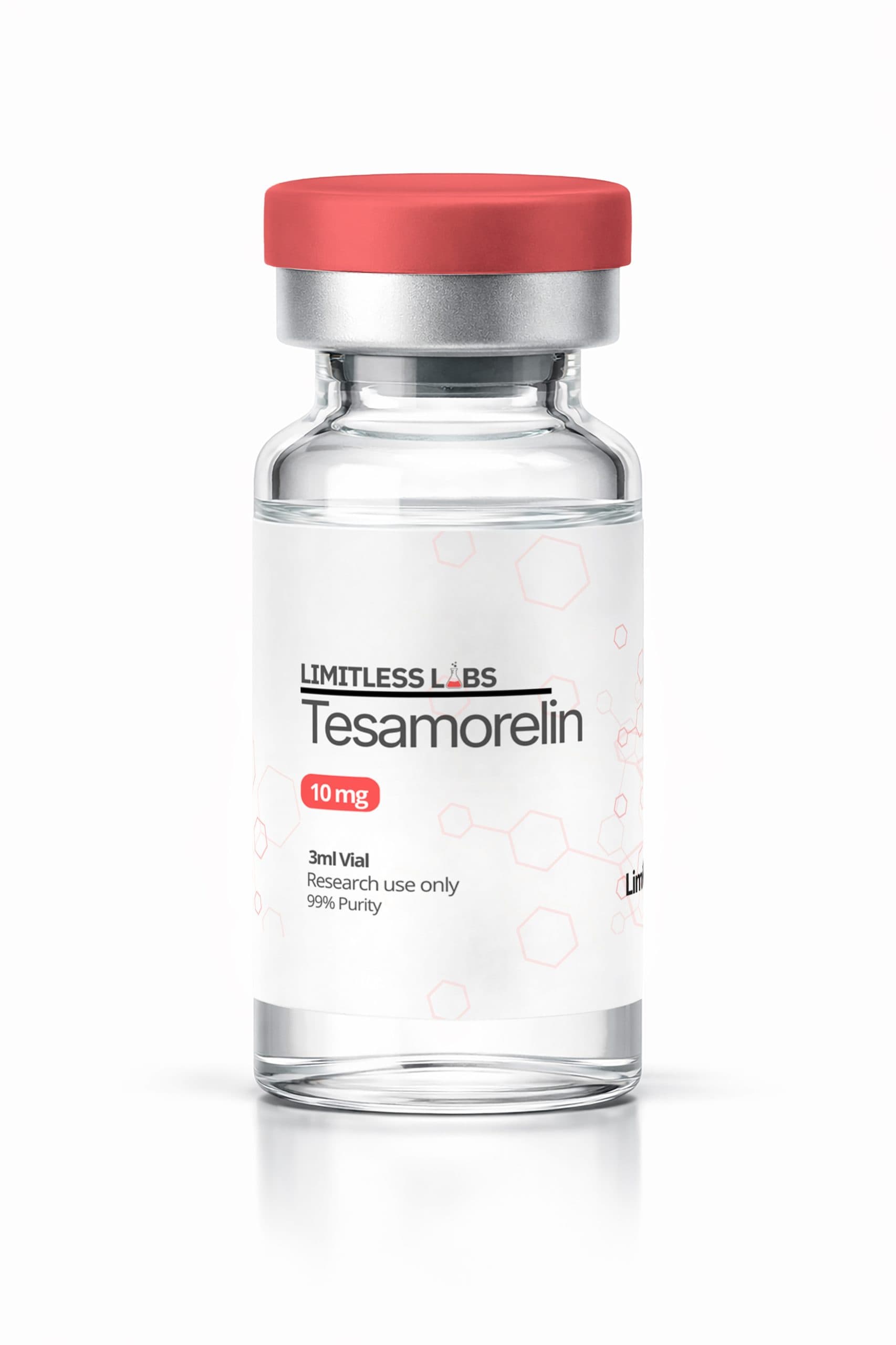
Tesamorelin is a stabilized synthetic analog of human growth hormone-releasing hormone (GHRH), engineered to resist the rapid enzymatic degradation that limits native GHRH(1-44). Unlike most compounds covered in this research library, tesamorelin is an FDA-approved pharmaceutical: it is marketed as Egrifta (and, in later reformulations, Egrifta SV and Egrifta WR) for the reduction of excess visceral abdominal fat in adults with HIV-associated lipodystrophy — the only GHRH analog currently on the US market [13]. In the pivotal phase 3 trial, 412 HIV-infected adults with abdominal fat accumulation received tesamorelin or placebo for 26 weeks; visceral adipose tissue (VAT) decreased 15.2% with tesamorelin versus an increase of 5.0% with placebo, alongside improvements in triglycerides and the total cholesterol-to-HDL ratio (P<0.001 for all three) [1]. This article summarizes the published scientific literature — trial designs, reported outcomes, and open questions — for research and educational purposes. It is not medical guidance, and later sections describing cognition and liver-fat research describe investigational findings, not approved indications.
What Is Tesamorelin?
Tesamorelin (developmental code TH9507) is the 44-amino-acid sequence of human GHRH with a trans-3-hexenoyl group attached at the N-terminal tyrosine residue, a modification intended to slow the rapid enzymatic inactivation that limits native GHRH's activity, supporting once-daily subcutaneous dosing in the clinical trials described below [1][12].
Tesamorelin's regulatory history reflects three successive formulations of the same active peptide:
- Egrifta (original formulation). The FDA approved tesamorelin for injection in November 2010 as the first and only treatment indicated to reduce excess abdominal fat in HIV-infected patients with lipodystrophy, based on the phase 3 program described below [12][13].
- Egrifta SV. A reformulation requiring daily reconstitution at a reduced injection volume received FDA approval in 2019, replacing the original formulation in the US market [14].
- Egrifta WR. The current formulation, approved by the FDA in 2025, is injected daily but requires only weekly reconstitution and roughly half the administration volume of Egrifta SV [15].
Prescription tesamorelin is dispensed through licensed pharmacies under medical supervision for its approved indication. Research-grade tesamorelin sold as a laboratory reference material is a separate category that is not a drug product and is not for human use.
Mechanism of Action
Tesamorelin binds GHRH receptors on somatotroph cells in the anterior pituitary, stimulating the synthesis and pulsatile release of endogenous growth hormone (GH), which in turn drives hepatic and peripheral production of insulin-like growth factor 1 (IGF-1).
A controlled pharmacodynamic study in 13 healthy men found that two weeks of once-daily tesamorelin (2 mg) increased mean overnight GH secretion, average GH pulse area, and basal GH secretion (all P≤0.008), while IGF-1 rose by 181 ± 22 μg/L (P<0.0001); neither fasting glucose nor insulin-stimulated glucose uptake, measured by euglycemic clamp, was significantly affected [8]. Because tesamorelin acts upstream at the GHRH receptor rather than replacing GH directly, endogenous feedback loops — including negative feedback from IGF-1 and somatostatin on the pituitary — remain intact, which the study authors propose limits the risk of supraphysiologic GH/IGF-1 elevation compared with exogenous GH administration [8].
The downstream rationale for targeting visceral fat specifically is that GH signaling promotes lipolysis preferentially in visceral adipose depots, which are more metabolically active and more densely populated with GH receptors than subcutaneous fat. Across the phase 3 program, tesamorelin consistently reduced visceral adipose tissue while leaving abdominal subcutaneous fat largely unchanged [1][2][3] — a selectivity pattern that distinguishes it from broader adipose-reducing interventions and is the basis for its labeled indication.
Research Findings by Area
Pivotal phase 3 trials in HIV-associated lipodystrophy
The primary evidence base for tesamorelin's approval comes from two multicenter, randomized, double-blind, placebo-controlled phase 3 trials plus their pooled and extension analyses.
Trial 1 (Falutz et al., NEJM 2007). 412 HIV-infected adults (86% men) with abdominal fat accumulation received tesamorelin 2 mg or placebo subcutaneously daily for 26 weeks. VAT fell 15.2% with tesamorelin versus a 5.0% increase with placebo; triglycerides fell 50 mg/dL versus rising 9 mg/dL; the total cholesterol-to-HDL ratio fell 0.31 versus rising 0.21 (P<0.001 for all). IGF-1 rose 81.0% with tesamorelin versus falling 5.0% with placebo (P<0.001). No significant between-group differences were observed in glycemic measures [1].
Trial 2 (Falutz et al., JAIDS 2010). A second, independent 404-patient trial ran a 6-month randomized efficacy phase followed by a 6-month safety extension. VAT decreased 10.9% with tesamorelin versus 0.6% with placebo during the efficacy phase (P<0.0001); trunk fat, waist circumference, and waist-hip ratio also improved, with no change in limb or subcutaneous abdominal fat. Patients who continued tesamorelin through 12 months maintained an approximate 18% VAT reduction (P<0.001), while those switched from tesamorelin to placebo rapidly lost their gains [2].
Pooled analysis (Falutz et al., JCEM 2010). Combining both trials (n=806), the treatment effect on VAT at week 26 was −15.4% versus placebo (P<0.001), alongside reductions in triglycerides (treatment effect −12.3%) and the cholesterol-to-HDL ratio (treatment effect −7.2%, both P<0.001). Patients who remained on tesamorelin through week 52 maintained a 17.5% VAT reduction from original baseline. Belly-appearance distress and both patient- and physician-rated belly profile improved significantly (P≤0.003), and no clinically meaningful between-group differences in glucose parameters were observed at either week 26 or week 52 [3].
A subsequent narrative review characterized the two-trial, pooled, and extension dataset as establishing tesamorelin's efficacy for visceral fat and body-image outcomes over 26–52 weeks, while noting that long-term safety and adherence data remained comparatively limited at the time [12].
Visceral and liver fat (Stanley et al., JAMA 2014)
A National Institutes of Health-funded trial randomized 50 antiretroviral-treated HIV-infected adults with abdominal fat accumulation to tesamorelin 2 mg or placebo daily for 6 months, adding liver fat as a co-primary endpoint alongside VAT. VAT fell by a mean 34 cm² with tesamorelin versus an 8 cm² increase with placebo (treatment effect −42 cm², P=.005). Liver fat, measured by proton MR spectroscopy as lipid-to-water percentage, fell by a median 2.0 percentage points with tesamorelin versus a 0.9-point increase with placebo (net treatment effect −2.9 percentage points, P=.003). Fasting glucose rose transiently at 2 weeks in the tesamorelin group but showed no significant between-group difference by 6 months. The authors described the findings as preliminary, noting that further study was needed to establish clinical importance and long-term consequences [4].
Dedicated NAFLD trial and liver histology (Stanley/Fourman et al., Lancet HIV 2019)
A dedicated, randomized, double-blind trial enrolled 61 people with HIV and biopsy- or imaging-eligible non-alcoholic fatty liver disease (hepatic fat fraction ≥5%), randomizing to tesamorelin 2 mg or placebo daily for 12 months (followed by an open-label extension). Tesamorelin produced an absolute reduction in hepatic fat fraction of 4.1 percentage points versus placebo (a 37% relative reduction from baseline, P=.016); 35% of tesamorelin-treated participants reached a hepatic fat fraction below 5% versus 4% with placebo (P=.0069). Glucose and glycated hemoglobin did not differ significantly between groups at 12 months. Injection-site complaints were more frequent with tesamorelin but none were serious. The authors concluded that tesamorelin "might be beneficial" in HIV-associated NAFLD and called for further study of long-term effects on liver histology [5].
Cognitive function research (Baker et al., Archives of Neurology 2012)
In a separate line of investigation unrelated to the HIV-lipodystrophy indication, 152 older adults (66 with mild cognitive impairment, or MCI; ages 55–87) were randomized to self-administered tesamorelin (1 mg/day — a lower dose than the 2 mg/day used in the HIV trials) or placebo nightly for 20 weeks. The intent-to-treat analysis showed a favorable overall cognitive effect of GHRH administration (P=.03), driven primarily by executive function (P=.005), with a non-significant trend toward improved verbal memory (P=.08); effects were similar in the MCI and cognitively healthy subgroups. IGF-1 rose 117% (P<.001) and body fat percentage fell 7.4% (P<.001) in the treatment group. Adverse events, described as mild, were reported by 68% of GHRH-treated participants versus 36% on placebo [6]. A neuroimaging substudy of 30 participants from the same trial found that 20 weeks of GHRH administration increased brain GABA levels across three regions examined (P<.04) and decreased posterior cingulate myo-inositol (P=.002), proposing altered inhibitory-neurotransmitter and osmolyte signaling as one candidate mechanism for the cognitive findings; no significant correlation was found between neurochemical and cognitive changes in that substudy [7]. These trials studied tesamorelin as a research probe of GHRH biology in cognition and are not evidence for, and do not establish, any cognition-related indication.
Contemporary and real-world data in the integrase-inhibitor era
Because the pivotal phase 3 trials were conducted before integrase strand transfer inhibitors (INSTIs) became standard antiretroviral therapy, a 2024 analysis re-examined tesamorelin's effects specifically in people on INSTI-based regimens, using data from the NAFLD trial described above. Among 38 participants on INSTIs at baseline (15 tesamorelin, 16 placebo completers), tesamorelin was associated with significant declines in visceral fat (median −25 vs +14 cm², P=.001), hepatic fat (−4.2% vs −0.5%, P=.01), and trunk-to-appendicular fat ratio (P=.03), with a similar adverse-event frequency, including hyperglycemia, between arms [9].
Systematic reviews and meta-analyses (2026)
Two 2026 quantitative syntheses pooled the randomized trial evidence. A GRADE-assessed systematic review and meta-analysis of four RCTs (909 patients) found tesamorelin 2 mg significantly reduced VAT (mean difference −21.5 cm², P=.002), waist circumference, and trunk fat, and increased lean body mass, while flagging growth-hormone-related adverse effects and a numerically higher (not statistically significant) discontinuation rate as areas warranting caution [10]. A separate meta-analysis of five RCTs reported a pooled VAT reduction of 27.7 cm² (P<.001), hepatic fat reduction of 4.28 percentage points (P<.001), and lean-mass gain of 1.42 kg (P<.001), with no significant change in subcutaneous fat, BMI, or CD4+ T-cell counts, and adverse events limited mainly to arthralgia, myalgia, paresthesia, and injection-site reactions [11].
Limitations & Open Questions in the Literature
- Evidence base is concentrated in one population. Nearly all randomized efficacy data come from HIV-infected adults with lipodystrophy; the approved indication reflects this specific population, and findings should not be assumed to generalize elsewhere.
- Cognition and hepatic-fibrosis findings are early-stage. The MCI/cognition trials used a lower dose (1 mg/day) in a different population than the HIV trials (2 mg/day) and remain a single research program from one center [6][7]; the NAFLD trial explicitly called for further study before drawing conclusions about liver histology [5].
- Modest sample sizes outside the pivotal program. The liver-fat trials enrolled 50–61 participants; the cognition trial enrolled 152, with a 30-person neuroimaging substudy — considerably smaller than the pooled 806-patient lipodystrophy dataset [3][4][5][6].
- Discontinuation and tolerability signals. The 2026 systematic review flagged a numerically elevated, non-statistically-significant discontinuation rate alongside growth-hormone-related adverse effects across pooled trials [10].
- Long-term cardiovascular and oncologic surveillance is limited. Because tesamorelin raises IGF-1 through an intact GH axis, and IGF-1 signaling is implicated in some proliferative pathways, none of the published RCTs were powered or of sufficient duration to assess long-term cardiovascular or neoplasia-related outcomes.
- Rapid loss of benefit on discontinuation. VAT reductions achieved during active treatment were "rapidly lost" in participants switched from tesamorelin to placebo in the JAIDS extension trial, indicating that observed effects do not persist off treatment [2].
Frequently Asked Questions
What is tesamorelin, in one sentence? A stabilized, once-daily-injectable analog of human growth hormone-releasing hormone, approved by the FDA as Egrifta (and its Egrifta SV/WR reformulations) for reducing excess visceral abdominal fat in adults with HIV-associated lipodystrophy [1][13][15].
Is tesamorelin FDA-approved? Yes — tesamorelin is an approved prescription medicine in the United States for HIV-associated lipodystrophy, first approved in 2010 and since reformulated as Egrifta SV (2019) and Egrifta WR (2025) [13][14][15]. Research-grade material sold as a laboratory reference standard is a distinct category and is not for human use.
How much visceral fat reduction has been reported in trials? The first pivotal trial reported a 15.2% VAT reduction from baseline versus a 5.0% increase on placebo at 26 weeks [1]. The pooled analysis reported a 15.4% treatment effect versus placebo at 26 weeks and a 17.5% reduction from original baseline with continued treatment at 52 weeks [3].
What did the liver-fat research show? An early 50-patient trial reported a median liver-fat reduction (lipid-to-water percentage) of 2.9 percentage points versus placebo at 6 months [4]; a larger, dedicated 61-patient NAFLD trial reported a 37% relative reduction in hepatic fat fraction from baseline over 12 months [5].
What did the cognition research find? In a 152-person trial unrelated to the approved indication, GHRH administration (tesamorelin 1 mg/day) was associated with improved executive function over 20 weeks in both healthy older adults and adults with mild cognitive impairment; this is a research finding, not an approved use [6].
What were the most common adverse events in trials? Across the phase 3 program and subsequent meta-analyses, reported adverse effects included injection-site reactions, arthralgia, myalgia, and paresthesia, generally without significant disruption of glucose parameters at the group level [2][3][11].
What major questions remain unanswered? Long-term cardiovascular and neoplasia-related safety given sustained IGF-1 elevation, durability of benefit after discontinuation, and confirmation of the liver-histology and cognition findings in larger, longer trials [2][5][6].
References
- Falutz J, Allas S, Blot K, et al. Metabolic effects of a growth hormone-releasing factor in patients with HIV. N Engl J Med. 2007;357(23):2359–2370. doi:10.1056/NEJMoa072375. PMID: 18057338
- Falutz J, Potvin D, Mamputu JC, et al. Effects of tesamorelin, a growth hormone-releasing factor, in HIV-infected patients with abdominal fat accumulation: a randomized placebo-controlled trial with a safety extension. J Acquir Immune Defic Syndr. 2010;53(3):311–322. doi:10.1097/QAI.0b013e3181cbdaff. PMID: 20101189
- Falutz J, Mamputu JC, Potvin D, et al. Effects of tesamorelin (TH9507), a growth hormone-releasing factor analog, in human immunodeficiency virus-infected patients with excess abdominal fat: a pooled analysis of two multicenter, double-blind placebo-controlled phase 3 trials with safety extension data. J Clin Endocrinol Metab. 2010;95(9):4291–4304. doi:10.1210/jc.2010-0490. PMID: 20554713
- Stanley TL, Feldpausch MN, Oh J, et al. Effect of tesamorelin on visceral fat and liver fat in HIV-infected patients with abdominal fat accumulation: a randomized clinical trial. JAMA. 2014;312(4):380–389. doi:10.1001/jama.2014.8334. PMID: 25038357
- Stanley TL, Fourman LT, Feldpausch MN, et al. Effects of tesamorelin on non-alcoholic fatty liver disease in HIV: a randomised, double-blind, multicentre trial. Lancet HIV. 2019;6(12):e821–e830. doi:10.1016/S2352-3018(19)30338-8. PMID: 31611038
- Baker LD, Barsness SM, Borson S, et al. Effects of growth hormone–releasing hormone on cognitive function in adults with mild cognitive impairment and healthy older adults: results of a controlled trial. Arch Neurol. 2012;69(11):1420–1429. doi:10.1001/archneurol.2012.1970. PMID: 22869065
- Friedman SD, Baker LD, Borson S, et al. Growth hormone-releasing hormone effects on brain γ-aminobutyric acid levels in mild cognitive impairment and healthy aging. JAMA Neurol. 2013;70(7):883–890. doi:10.1001/jamaneurol.2013.1425. PMID: 23689947
- Stanley TL, Chen CY, Branch KL, Makimura H, Grinspoon SK. Effects of a growth hormone-releasing hormone analog on endogenous GH pulsatility and insulin sensitivity in healthy men. J Clin Endocrinol Metab. 2011;96(1):150–158. doi:10.1210/jc.2010-1587. PMID: 20943777
- Russo SC, Ockene MW, Arpante AK, et al. Efficacy and safety of tesamorelin in people with HIV on integrase inhibitors. AIDS. 2024;38(12):1758–1764. doi:10.1097/QAD.0000000000003965. PMID: 38905488
- Ditta AM, Naeem RM, Sami MM, et al. Efficacy and Safety of Tesamorelin in People Living With HIV (PLWH) With Lipodystrophy: A Systematic Review and Meta-Analysis. J Int Assoc Provid AIDS Care. 2026;25:23259582261475549. doi:10.1177/23259582261475549. PMID: 42538058
- Badran AS, Helal A, Shata KS, Ayesh H. Body composition, hepatic fat, metabolic, and safety outcomes of Tesamorelin, a GHRH analogue, in HIV-associated lipodystrophy: A meta-analysis of randomized controlled trials. Obes Res Clin Pract. 2026;20(1):2–12. doi:10.1016/j.orcp.2026.01.002. PMID: 41545261
- Spooner LM, Olin JL. Tesamorelin: a growth hormone-releasing factor analogue for HIV-associated lipodystrophy. Ann Pharmacother. 2012;46(2):240–247. doi:10.1345/aph.1Q629. PMID: 22298602
- U.S. Food and Drug Administration. Approval letter for NDA 22-505 (Egrifta, tesamorelin for injection). November 10, 2010. https://www.accessdata.fda.gov/drugsatfda_docs/appletter/2010/022505s000ltr.pdf
- U.S. Food and Drug Administration. Egrifta SV prescribing information, supplement approvals s012/s013. 2019. https://www.accessdata.fda.gov/drugsatfda_docs/label/2019/022505s012s013lbl.pdf
- Theratechnologies Inc. Theratechnologies Receives FDA Approval for EGRIFTA WR (Tesamorelin F8) to Treat Excess Visceral Abdominal Fat in Adults with HIV and Lipodystrophy. Press release, March 25, 2025. https://www.globenewswire.com/news-release/2025/03/25/3049233/0/en/Theratechnologies-Receives-FDA-Approval-for-EGRIFTA-WR-Tesamorelin-F8-to-Treat-Excess-Visceral-Abdominal-Fat-in-Adults-with-HIV-and-Lipodystrophy.html
This article summarizes published scientific literature for educational purposes only. Tesamorelin is an FDA-approved prescription medicine (Egrifta/Egrifta SV/Egrifta WR) indicated specifically for the reduction of excess visceral abdominal fat in adults with HIV-associated lipodystrophy, available only through licensed pharmacies under medical supervision; research-grade tesamorelin sold as a laboratory reference material is not a drug product and is not for human use. The cognition and non-approved-indication research discussed above describes investigational findings, not a use of the approved drug or of research material. Nothing here constitutes medical advice, and no statement about research materials has been evaluated by the FDA.