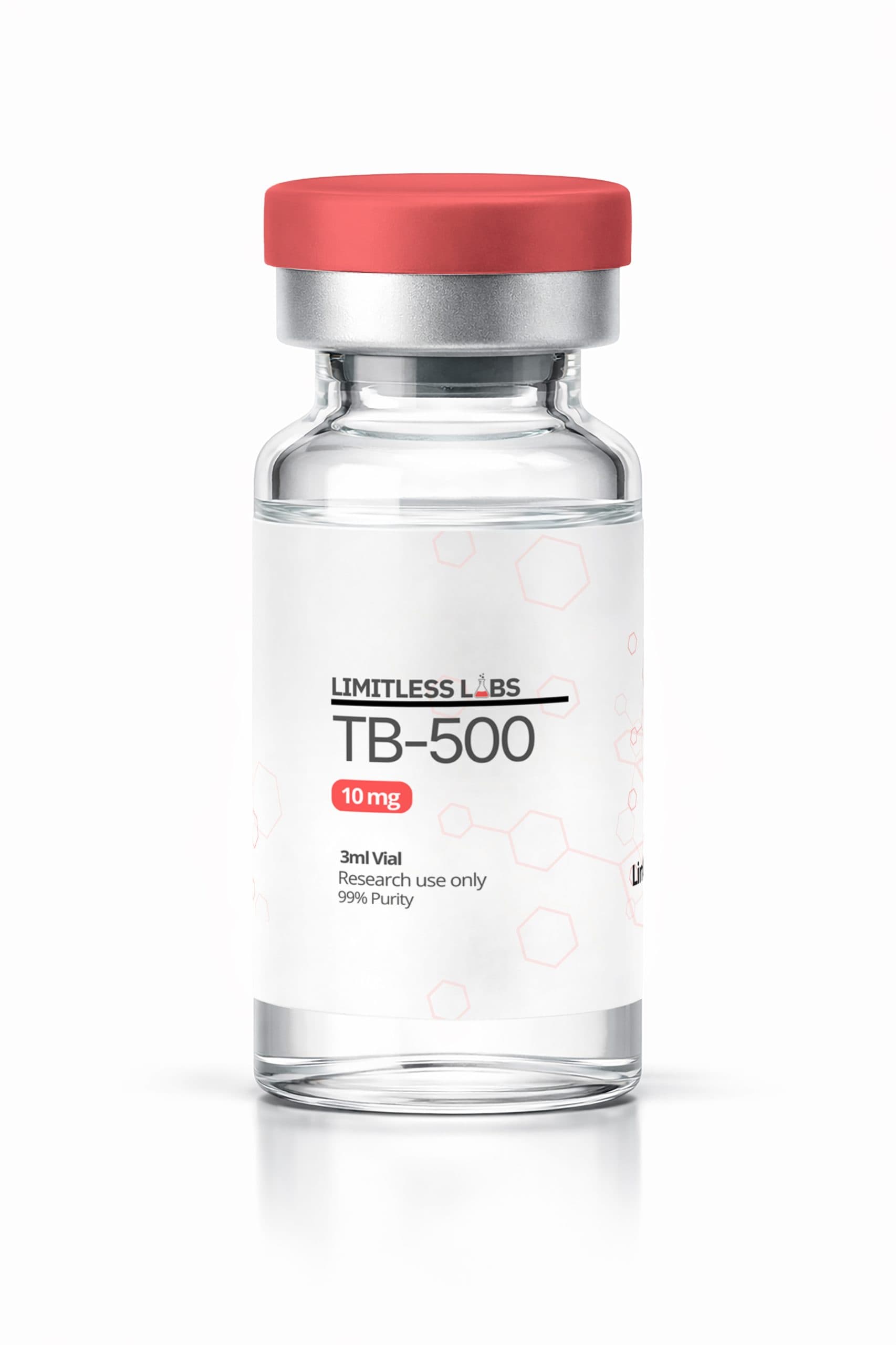
TB-500 is a synthetic peptide sold in the research-chemical market as a version of thymosin beta-4 (Tβ4), a naturally occurring 43-amino-acid peptide involved in regulating the cell's actin cytoskeleton. Two points should be made plainly before anything else. First, TB-500 and thymosin beta-4 are not interchangeable terms: doping-control laboratories that analyzed marketed TB-500 products identified the constituent as a short, seven-amino-acid fragment of Tβ4 — its actin-binding segment — rather than the full-length peptide, although product composition in this unregulated market varies [13,14]. Second, there are no published human clinical trials of TB-500 itself, for any indication, by any route of administration. Human studies of full-length thymosin beta-4 include ophthalmic trials, early intravenous safety/pharmacokinetic studies and a small venous-ulcer trial [10–12][18–20]. Those studies do not establish efficacy or safety for the TB-500 fragment. TB-500 is not approved as a drug by the FDA or any other regulatory authority, and thymosin beta-4 and its synthetic versions are prohibited at all times for athletes under the World Anti-Doping Code.
What is TB-500?
Thymosin beta-4 is one of the most abundant intracellular peptides in mammalian cells. Its defining biochemical role was established in 1991, when researchers showed that Tβ4 is identical to "Fx," a previously described peptide that binds monomeric G-actin and holds it in an unpolymerized pool [1]. By sequestering actin monomers, Tβ4 sits at the center of how cells regulate assembly and disassembly of their actin cytoskeleton — the machinery of cell shape, division, and movement [1,3]. Because cell migration is fundamental to wound repair, researchers hypothesized that Tβ4 released at injury sites might participate in tissue healing, and a large preclinical literature grew from that idea [2,16].
"TB-500" is not a name from this scientific literature; it originated as a product name in the veterinary and gray-market peptide trade. Its chemistry was characterized by doping-control scientists. In 2012, the Hong Kong Jockey Club's racing laboratory published an analysis of a TB-500 product marketed for horses and identified the key constituent for detection purposes, developing methods to find it in equine urine and plasma [13]. The same year, a Belgian doping-control group synthesized and characterized the substance identified in TB-500: the N-terminally acetylated 17–23 fragment of thymosin beta-4 (Ac-LKKTETQ), which corresponds to the actin-binding motif of the parent peptide [14]. In other words, the canonical TB-500 is a seven-amino-acid piece of the 43-amino-acid Tβ4 — the piece responsible for binding actin. That said, products sold under the TB-500 label are unregulated, and some vials marketed as TB-500 may contain full-length synthetic Tβ4 or other mixtures; buyers of research material have no regulatory guarantee of identity or purity.
One more molecule matters for context: Ac-SDKP, the N-terminal tetrapeptide of Tβ4, which is released enzymatically from the parent peptide in vivo and has its own research literature in cardiovascular and fibrosis models [15]. Ac-SDKP is a metabolite-level fragment studied by hypertension researchers; it is a different peptide from TB-500, and findings about one fragment do not transfer to the other.
This nesting of molecules — full-length Tβ4, the 17–23 actin-binding fragment (TB-500), and the 1–4 fragment (Ac-SDKP) — is a recurring source of confusion. Most of the biology described below was established for full-length Tβ4. Whether a seven-amino-acid fragment reproduces it is, for nearly every finding, an open question.
Mechanism of action (proposed)
G-actin sequestration and cytoskeletal dynamics. Tβ4 binds monomeric actin in a 1:1 complex, maintaining the cytoplasmic pool of unpolymerized actin that cells draw on to remodel their cytoskeleton [1]. A 2023 review details the binding modes and the downstream consequences for cell motility [3]. Because migration of keratinocytes, endothelial cells, and progenitor cells into a wound is an early step in repair, actin regulation is the leading proposed link between Tβ4 and the healing-related observations in animal models [2,3].
The actin-binding motif as the "active" segment. Peptide-mapping work from the group of Hynda Kleinman and Allan Goldstein at the NIH reported that short synthetic peptides containing the LKKTET actin-binding motif reproduced some of full-length Tβ4's activity in migration and hair-growth assays in rodents [6]. This is the mechanistic rationale behind TB-500 as a product — but it is a rationale built on a small number of preclinical experiments, not a demonstration that the fragment does everything the parent peptide does.
Cell survival and cardiac signaling. In mouse cardiac injury work, Tβ4 treatment was associated with activation of integrin-linked kinase (ILK) and Akt, pathways involved in cell survival and migration, in cardiomyocytes [7].
Anti-inflammatory associations. In corneal injury models, Tβ4 administration was associated with reduced inflammatory cell infiltration and modulation of inflammatory mediators [9]. Reviews compile similar anti-inflammatory associations across other models [16,17].
Ac-SDKP signaling. Some investigators propose that part of Tβ4's cardiovascular activity is mediated through its cleavage product Ac-SDKP, which has been studied in animal models of cardiac and renal fibrosis [15]. This pathway belongs to the parent peptide's biology; TB-500 (the 17–23 fragment) does not contain the Ac-SDKP sequence.
As with any compound at this stage, these are proposed mechanisms assembled from preclinical work. No cell-surface receptor for Tβ4 has been definitively established, and how the pathways fit together in a living human is unknown.
Research findings by area
Except where human trials are explicitly noted, everything in this section describes animal-model or in vitro research on full-length thymosin beta-4 — not TB-500.
Dermal wound healing
In a 1999 study, topical or intraperitoneal Tβ4 administration was associated with accelerated wound closure, increased re-epithelialization, and increased collagen deposition in a rat full-thickness wound model [4]. Follow-up rodent work from the same NIH-affiliated group reported associations with angiogenesis and wound repair, including in aged animals [5]. Reviews summarize additional models — burns, diabetic-animal wounds, and others — largely from laboratories connected to the original investigators [2,16]. A published randomized, placebo-controlled phase 2 study enrolled 73 patients with venous stasis ulcers and assessed topical full-length Tβ4 [20]. The exploratory findings warrant further study; they do not validate the TB-500 fragment.
Cardiac injury models
Two Nature papers anchor this area. In 2004, Bock-Marquette and colleagues reported that Tβ4 treatment after coronary artery ligation in mice was associated with reduced cardiomyocyte death and improved cardiac function, with ILK/Akt signaling proposed as the mechanism [7]. In 2007, Smart and colleagues reported that Tβ4 mobilized adult epicardial progenitor cells and supported new blood-vessel formation in the injured mouse heart [8]. These are influential, well-cited studies — and they are mouse studies. Later work in the field found that some of the effects did not replicate cleanly in all models, and a 2023 review from the original first author frames cardiac Tβ4 therapy as a direction still requiring development rather than an established result [17]. No controlled human trial of Tβ4 for cardiac repair has been published.
Corneal injury and ophthalmic human trials
This section concerns human research with full-length Tβ4 delivered as eye drops; intravenous and dermal studies are separate evidence. The preclinical foundation: in a mouse alkali-injury model, topical Tβ4 was associated with accelerated corneal re-epithelialization and reduced inflammation [9].
RegeneRx (and later partners including HLB Therapeutics) developed RGN-259, a preservative-free 0.1% Tβ4 ophthalmic solution. In a phase 2 randomized, placebo-controlled dry-eye trial using the controlled-adverse-environment model, RGN-259 was associated with improvements in some — not all — sign and symptom endpoints [10]. A separate small phase 2 trial in severe dry eye reported significant improvements in staining scores and symptoms versus vehicle [11]. In neurotrophic keratopathy, a published randomized, placebo-controlled, double-masked phase 3 trial (SEER-1) reported complete healing of the persistent epithelial defect after four weeks in 6 of 10 Tβ4-treated patients versus 1 of 8 placebo patients. This four-week endpoint did not reach conventional statistical significance (p=0.0656), although later and secondary measures favored treatment [12]. In 2025, however, a European phase 3 trial (SEER-3) missed its primary endpoint, with the sponsor attributing the result to a strong placebo response (Ophthalmology Times report); further US phase 3 work was ongoing as of that report. RGN-259 remains investigational — no Tβ4 product is approved anywhere.
Two honesty notes. These trials used pharmaceutical-grade full-length Tβ4 applied to the surface of the eye, which says nothing about systemic administration of a research-chemical fragment. And the largest of them enrolled tens of patients, not hundreds.
Intravenous human safety studies
Published early-phase studies evaluated intravenous full-length synthetic or recombinant Tβ4 in healthy volunteers [18][19]. They assessed short-term tolerability and pharmacokinetics, not clinical repair outcomes. Their findings do not establish long-term safety or apply automatically to the TB-500 fragment.
Hair growth
In rodent experiments, Tβ4 administration was associated with accelerated hair regrowth, and the investigators reported that peptides containing the actin-binding motif reproduced the effect, proposing follicular stem-cell migration as the mechanism [5,6]. These are small animal studies from a single group; no human trial of Tβ4 or TB-500 for hair growth exists.
Doping-control research
A distinct body of literature exists because anti-doping scientists took TB-500 seriously as a misuse risk. The Hong Kong racing laboratory's 2012 paper established detection methods for TB-500 in equine urine and plasma after identifying the product's active constituent [13], and the Ghent doping-control laboratory synthesized the Ac-LKKTETQ fragment to build reference material for human sports-drug testing [14]. WADA-accredited laboratories subsequently incorporated Tβ4-related peptides into routine screening. The practical consequence: this compound class is not only prohibited but actively detectable.
Limitations and open questions
No human data for TB-500 itself. This is the decisive limitation, and it is worth stating without hedging: there are no published clinical trials — not phase 1, not case series — of the TB-500 fragment in humans. Claims about what TB-500 does in people are extrapolations twice over: from animals to humans, and from full-length Tβ4 to a seven-amino-acid fragment.
The human Tβ4 data is narrow and mixed. Published studies span ophthalmic outcomes, early intravenous safety/pharmacokinetics and a small venous-ulcer trial [10–12][18–20]. Different formulations, routes and endpoints cannot be combined into a general efficacy claim.
Fragment-versus-parent uncertainty. The 17–23 fragment contains the actin-binding motif but lacks the rest of the molecule, including the Ac-SDKP-generating N-terminus proposed to matter for cardiovascular signaling [15]. Which of Tβ4's reported activities survive truncation is largely untested.
Product identity and purity. TB-500 exists only as an unregulated research chemical. Analyses of marketed products were performed precisely because composition was unverified [13,14]; there is no manufacturing standard, and vial contents may differ from labels.
Regulatory status. Neither TB-500 nor thymosin beta-4 is an approved drug anywhere. In sport, thymosin beta-4 and its synthetic analogs, including TB-500, are prohibited at all times under Section S2 (Peptide Hormones, Growth Factors, Related Substances and Mimetics) of the WADA Prohibited List, and anti-doping organizations have issued sanctions involving TB-500-containing products (BSCG overview). Detection methods are established in accredited laboratories [13,14].
Mechanistic incompleteness. No definitive Tβ4 receptor has been identified, and the breadth of reported preclinical effects — skin, heart, cornea, hair, nervous system — is itself a question that warrants skeptical, independent replication [3,16,17].
Frequently asked questions
Is TB-500 the same as thymosin beta-4? Not exactly. Thymosin beta-4 is a natural 43-amino-acid peptide. The substance identified in analyzed TB-500 products is a synthetic seven-amino-acid fragment of it (Ac-LKKTETQ, residues 17–23) containing the actin-binding motif [13,14]. Some products sold as TB-500 may instead contain full-length Tβ4. Scientific findings about Tβ4 do not automatically apply to the fragment.
Has TB-500 been tested in humans? No. There are no published human clinical trials of TB-500 for any indication. Human research on the parent Tβ4 includes eye drops, intravenous preparations and topical gel [10–12][18–20]; those are not interchangeable with the fragment.
What is the strongest human evidence for thymosin beta-4? The small SEER-1 trial reported corneal healing in 6 of 10 Tβ4-treated patients versus 1 of 8 receiving placebo [12]. The four-week comparison was not statistically significant (p=0.0656); later and secondary findings do not erase that limitation. A subsequent European phase 3 trial missed its primary endpoint in 2025, so even the ophthalmic story is unresolved.
Is TB-500 approved by the FDA? No. Neither TB-500 nor thymosin beta-4 is an approved drug for any indication in any country. RGN-259 remains an investigational product.
Can athletes use TB-500? No. Thymosin beta-4 and its analogs, including TB-500, are prohibited at all times under Section S2 of the WADA Prohibited List, detection methods are in routine use at accredited laboratories [13,14], and sanctions have been issued.
Where did the cardiac repair claims come from? From mouse studies — principally two Nature papers reporting improved cardiac outcomes after experimental heart injury with Tβ4 treatment [7,8]. No human cardiac trial has been published, and later preclinical work complicated parts of the original picture [17].
Is TB-500 the same as BPC-157? No. They are unrelated molecules. BPC-157 is a synthetic fragment of a gastric-juice protein with its own, separate (and also almost entirely preclinical) literature. The two are often discussed together in tissue-repair research contexts, but findings from one do not apply to the other.
References
Safer D, Elzinga M, Nachmias VT. Thymosin beta 4 and Fx, an actin-sequestering peptide, are indistinguishable. J Biol Chem. 1991;266(7):4029-4032. doi:10.1016/S0021-9258(20)64278-8 — PMID: 1999398
Goldstein AL, Hannappel E, Kleinman HK. Thymosin beta4: actin-sequestering protein moonlights to repair injured tissues. Trends Mol Med. 2005;11(9):421-429. doi:10.1016/j.molmed.2005.07.004 — PMID: 16099219
Ying Y, Lin C, Tao N, et al. Thymosin β4 and Actin: Binding Modes, Biological Functions and Clinical Applications. Curr Protein Pept Sci. 2023;24(1):78-88. doi:10.2174/1389203724666221201093500 — PMID: 36464872
Malinda KM, Sidhu GS, Mani H, et al. Thymosin beta4 accelerates wound healing. J Invest Dermatol. 1999;113(3):364-368. doi:10.1046/j.1523-1747.1999.00708.x — PMID: 10469335
Philp D, Goldstein AL, Kleinman HK. Thymosin beta4 promotes angiogenesis, wound healing, and hair follicle development. Mech Ageing Dev. 2004;125(2):113-115. doi:10.1016/j.mad.2003.11.005 — PMID: 15037013
Philp D, St-Surin S, Cha HJ, et al. Thymosin beta 4 induces hair growth via stem cell migration and differentiation. Ann N Y Acad Sci. 2007;1112:95-103. doi:10.1196/annals.1415.009 — PMID: 17947589
Bock-Marquette I, Saxena A, White MD, et al. Thymosin beta4 activates integrin-linked kinase and promotes cardiac cell migration, survival and cardiac repair. Nature. 2004;432(7016):466-472. doi:10.1038/nature03000 — PMID: 15565145
Smart N, Risebro CA, Melville AA, et al. Thymosin beta4 induces adult epicardial progenitor mobilization and neovascularization. Nature. 2007;445(7124):177-182. doi:10.1038/nature05383 — PMID: 17108969
Sosne G, Szliter EA, Barrett R, et al. Thymosin beta 4 promotes corneal wound healing and decreases inflammation in vivo following alkali injury. Exp Eye Res. 2002;74(2):293-299. doi:10.1006/exer.2001.1125 — PMID: 11950239
Sosne G, Ousler GW. Thymosin beta 4 ophthalmic solution for dry eye: a randomized, placebo-controlled, Phase II clinical trial conducted using the controlled adverse environment (CAE™) model. Clin Ophthalmol. 2015;9:877-884. doi:10.2147/OPTH.S80954 — PMID: 26056426
Sosne G, Dunn SP, Kim C. Thymosin β4 significantly improves signs and symptoms of severe dry eye in a phase 2 randomized trial. Cornea. 2015;34(5):491-496. doi:10.1097/ICO.0000000000000379 — PMID: 25826322
Sosne G, Kleinman HK, Springs C, et al. 0.1% RGN-259 (Thymosin ß4) Ophthalmic Solution Promotes Healing and Improves Comfort in Neurotrophic Keratopathy Patients in a Randomized, Placebo-Controlled, Double-Masked Phase III Clinical Trial. Int J Mol Sci. 2022;24(1):554. doi:10.3390/ijms24010554 — PMID: 36613994
Ho ENM, Kwok WH, Lau MY, et al. Doping control analysis of TB-500, a synthetic version of an active region of thymosin β4, in equine urine and plasma by liquid chromatography-mass spectrometry. J Chromatogr A. 2012;1265:57-69. doi:10.1016/j.chroma.2012.09.043 — PMID: 23084823
Esposito S, Deventer K, Goeman J, et al. Synthesis and characterization of the N-terminal acetylated 17-23 fragment of thymosin beta 4 identified in TB-500, a product suspected to possess doping potential. Drug Test Anal. 2012;4(9):733-738. doi:10.1002/dta.1402 — PMID: 22962027
Kassem KM, Vaid S, Peng H, et al. Tβ4-Ac-SDKP pathway: Any relevance for the cardiovascular system? Can J Physiol Pharmacol. 2019;97(7):589-599. doi:10.1139/cjpp-2018-0570 — PMID: 30854877
Xing Y, Ye Y, Zuo H, Li Y. Progress on the Function and Application of Thymosin β4. Front Endocrinol (Lausanne). 2021;12:767785. doi:10.3389/fendo.2021.767785 — PMID: 34992578
Bock-Marquette I, Maar K, Maar S, et al. Thymosin beta-4 denotes new directions towards developing prosperous anti-aging regenerative therapies. Int Immunopharmacol. 2023;116:109741. doi:10.1016/j.intimp.2023.109741 — PMID: 36709593
Ruff D, et al. A randomized, placebo-controlled, single and multiple dose study of intravenous thymosin beta4 in healthy volunteers. Ann N Y Acad Sci. 2010;1194:223-9. doi:10.1111/j.1749-6632.2010.05474.x. PMID: 20536472
Wang X, et al. A first-in-human, randomized, double-blind, single- and multiple-dose, phase I study of recombinant human thymosin β4 in healthy Chinese volunteers. J Cell Mol Med. 2021;25(17):8222-8228. doi:10.1111/jcmm.16693. PMID: 34346165
Guarnera G, et al. The effect of thymosin treatment of venous ulcers. Ann N Y Acad Sci. 2010;1194:207-12. doi:10.1111/j.1749-6632.2010.05490.x. PMID: 20536470
This article is an educational summary of published research. It is not medical advice, and it does not describe, endorse, or recommend any use of TB-500 or thymosin beta-4 in humans. TB-500 is not an approved drug. Products referenced on this site are sold for laboratory research use only.