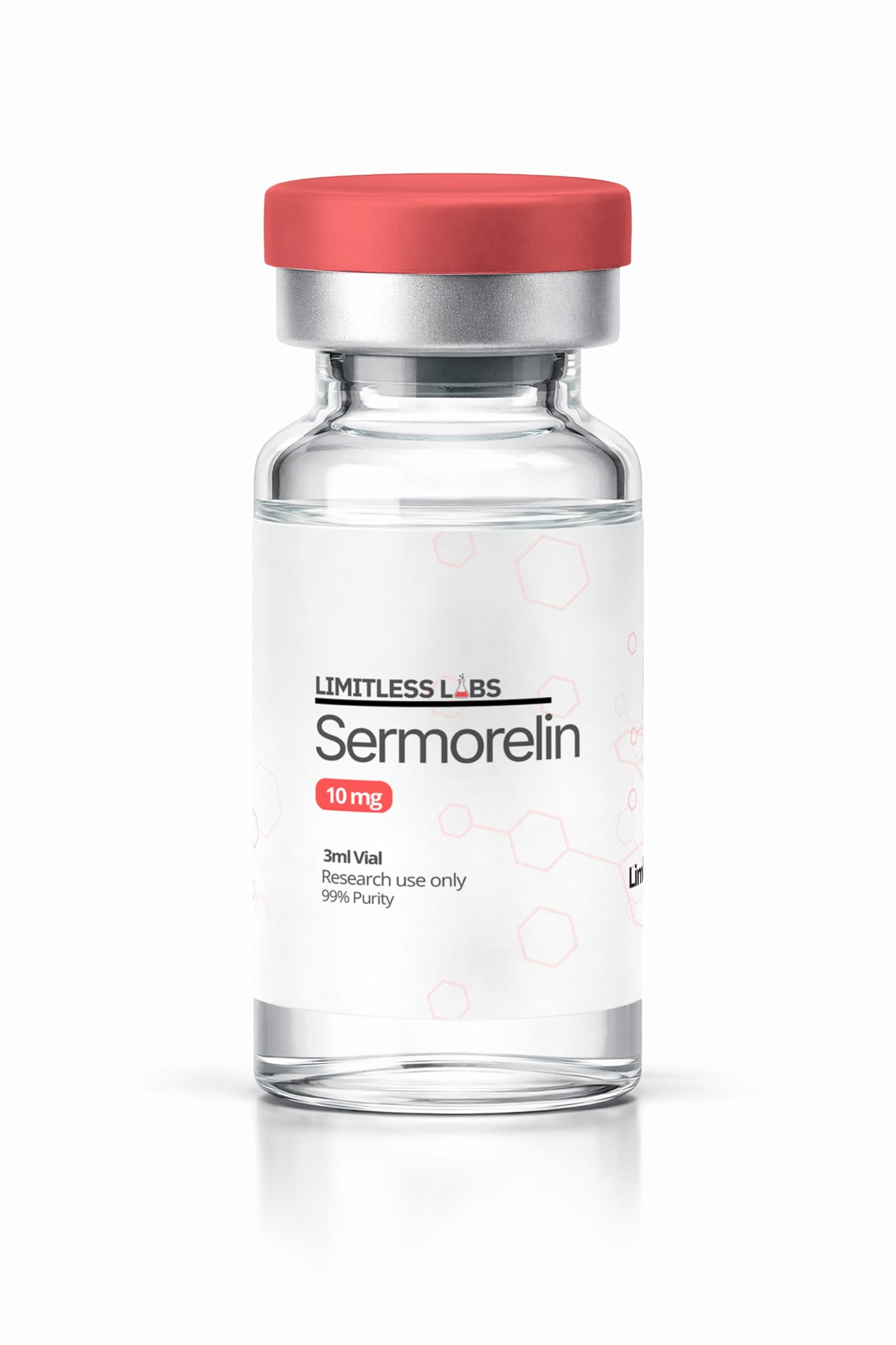
Sermorelin (chemical name GRF(1-29)-NH2, also written GHRH(1-29)-NH2) is a synthetic 29-amino-acid peptide corresponding to the biologically active amino-terminal fragment of human growth hormone-releasing hormone (GHRH). It was formerly marketed as an FDA-approved drug. Marketed as Geref by Serono (later EMD Serono), sermorelin acetate was approved in the United States first for diagnostic use in 1990 and then for treatment of pediatric growth hormone deficiency in 1997, before the manufacturer discontinued it commercially in 2008 — a withdrawal the FDA later determined, in a formal 2013 Federal Register notice, was not for reasons of safety or effectiveness [15]. That history separates sermorelin from peptides that have never held any form of regulatory approval, but it does not change the fact that no sermorelin product carries FDA approval today, that the clinical trial base is decades old, and that current compounded formulations are a distinct regulatory category from the discontinued drug. Everything below should be read with that context in mind.
What Is Sermorelin?
Growth hormone-releasing hormone was independently isolated in 1982 by two research groups working from human pancreatic tumors that had caused acromegaly — Guillemin and colleagues characterized a 44-amino-acid peptide (GRF-44) from one tumor [1], while Rivier, Spiess, Thorner, and Vale isolated a closely related 40-residue peptide from a second [2]. Two years later, Ling and colleagues isolated, sequenced, and synthesized the native human hypothalamic hormone itself, confirming the 44-amino-acid structure and establishing the basis for structure-activity work on shorter fragments [3]. That work showed that the first 29 amino acids of the molecule, amidated at the carboxy terminus — GRF(1-29)-NH2 — retained the full GH-releasing potency of the intact 44-residue hormone, making it the shortest fragment with full biological activity and a far more practical synthetic target [3,6].
Sermorelin is the amidated 29-residue fragment of native GHRH, retaining methionine at position 27 (PubChem identity record). The norleucine-substituted analog [Nle27]GHRH(1-29)-NH2 is chemically distinct. Studies using that analog are discussed below as related GHRH research, not as direct evidence for the identical sermorelin molecule.
Geref's regulatory history has two chapters. The lower-dose formulation (0.05 mg base/ampule) was approved in 1990 for diagnostic use — provoking a GH response to help evaluate pituitary function. The higher-dose formulations (0.5 mg and 1.0 mg base/vial) were approved in 1997 for daily subcutaneous treatment of children with GH deficiency due to insufficient endogenous GHRH secretion. In 2008, EMD Serono notified the FDA it was discontinuing both formulations as sales declined amid competition from recombinant human growth hormone, and the FDA withdrew the associated NDAs effective June 2009. In 2013, responding to a generic-manufacturer petition, the FDA reviewed its records, postmarketing adverse-event data, and the published literature and formally determined that Geref "was not withdrawn from sale for reasons of safety or effectiveness" [15].
Sermorelin should not be confused with tesamorelin (marketed as Egrifta), the only GHRH-class peptide with current FDA approval. Tesamorelin retains the full 44-amino-acid GHRH backbone with an added stabilizing hexenoyl group at the amino terminus, a structurally distinct molecule studied in large placebo-controlled trials and approved in 2010 specifically for reducing excess abdominal fat in HIV-associated lipodystrophy [13]. Findings for tesamorelin do not automatically transfer to sermorelin, and vice versa.
Mechanism of Action
GHRH — and, correspondingly, sermorelin — acts on a single well-characterized target: the GHRH receptor (GHRH-R), a class B (secretin-family) G protein-coupled receptor expressed predominantly on pituitary somatotroph cells. A 2020 cryo-electron microscopy structure of the human GHRH-R bound to its native ligand and a stimulatory G protein showed that GHRH forms an extensive, continuous interface with the receptor's extracellular domain, extracellular loops, and most of its transmembrane helices — a "hormone recognition" pattern that helps explain why even the truncated 29-residue fragment retains full agonist activity, since this interface is concentrated in the amino-terminal portion of the hormone [4]. Receptor engagement activates a stimulatory G protein, which activates adenylyl cyclase to raise intracellular cAMP; this triggers protein kinase A activity and calcium influx through voltage-sensitive channels, driving GH synthesis and its exocytotic release from somatotroph secretory granules [4,5].
A distinction that recurs throughout the GHRH-class literature, and is central to how this class differs pharmacologically from directly administered recombinant GH, is that GHRH stimulates the pituitary's own GH-secreting machinery rather than substituting for it [5]. Because the hypothalamic-pituitary axis retains its normal regulatory circuitry — GHRH driving release, somatostatin restraining it, and IGF-1 providing negative feedback — reviews of the GHRH/GH axis describe GHRH administration as working within, rather than bypassing, that feedback system, and as preserving the pulsatile pattern of GH secretion rather than the flat, sustained elevation characteristic of exogenous GH injection [5,11]. This is a mechanistic distinction reported in the literature, not a claim about superior clinical outcomes; it also means sermorelin's effect is capped by the responsiveness of the patient's own somatotroph population, which is precisely why it works differently — and is diagnostically informative — in patients with reduced pituitary reserve versus intact hypothalamic-pituitary function [7,8].
Research Findings by Area
Pediatric growth hormone deficiency — the basis for FDA approval
The clinical trial base underlying Geref's 1997 approval is the most substantial body of controlled human data for this compound in this library. A comprehensive drug-class review compiled the pediatric program: once-daily subcutaneous sermorelin in the studied pediatric regimens produced significant increases in height velocity sustained over 12 months of treatment, with data in a subset of children suggesting the effect persisted through 36 months of continued treatment [6]. The review characterized sermorelin as inducing catch-up growth in the majority of treated children with idiopathic GH deficiency, while noting that the increase in height velocity from baseline was generally smaller than that seen with equivalent-dose recombinant somatropin — consistent with sermorelin's mechanism requiring an intact, GHRH-responsive somatotroph population rather than delivering GH directly [6]. This pediatric program, run by Serono, is the evidentiary foundation the FDA relied on for the original approval; it is also, notably, the only indication for which sermorelin was ever formally shown, to a regulator's satisfaction, to work.
Diagnostic use
Before treatment approval, sermorelin's primary approved use was diagnostic: an injection intended to provoke a measurable GH response as one component of testing pituitary function. GHRH(1-29) — the sermorelin molecule — became a standard secretagogue in adult GH-deficiency testing, typically combined with arginine (which blunts somatostatin tone) in the "GHRH-arginine" stimulation test. A comparative study of adults with hypothalamic-pituitary disease found that GHRH-based combined tests performed comparably to, and more practically than, the insulin tolerance test — historically the reference standard but labor-intensive, unpleasant, and contraindicated in patients with seizure disorders or ischemic heart disease, both common in older or hypopituitary populations [7]. A separate multicenter study established body-mass-index-adjusted peak-GH cutoffs for the test (11.5 µg/L for BMI under 25 kg/m², 8.0 µg/L for 25–30, 4.2 µg/L above 30), reflecting adiposity's well-documented influence on GH stimulation-test results [8]. This diagnostic literature remains part of the standard adult endocrine-testing toolkit even though the approved Geref diagnostic product is no longer marketed.
Adult growth hormone axis and aging studies
Outside the pediatric indication, GHRH(1-29) and the distinct [Nle27]GHRH(1-29)-NH2 analog were studied in small studies examining the aging GH axis, all predating 2000. An uncontrolled six-week study in 11 healthy elderly men reported improvements in two of six strength measures and muscle endurance compared with baseline, without increases in muscle mass or IGF-1 [9]. It did not establish efficacy against a parallel control group. In a separate single-blind study in 19 age-advanced men and women, a four-week placebo period was followed by four months of nightly [Nle27]GHRH(1-29)-NH2 administration activated the somatotropic axis and increased skin thickness in both sexes, but increases in lean body mass, insulin sensitivity, and self-reported wellbeing were observed in men only, not women — a sex-differentiated response the study authors flagged explicitly [10]. A 2025 clinical review of the GH-and-aging literature situates these findings within a field that remains unresolved: GH axis activity clearly declines with age, and older GHRH-analog and recombinant-GH studies show measurable effects on body-composition surrogates, but whether restoring youthful GH/IGF-1 levels produces net clinical benefit remains uncertain, given signals connecting sustained elevated GH/IGF-1 exposure with long-term health risks [11]. Both adult GHRH-axis trials described here are small, decades-old, short in duration, and report primarily surrogate endpoints rather than hard clinical outcomes.
Sleep architecture
One of the more distinct, mechanistically interesting lines of GHRH research concerns sleep rather than growth. GH secretion and slow-wave sleep (SWS) both peak early in the night, and GHRH administration engages this relationship directly. In a controlled study in healthy volunteers, intravenous GHRH given as four repeated boluses (episodic administration, mimicking natural pulsatile secretion) produced significantly more stage-4 slow-wave sleep than the same total dose given as a continuous infusion; compared with placebo, episodic GHRH administration also increased slow-wave and REM sleep time while reducing wakefulness and stage-1 sleep [12]. This dose-pattern dependence — pulsatile delivery outperforming continuous delivery for a sleep-architecture endpoint — is often cited as further indirect support for the broader mechanistic claim that preserving physiological pulsatility matters for how GHRH-class peptides act, independent of the pediatric growth-hormone-deficiency data [12].
Current research and compounding landscape
The discontinued Geref product and contemporary compounded preparations are different regulatory subjects. Prior approval does not establish that any particular current preparation or use satisfies compounding requirements. This places sermorelin in a different regulatory lane from peptides such as BPC-157, CJC-1295, or ipamorelin, which were never FDA-approved drugs and have instead gone through the FDA's separate nomination-and-category review process for bulk drug substances used in compounding. A 2026 JAMA commentary on the broader growth of injectable peptides marketed online for muscle growth, recovery, and anti-aging purposes — citing BPC-157 as an example — described this market as expanding faster than the oversight apparatus built to monitor it [14]. Sermorelin itself was not named there, but it sits within the same commercial environment: a previously approved active ingredient whose current preparations require their own regulatory assessment, marketed today mainly for adult and anti-aging indications never part of its original FDA-reviewed use, and for which no comparably rigorous modern trial exists.
Limitations and Open Questions
The clinical evidence base is old and narrow. Nearly every controlled human trial of sermorelin was conducted between the mid-1980s and the late 1990s, predates current GH-assay standardization, and used sample sizes in the tens of subjects. The pediatric GHD trials that supported Geref's approval remain the strongest evidence sermorelin has [6]; the adult aging-related studies are smaller, shorter, and report mostly surrogate markers rather than clinical outcomes [9,10].
Adult and anti-aging use has no dedicated modern evidence base. The related 1990s Vittone and Khorram GHRH-axis trials [9,10] include a chemically distinct norleucine-substituted analog, neither of which was designed, sized, or intended to establish a case for long-term adult use, and neither of which has been meaningfully replicated in the decades since. The sex-differentiated results in the Khorram trial — benefits reported in men but not women on several endpoints — are rarely mentioned in secondary or marketing sources [10].
Efficacy depends on intact pituitary reserve. Because sermorelin works by stimulating the patient's own somatotrophs rather than supplying GH directly, its effect is mechanistically capped by however much functional pituitary GH-secreting capacity remains. This is a documented feature of GHRH-based diagnostic testing (a blunted response helps identify pituitary rather than purely hypothalamic disease) [7,8], and it is equally a limitation of any therapeutic use in populations with reduced pituitary reserve.
Regulatory status is easy to misstate. Sermorelin was an approved drug and was withdrawn for commercial, not safety, reasons — a fact worth stating precisely because it is unusual in this library and is often mangled in both directions online: some sources imply the withdrawal reflected a safety problem it did not, and others imply current compounded sermorelin carries the same regulatory backing Geref once did, which it does not [15]. No sermorelin product currently holds FDA approval for any indication, and compounded sermorelin is subject to compounding-pharmacy oversight rather than new-drug review.
Frequently Asked Questions
Was sermorelin ever an FDA-approved drug? Yes. As Geref (sermorelin acetate), it was approved for diagnostic use in 1990 and for treatment of pediatric growth hormone deficiency in 1997, manufactured by Serono/EMD Serono [15].
Why was Geref withdrawn from the market? The manufacturer discontinued it commercially in 2008 as recombinant human growth hormone came to dominate the pediatric GH-deficiency market. In 2013 the FDA formally determined the product "was not withdrawn from sale for reasons of safety or effectiveness" [15].
Is sermorelin FDA-approved today? No. No sermorelin product currently holds FDA approval for any indication. Compounded preparations do not inherit the discontinued product’s FDA review; this article does not establish their regulatory eligibility.
Is sermorelin the same molecule as GHRH? Not exactly. Native human GHRH is a 44-amino-acid hormone. Sermorelin is the truncated 29-amino-acid amino-terminal fragment (GRF(1-29)-NH2), retaining the native methionine at position 27, that retains the full biological potency of the intact hormone [3,6].
How does sermorelin differ from tesamorelin? Tesamorelin (Egrifta) is a chemically distinct, full-length 44-amino-acid GHRH analog with a stabilizing modification, and remains the only GHRH-class peptide with current FDA approval — for reduction of excess abdominal fat in HIV-associated lipodystrophy, based on large placebo-controlled trials [13]. Findings for one do not transfer to the other.
Does sermorelin preserve the body's negative-feedback control over GH better than injected GH? Reviews of GHRH pharmacology describe GHRH-class agents as working through the intact hypothalamic-pituitary feedback loop and preserving pulsatile GH release, in contrast to exogenous GH, which bypasses that loop [5,11]. This is a mechanistic description reported in the literature, not a demonstrated clinical-outcome advantage for sermorelin specifically.
What is the strongest evidence for sermorelin? The pediatric growth-hormone-deficiency trials that supported its original FDA approval remain the most substantial controlled evidence base in the literature [6]. Its use in adult GH-axis and aging research rests on much smaller, older, and narrower studies [9,10].
Is sermorelin used for anti-aging purposes today? Compounding pharmacies market sermorelin for adult and anti-aging indications, but this is not an FDA-approved use, and the supporting adult trial literature is decades old, small, and reports mixed, sex-differentiated results on surrogate markers rather than established clinical benefit [9,10,14].
References
- Guillemin R, Brazeau P, Böhlen P, Esch F, Ling N, Wehrenberg WB. Growth hormone-releasing factor from a human pancreatic tumor that caused acromegaly. Science. 1982;218(4572):585-587. doi:10.1126/science.6812220 — PMID: 6812220
- Rivier J, Spiess J, Thorner M, Vale W. Characterization of a growth hormone-releasing factor from a human pancreatic islet tumour. Nature. 1982;300(5889):276-278. doi:10.1038/300276a0 — PMID: 6292724
- Ling N, Esch F, Böhlen P, Brazeau P, Wehrenberg WB, Guillemin R. Isolation, primary structure, and synthesis of human hypothalamic somatocrinin: growth hormone-releasing factor. Proc Natl Acad Sci U S A. 1984;81(14):4302-4306. doi:10.1073/pnas.81.14.4302 — PMID: 6431406
- Zhou F, Zhang H, Cong Z, et al. Structural basis for activation of the growth hormone-releasing hormone receptor. Nat Commun. 2020;11(1):5205. doi:10.1038/s41467-020-18945-0 — PMID: 33060564
- Granata R, Leone S, Zhang X, et al. Growth hormone-releasing hormone and its analogues in health and disease. Nat Rev Endocrinol. 2025;21(3):180-195. doi:10.1038/s41574-024-01052-1 — PMID: 39537825
- Prakash A, Goa KL. Sermorelin: a review of its use in the diagnosis and treatment of children with idiopathic growth hormone deficiency. BioDrugs. 1999;12(2):139-157. doi:10.2165/00063030-199912020-00007 — PMID: 18031173
- Hoeck HC, Vestergaard P, Jakobsen PE, Falhof J, Laurberg P. Diagnosis of growth hormone (GH) deficiency in adults with hypothalamic-pituitary disorders: comparison of test results using pyridostigmine plus GH-releasing hormone (GHRH), clonidine plus GHRH, and insulin-induced hypoglycemia as GH secretagogues. J Clin Endocrinol Metab. 2000;85(4):1467-1472. doi:10.1210/jcem.85.4.6538 — PMID: 10770183
- Corneli G, Di Somma C, Baldelli R, et al. The cut-off limits of the GH response to GH-releasing hormone-arginine test related to body mass index. Eur J Endocrinol. 2005;153(2):257-264. doi:10.1530/eje.1.01967 — PMID: 16061832
- Vittone J, Blackman MR, Busby-Whitehead J, et al. Effects of single nightly injections of growth hormone-releasing hormone (GHRH 1-29) in healthy elderly men. Metabolism. 1997;46(1):89-96. doi:10.1016/S0026-0495(97)90174-8 — PMID: 9005976
- Khorram O, Laughlin GA, Yen SSC. Endocrine and metabolic effects of long-term administration of [Nle27]growth hormone-releasing hormone-(1-29)-NH2 in age-advanced men and women. J Clin Endocrinol Metab. 1997;82(5):1472-1479. doi:10.1210/jcem.82.5.3943 — PMID: 9141536
- Fernández-Garza LE, Guillen-Silva F, Sotelo-Ibarra MA, Domínguez-Mendoza AE, Barrera-Barrera SA, Barrera-Saldaña HA. Growth hormone and aging: a clinical review. Front Aging. 2025;6:1549453. doi:10.3389/fragi.2025.1549453 — PMID: 40260058
- Marshall L, Mölle M, Böschen G, Steiger A, Fehm HL, Born J. Greater efficacy of episodic than continuous growth hormone-releasing hormone (GHRH) administration in promoting slow-wave sleep (SWS). J Clin Endocrinol Metab. 1996;81(3):1009-1013. doi:10.1210/jcem.81.3.8772566 — PMID: 8772566
- Falutz J, Allas S, Blot K, et al. Metabolic effects of a growth hormone-releasing factor in patients with HIV. N Engl J Med. 2007;357(23):2359-2370. doi:10.1056/NEJMoa072375 — PMID: 18057338
- Piatkowski T, Ganson KT, Nagata JM. Illicit Injectable Peptides and Regulatory Gaps. JAMA. 2026;336(3):189-190. doi:10.1001/jama.2026.10690 — PMID: 42295803
- U.S. Food and Drug Administration. Determination That GEREF (Sermorelin Acetate) Injection, 0.5 Milligrams Base/Vial and 1.0 Milligrams Base/Vial, and GEREF (Sermorelin Acetate) Injection, 0.05 Milligrams Base/Amp, Were Not Withdrawn From Sale for Reasons of Safety or Effectiveness. Federal Register, 78 FR 14304, March 4, 2013. govinfo.gov
This article is an educational summary of published research and regulatory history. It is not medical advice, and it does not describe, endorse, or recommend any use of sermorelin in humans. Sermorelin was formerly approved as the drug Geref; it is not currently marketed as an FDA-approved drug in the United States. Products referenced on this site are sold for laboratory research use only and are not for human use.