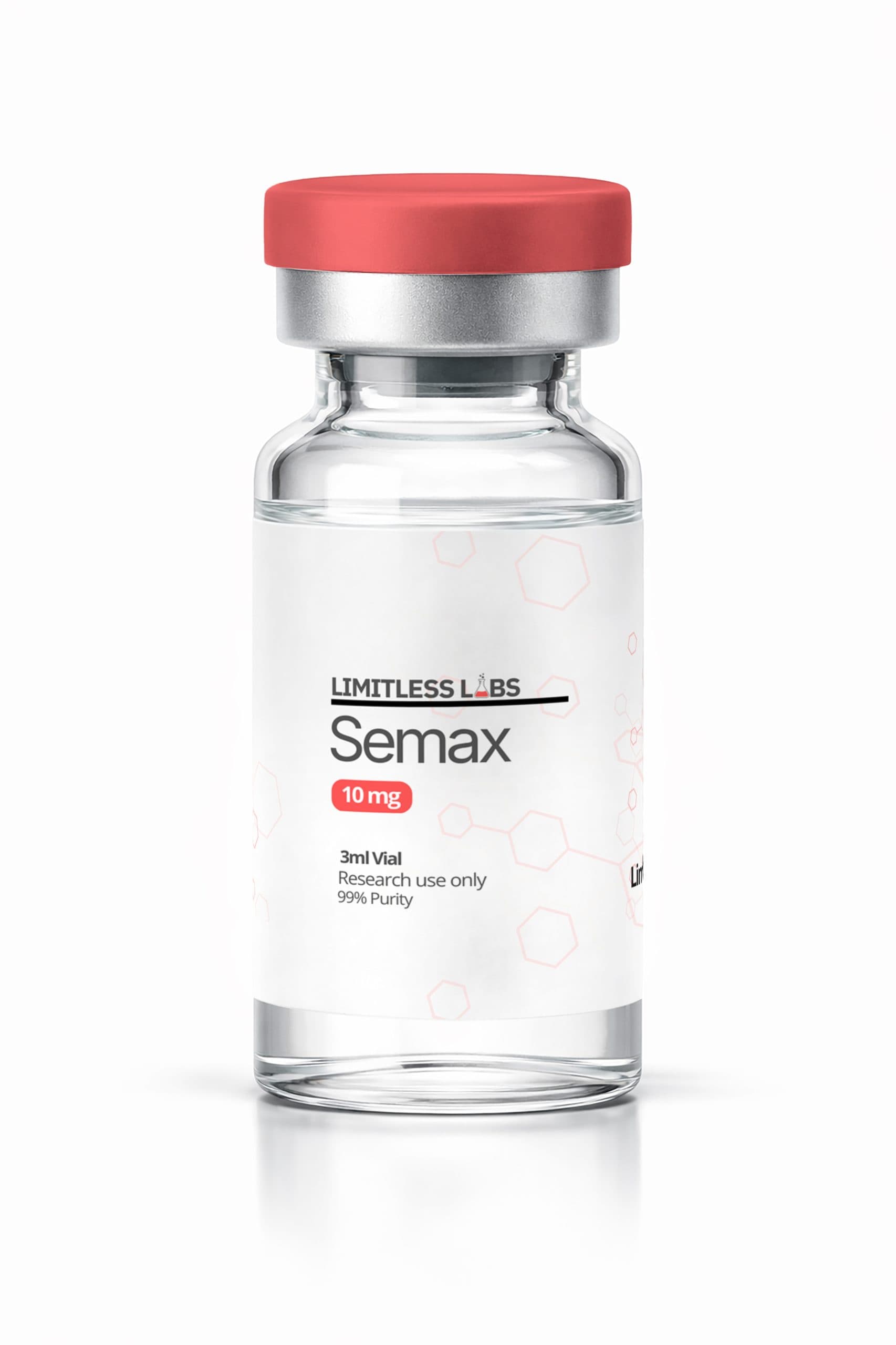
Semax (Met-Glu-His-Phe-Pro-Gly-Pro) is a synthetic heptapeptide developed in Russia from an adrenocorticotropic hormone (ACTH) fragment. Its literature includes animal and cell-culture experiments and Russian clinical reports on stroke and cerebrovascular disease [1][12][13][14][15]. PubMed provides translated titles and English abstracts for several clinical reports; these should be distinguished from access to complete methods. The mechanistic and clinical findings are summarized separately below. Neither evidence tier establishes FDA approval or supports treating research material as a clinical product.
What is Semax?
Semax combines the four residues of ACTH(4-7), Met-Glu-His-Phe, with Pro-Gly-Pro. It is commonly described as an ACTH(4-10) analog because the last three residues of that seven-residue fragment are replaced. Its developers proposed the Pro-Gly-Pro extension as a way to stabilize the peptide while retaining neuroactive properties without the corticotropic activity of full-length ACTH [1]. That design rationale is distinct from a confirmed human mechanism or safety profile.
The cited clinical literature describes Semax use in Russia [12][13][14][15]. It does not establish current marketing authorization in other jurisdictions. This article does not infer FDA approval, clinical efficacy, or the lawful marketing status of a particular preparation from those reports.
Mechanism of action
No single validated receptor mechanism fully explains Semax's reported effects; the literature describes several proposed and partially overlapping pathways.
Neurotrophin (BDNF) induction. The most extensively characterized proposed mechanism is stimulation of brain-derived neurotrophic factor (BDNF). In rat basal-forebrain astrocyte cultures and following intranasal administration, Semax was associated with rapid increases in BDNF protein and with region-specific increases in BDNF gene expression, alongside changes in expression of its receptor, trkB, in the hippocampus [3,5]. A companion binding study identified a specific, saturable, calcium-dependent binding site for tritium-labeled Semax in rat basal-forebrain membranes (reported dissociation constant in the low-nanomolar range), distinct from the diffuse, non-specific binding seen elsewhere in the brain — though the molecular identity of that binding site has not been established, and the paper does not claim it is unrelated to melanocortin receptors, only that it is regionally specific and pharmacologically distinguishable from generalized peptide binding [4]. Time-course work extended these findings to NGF as well as BDNF across hippocampus, frontal cortex, and retina, showing that the two neurotrophins follow different induction kinetics after Semax exposure [7].
Enkephalinase (peptidase) inhibition. In human serum, Semax and the related Russian peptide Selank were reported to inhibit enkephalin-degrading enzymes in a dose-dependent manner, with an IC50 in the low-micromolar range — more potent than the reference inhibitor puromycin in that assay [2]. Because these same enzymes degrade a broad range of regulatory peptides (not only enkephalins), the authors proposed that peptidase inhibition is one general mechanism by which Semax could prolong the activity of other endogenous signaling peptides, rather than acting through a single dedicated receptor [2]. Structure-activity work in the same study found that Semax's pentapeptide fragment retained inhibitory activity while shorter fragments did not, suggesting the effect depends on a minimum sequence length rather than any single residue [2].
Melanocortin-receptor context. Semax is a fragment-derived melanocortin peptide, and the ACTH(4-7) sequence it retains is the same "message" sequence implicated in earlier behavioral pharmacology of melanocortin fragments, historically studied for effects on attention and motivation independent of the corticotropic (MC2 receptor/adrenal) axis. However, no publication reviewed for this article reports direct receptor-binding affinity data for Semax at any of the five cloned melanocortin receptor subtypes (MC1R–MC5R). The basal-forebrain binding site described above [4] is the closest available direct-binding evidence, and it has not been mapped to a specific melanocortin receptor. Readers should treat "acts via melanocortin receptors" as a plausible hypothesis grounded in the peptide's ancestry, not a demonstrated pharmacological fact.
Monoamine systems. In rodents, systemic Semax administration was associated with changes in dopamine and serotonin turnover in several brain regions, interpreted by the authors as activation of dopaminergic and serotonergic systems rather than a single-neurotransmitter effect [8]. A separate study reported that Semax's behavioral effects were altered under dopamine-receptor blockade with haloperidol, consistent with at least partial dependence on intact dopaminergic signaling for some of its behavioral outcomes.
Research findings by area
Neurotrophin signaling and cognition (animal and cell-culture data)
The BDNF/NGF induction literature summarized above [3,4,5,6,7] is a well-characterized preclinical thread in Semax research, spanning cell culture, acute rodent dosing, and multi-region gene-expression time courses. Separately, rodent studies have reported that Semax administration was associated with improved performance in learning and memory tasks and with reduced infarct-related cognitive deficits following experimental cerebral ischemia. All of this evidence is preclinical; no controlled human cognitive-testing trial of Semax has been published in an internationally indexed journal.
Gene-expression and transcriptome studies
A distinct research program, centered on the Institute of Molecular Genetics and involving Shadrina, Slominsky, Dergunova, Filippenkov, and colleagues, has used genome-wide expression profiling to characterize Semax's effects at the transcript level. Early work found that Semax rapidly induced neurotrophin mRNAs in rat glial cell cultures [6] and later work directly compared the time-dependent regulation of NGF and BDNF transcription across brain regions [7]. Genome-wide transcriptional analysis in a rat focal cerebral ischemia model reported that Semax modulated expression of gene clusters related to the immune response and vascular systems, rather than acting on a narrow gene set [9]. Follow-up work using RNA-sequencing in a cerebral ischemia-reperfusion model reported broad shifts in transcriptomic activity attributed to Semax and related ACTH-like peptides, again concentrated in inflammatory and neurosignaling gene networks [10,11]. This line of research is useful precisely because it is hypothesis-generating rather than outcome-confirming: it maps which biological systems respond to Semax exposure at the molecular level without establishing that any single pathway is causally responsible for a specific behavioral or clinical effect.
Russian stroke and cerebrovascular clinical literature
This is the area requiring the most careful sourcing distinction. The foundational clinical study, published by Gusev, Skvortsova, and Myasoedov in 1997, evaluated Semax added to standard intensive therapy in 30 patients with acute hemispheric ischemic stroke against 80 patients receiving conventional therapy alone, using clinical rating scales plus EEG and evoked-potential monitoring, and reported an association between Semax administration and faster regression of neurological deficits, particularly motor deficits [12]. A related 1999 report from the same clinical group examined proposed mechanisms of the neuroprotective effect observed in that acute-stroke population [13]. A subsequent 2005 publication assessed the peptide's association with reduced disease progression and fewer exacerbations in patients with chronic cerebrovascular insufficiency [14]. A more recent, methodologically different study (2018, Gusev, Martynov, and colleagues) examined 110 post-stroke patients, split by early versus late rehabilitation timing and by Semax exposure, and reported that Semax administration was associated with increased and sustained plasma BDNF levels and with faster improvement on the Barthel index of functional independence, correlated with BDNF level [15].
These clinical reports appeared in the Russian-language journal Zhurnal Nevrologii i Psikhiatrii imeni S.S. Korsakova. English abstracts are available for several indexed reports, including the 1997, 2005 and 2018 studies [12][14][15]. Abstracts do not provide enough detail to fully assess allocation, masking, preregistration or risk of bias. Their reported findings warrant scrutiny of the original methods and independent replication before clinical conclusions are drawn.
Neuroprotection and disease-model research beyond stroke
The originating research network has extended Semax study to a wide range of injury and disease models: neuroprotection against MPTP-induced dopaminergic lesions in rodents, modulation of nitric-oxide generation after incomplete global cerebral ischemia, and effects on rat myocardial infarction outcomes. More recent work has moved into other injury contexts entirely — a 2025 study reported that Semax modulated the mu-opioid receptor gene Oprm1 and was associated with functional recovery after spinal cord injury in mice [17], and a separate 2025 study characterized Semax's effects on intracellular calcium dynamics in rat brain neurons, proposing this as a contributing electrophysiological mechanism [18]. A 2025 study in a transgenic APPswe/PS1dE9 Alzheimer's disease mouse model reported that Semax and a derivative peptide improved performance on open-field, novel-object-recognition, and Barnes-maze cognitive tests and were associated with fewer amyloid inclusions in cortex and hippocampus on histological examination [16]. This body of work illustrates that Semax research remains active and has broadened well beyond its original stroke indication, but every one of these newer findings is, again, an animal-model observation.
Limitations and open questions
Limited clinical-method reporting. The cited human studies provide a clinical research record, but their indexed summaries do not establish the methodological detail or independent replication needed to draw reliable treatment conclusions [12][13][14][15]. Publication language alone is not a measure of study quality.
Publication and access barriers. A meaningful share of the clinical literature exists only in Russian, in a journal that is indexed but not fully translated in international databases. This makes independent verification by non-Russian-reading researchers difficult and means many claims circulating about Semax's clinical effects cannot be checked against full study methodology by most readers, including the authors of this article for the oldest reports.
Concentration in one research network. As with several other Russian neuropeptides, a large share of both the clinical and mechanistic literature traces back to overlapping author groups connected to the Institute of Molecular Genetics / Kurchatov Institute. Independent replication by laboratories outside that network is thin.
Mechanism is not settled. BDNF induction, enkephalinase inhibition, and monoamine-system effects are all plausible and evidence-supported at the preclinical level, but no single receptor or pathway has been confirmed as the primary driver of Semax's reported effects, and how (or whether) these mechanisms interact is unresolved.
Human pharmacokinetics and safety are thinly characterized in the internationally accessible literature. Long-term safety data, dose-response relationships, and pharmacokinetic parameters in humans are not well documented in English-language, peer-reviewed sources, despite decades of Russian marketing.
Frequently asked questions
Is Semax FDA-approved? No. The research reports summarized here do not establish FDA approval for Semax or for products sold as research material.
Is Semax approved anywhere? The cited literature describes clinical use in Russia [12][13][14][15]. Current registration details should be checked in the relevant regulator’s product register; this article does not use a historical clinical report as proof of current authorization.
Has Semax been tested in humans? Yes, in several Russian clinical studies dating back to the 1990s, most focused on acute ischemic stroke and chronic cerebrovascular insufficiency [12,13,14,15]. These studies are real and published, but they used smaller, less rigorously controlled designs than would be expected for a Western regulatory submission, and most are accessible internationally through translated titles and English abstracts, with full methods requiring the original reports.
What is the strongest internationally indexed evidence for Semax? The BDNF/neurotrophin induction literature [3,4,5,6,7] and the genome-wide transcriptome studies [9,10,11] are published in full in English-language, peer-reviewed international journals and represent the most independently verifiable mechanistic work. They describe cellular and molecular responses in animals, not confirmed human clinical outcomes.
Does Semax act through corticotropic (adrenal-stimulating) pathways? The design rationale explicitly aims to avoid this: Semax retains only a truncated fragment of ACTH(4-10) capped with the Pro-Gly-Pro tripeptide, a combination reported by its developers to preserve behavioral/neuroactive properties while minimizing the corticotropic activity associated with full-length ACTH [1]. No study reviewed here reports meaningful cortisol-stimulating activity for Semax, but this has not been exhaustively tested against the full range of melanocortin receptor subtypes.
Is Semax the same as Selank? No. They are related in research lineage — both are Pro-Gly-Pro-stabilized synthetic peptides from the same Russian research tradition, and some studies test them side by side [2,8] — but they derive from different parent molecules (Semax from ACTH; Selank from tuftsin) and are distinct compounds with separate literatures.
References
- Ashmarin IP, Samonina GE, Lyapina LA, et al. Natural and hybrid ("chimeric") stable regulatory glyproline peptides. Pathophysiology. 2005;11(4):179-185. doi:10.1016/j.pathophys.2004.10.001 — PMID: 15837162
- Kost NV, Sokolov OYu, Gabaeva MV, et al. [Semax and selank inhibit the enkephalin-degrading enzymes from human serum]. Bioorg Khim. 2001;27(3):180-183. doi:10.1023/a:1011373002885 — PMID: 11443939
- Dolotov OV, Karpenko EA, Inozemtseva LS, et al. Semax, an analog of ACTH(4-10) with cognitive effects, regulates BDNF and trkB expression in the rat hippocampus. Brain Res. 2006;1117(1):54-60. PMID: 16996037
- Dolotov OV, Karpenko EA, Seredenina TS, et al. Semax, an analogue of adrenocorticotropin (4-10), binds specifically and increases levels of brain-derived neurotrophic factor protein in rat basal forebrain. J Neurochem. 2006;97(Suppl 1):82-86. doi:10.1111/j.1471-4159.2006.03658.x — PMID: 16635254
- Dolotov OV, Seredenina TS, Levitskaya NG, et al. The heptapeptide SEMAX stimulates BDNF expression in different areas of the rat brain in vivo. Dokl Biol Sci. 2003;391:292-295. PMID: 14556513
- Shadrina MI, Dolotov OV, Grivennikov IA, Slominsky PA, et al. Rapid induction of neurotrophin mRNAs in rat glial cell cultures by Semax, an adrenocorticotropic hormone analog. Neurosci Lett. 2001;308(2):115-118. PMID: 11457573
- Shadrina M, Kolomin T, Agapova T, et al. Comparison of the temporary dynamics of NGF and BDNF gene expression in rat hippocampus, frontal cortex, and retina under Semax action. J Mol Neurosci. 2010;41(1):30-35. doi:10.1007/s12031-009-9270-z — PMID: 19662538
- Eremin KO, Kudrin VS, Saransaari P, Oja SS, et al. Semax, an ACTH(4-10) analogue with nootropic properties, activates dopaminergic and serotoninergic brain systems in rodents. Neurochem Res. 2005;30(12):1493-1500. PMID: 16362768
- Medvedeva EV, Dmitrieva VG, Povarova OV, Limborska SA, Skvortsova VI, Myasoedov NF, Dergunova LV. The peptide semax affects the expression of genes related to the immune and vascular systems in rat brain focal ischemia: genome-wide transcriptional analysis. BMC Genomics. 2014;15:228. doi:10.1186/1471-2164-15-228 — PMID: 24661604
- Filippenkov IB, Stavchansky VV, Denisova AE, et al. Novel Insights into the Protective Properties of ACTH(4-7)PGP (Semax) Peptide at the Transcriptome Level Following Cerebral Ischaemia-Reperfusion in Rats. Genes (Basel). 2020;11(6):681. doi:10.3390/genes11060681 — PMID: 32580520
- Filippenkov IB, Glazova NY, Sebentsova EA, et al. Changes of Transcriptomic Activity in Rat Brain Cells under the Influence of Synthetic Adrenocorticotropic Hormone-Like Peptides. Biochemistry (Mosc). 2024;89(9):1643-1656. doi:10.1134/S0006297924090104 — PMID: 39418522
- Gusev EI, Skvortsova VI, Miasoedov NF, Nezavibat'ko VN, Zhuravleva EYu, Vanichkin AV. [Effectiveness of semax in acute period of hemispheric ischemic stroke (a clinical and electrophysiological study)]. Zh Nevrol Psikhiatr Im S S Korsakova. 1997;97(6):26-34. PMID: 11517472
- Miasoedova NF, Skvortsova VI, Nasonov EL, et al. [Investigation of mechanisms of neuro-protective effect of semax in acute period of ischemic stroke]. Zh Nevrol Psikhiatr Im S S Korsakova. 1999;99(5):15-19. PMID: 10358912
- Gusev EI, Skvortsova VI, Chukanova EI. [Semax in prevention of disease progress and development of exacerbations in patients with cerebrovascular insufficiency]. Zh Nevrol Psikhiatr Im S S Korsakova. 2005;105(2):35-40. PMID: 15792140
- Gusev EI, Martynov MY, Kostenko EV, Petrova LV, Bobyreva SN. [The efficacy of semax in the tretament of patients at different stages of ischemic stroke]. Zh Nevrol Psikhiatr Im S S Korsakova. 2018;118(3.Vyp.2):61-68. doi:10.17116/jnevro20181183261-68 — PMID: 29798983
- Radchenko AI, Kuzubova EV, Apostol AA, et al. The Potential of the Peptide Drug Semax and Its Derivative for Correcting Pathological Impairments in the Animal Model of Alzheimer's Disease. Acta Naturae. 2025;17(4):110-120. doi:10.32607/actanaturae.27808 — PMID: 41479572
- Liu R, Chen Y, Huang H, et al. Semax peptide targets the μ opioid receptor gene Oprm1 to promote deubiquitination and functional recovery after spinal cord injury in female mice. Br J Pharmacol. 2025;182(22):5489-5516. doi:10.1111/bph.70122 — PMID: 40692165
- Kolbaev SN, Sharonova IN, Skrebitsky VG. The Effect of Peptide Semax, an ACTH(4-10) Analogue, on Intracellular Calcium Dynamics in Rat Brain Neurons. Bull Exp Biol Med. 2025;179(4):416-420. doi:10.1007/s10517-025-06501-z — PMID: 41171324
This article is an educational summary of published research. It is not medical advice, and it does not describe, endorse, or recommend any use of Semax in humans. Semax is approved as a prescription pharmaceutical in Russia but is not FDA-approved, not EMA-approved, and not a lawfully marketed drug product in the United States or European Union. Materials referenced on this site are sold for laboratory research use only and are not intended for human consumption.