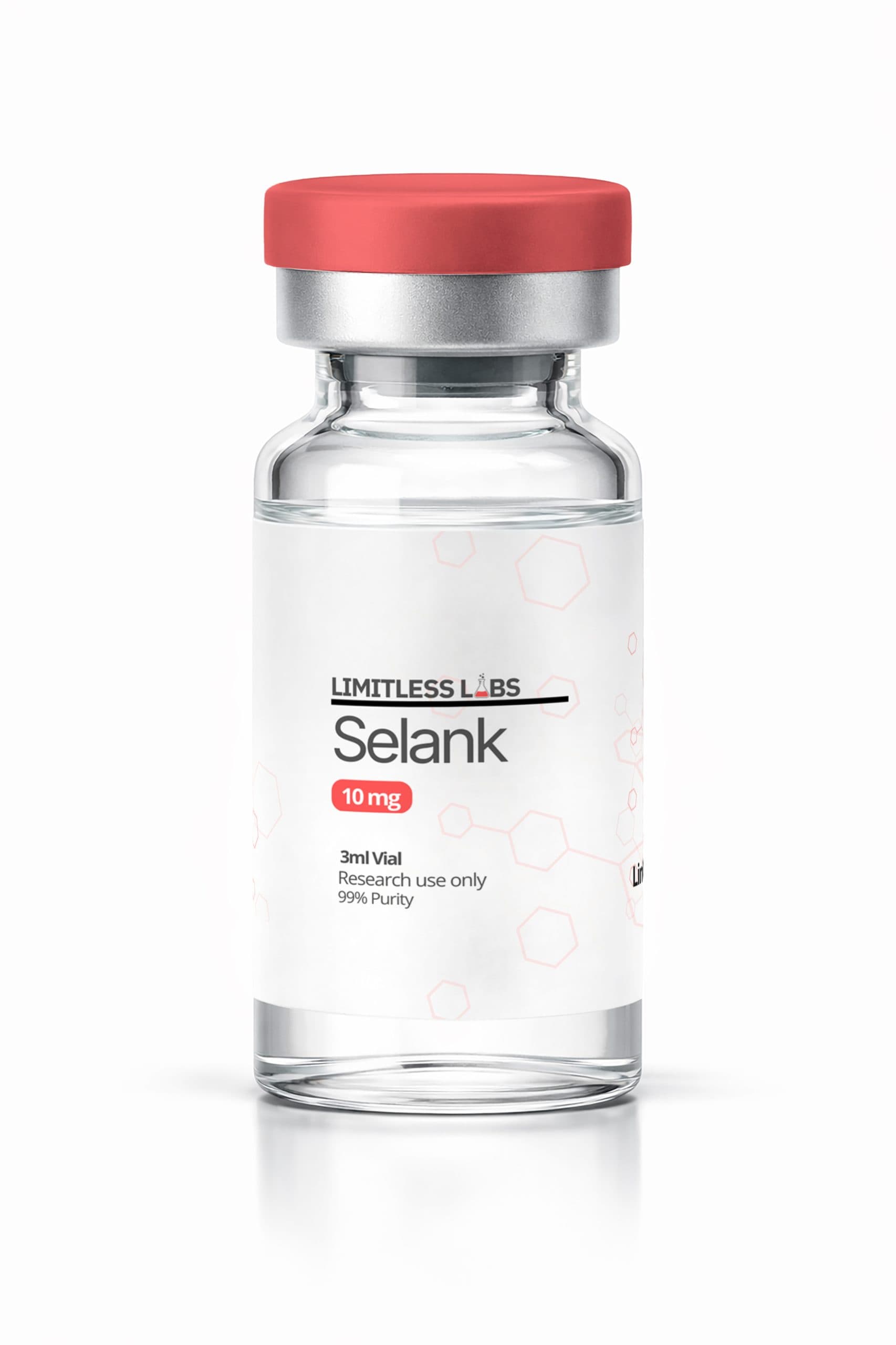
Selank (Thr-Lys-Pro-Arg-Pro-Gly-Pro) is a synthetic heptapeptide developed at the Institute of Molecular Genetics of the Russian Academy of Sciences (IMG RAS) — the same research program that produced Semax, a design-related sibling peptide. Selank is built around the sequence of tuftsin, a naturally occurring immune-regulatory tetrapeptide, with a stabilizing tripeptide tail appended to slow its breakdown in circulation. One fact should be stated plainly before anything else: Selank is an approved, marketed pharmaceutical in Russia — an intranasal solution for generalized anxiety disorder and neurasthenia under Russian drug registration — but it has no FDA or EMA approval anywhere else, and no internationally registered, Western-run controlled trial of Selank has been identified in the literature reviewed for this article. The evidence base splits into two pools that should not be blended: (1) Russian-language clinical literature — comparator studies run by overlapping author groups, published almost exclusively in one Russian psychiatric journal, without described randomization or blinding in the indexed abstracts; and (2) an internationally indexed mechanistic and preclinical literature (animal models, cell culture, gene expression) that is more methodologically transparent but still concentrated almost entirely within the same originating institute. Clinical claims about Selank's effects in people come from that first, thinner pool.
What Is Selank?
Selank's starting point is tuftsin (Thr-Lys-Pro-Arg), a naturally occurring tetrapeptide fragment released from the Fc region of the immunoglobulin G heavy chain, which acts as an endogenous immunomodulator affecting phagocyte activity and other immune functions [1]. Selank extends tuftsin's four-residue core with a C-terminal Pro-Gly-Pro (PGP) tripeptide, producing the stable heptapeptide Thr-Lys-Pro-Arg-Pro-Gly-Pro — a design strategy shared with Semax, which appends the same PGP tail to a fragment of ACTH(4-10) [2]. In Russian pharmacological literature Selank is also referenced by the code TP-7. Native tuftsin is degraded very rapidly by circulating peptidases; researchers at IMG RAS reported that adding the PGP tail extended the parent sequence's biological persistence enough to make it a viable drug candidate.
An important nuance the originating group itself has raised: the PGP tail is not a biologically inert stabilizer. In a rat model of focal cerebral ischemia, the free tripeptide Pro-Gly-Pro — tested alone, detached from Selank or Semax — produced its own genome-wide transcriptional signature, altering expression of 29 genes at 3 hours and 57 genes at 24 hours post-occlusion, with immune-response genes the most statistically prominent category affected [3]. A related finding using Selank's short Gly-Pro fragment in mouse spleen showed that fragment alone reproduced part of Selank's own inflammation-gene expression pattern [15]. This suggests some of Selank's reported activity may not depend on the intact heptapeptide at all.
No equivalent registration to Russia's exists in the United States or European Union. On the FDA's own bulk drug substances list for compounding, Selank (as "selank acetate") currently sits in the "nominated but withdrawn" category — not the permitted Category 1 list — with the agency stating compounded drugs containing it "may pose risk for immunogenicity for certain routes of administration due to the potential for aggregation and peptide-related impurities" (FDA, bulk drug substances page). That is a regulatory gray zone, not an authorization.
Mechanism of Action (proposed)
No single confirmed receptor or binding site for Selank has been established. The literature proposes several overlapping mechanisms, drawn mostly from animal, cell-culture, and a small number of human-sample studies:
Enkephalinase inhibition. The oldest and most consistently pursued mechanism. Selank dose-dependently inhibited enzymatic hydrolysis of plasma leu-enkephalin with an IC50 of approximately 15 μM, and was more potent in this respect than the reference peptidase inhibitors bacitracin and puromycin [4]. The effect was strain-dependent in mice: a 100 μg/kg dose produced anxiolytic behavior and prolonged plasma leu-enkephalin half-life in BALB/c mice, but had no effect on either measure in C57Bl/6 mice, tying the behavioral effect directly to the enzymatic one [5]. A companion study reported that Selank, alongside Semax, inhibited enkephalin-degrading enzymes isolated from human serum [6]. In the one published human study addressing this mechanism, GAD/neurasthenia patients showed a shortened plasma leu-enkephalin half-life at baseline (correlated with symptom severity), which lengthened during Selank treatment, with the strongest correlation to anxiety improvement in the GAD subgroup [18].
GABA-A receptor allosteric modulation. A radioligand-binding study reported that Selank acted as a positive allosteric modulator of [³H]GABA binding to brain membrane preparations, and that combining it with diazepam or the antipsychotic olanzapine produced non-additive, subtype-selective changes in binding — suggesting overlapping but not identical sites [2]. Electrophysiology in rat hippocampal slices found Selank increased the amplitude and discharge rate of spontaneous inhibitory postsynaptic currents in CA1 pyramidal neurons, with no clear dose-dependence across the tested 1–8 μM range [9]. Gene-expression work in rat frontal cortex found a single 300 μg/kg dose altered expression of 45 of 84 screened neurotransmission genes at 1 hour, and 22 of 84 at 3 hours, correlating with GABA's own expression signature [8]. That picture is complicated by a human neuroblastoma cell line (IMR-32) study in which Selank alone produced no change in the same gene panel's mRNA levels, though it still modified GABA's and olanzapine's effects when combined — the authors concluded Selank likely affects receptor interaction rather than transcription in that system [7]. The rat-versus-human-cell-line discrepancy is unresolved.
BDNF signaling. Intranasal Selank was reported to regulate BDNF expression in the rat hippocampus in vivo [10]. In a chronic-ethanol rat model (10% ethanol as sole fluid source for 30 weeks), intraperitoneal Selank at 0.3 mg/kg/day for 7 days produced a cognitive-stimulating effect on an object-recognition test in aged (9-month) rats not exposed to ethanol (p<0.05), prevented ethanol-associated memory/attention disturbances during withdrawal (p<0.01), and prevented an ethanol-induced rise in BDNF in hippocampus and frontal cortex (p<0.05) [11].
Immune modulation and cytokines. One study reported suppressed IL-6 gene expression but increased IL-6 concentration in cultured peripheral blood cells from depressed patients. Separately, it reported serum Th1/Th2 cytokine changes after 14 days in patients with generalized anxiety disorder and neurasthenia [13]. These are distinct measurements and populations; reduced gene expression should not be equated with reduced cytokine concentration. Rat stress experiments and mouse gene-expression studies provide additional preclinical observations [12][14][15][16][17], rather than demonstrated human immune benefits.
Research Findings by Area
Animal models of anxiety-like behavior
In an elevated-plus-maze study in rats, administration of the test substances was associated with worsening anxiety indicators even without chronic stress, although the changes were less pronounced with Selank. Under unpredictable chronic mild stress, the Selank–diazepam combination was most effective at restoring the measured indicators toward pre-stress values [21]. The results depend on the experimental condition and do not establish human anxiolytic efficacy. Much of the cited mechanistic work comes from overlapping author groups [7][8][14][15][16][17].
Human clinical literature — generalized anxiety disorder and comparator trials (Russia)
The foundational human trial examined 62 patients with generalized anxiety disorder and neurasthenia, comparing Selank (30 patients) to the benzodiazepine medazepam (32 patients) on the Hamilton, Zung, and CGI scales; it reported a similar magnitude of anxiolytic effect between arms, with Selank additionally associated with antiasthenic and psychostimulant effects not attributed to medazepam [18]. A later comparator study of 60 patients with phobic-anxiety and somatoform disorders (ICD-10 F40.2-9, F41.1-9, F45.0-1) compared Selank to the benzodiazepine phenazepam, reporting a pronounced anxiolytic and mild nootropic effect, an anxiolytic effect said to persist roughly a week after the last dose, and a positive effect on patient-reported quality of life [19]. A third study of 70 patients compared phenazepam monotherapy (30 patients) to combined Selank-plus-phenazepam treatment (40 patients) across the Hamilton, CGI, Spielberger, UKU, Stroop, and SF-36 instruments; the combined-treatment group reached phenazepam's therapeutic effect sooner on the Hamilton scale and experienced fewer of phenazepam's characteristic side effects — attention/memory impairment, asthenia, sedation, extended sleep duration, sexual disturbance, emotional blunting, orthostatic symptoms — both during co-administration and after benzodiazepine withdrawal [20].
These three trials are the clinical core of the Selank literature, and their limitations should be stated as plainly as their results: sample sizes of 60–70 patients, publication in a single Russian-language journal (Zhurnal nevrologii i psikhiatrii imeni S.S. Korsakova) by overlapping author teams, no description of randomization or blinding methodology in the indexed abstracts, and no evidence of independent replication or registration in an internationally searchable trial registry — a materially different evidentiary standard than the trials supporting FDA or EMA approvals.
Benzodiazepine comparisons, as reported
Selank is repeatedly compared to benzodiazepines in this literature: comparable anxiolytic magnitude to medazepam [18]; adding Selank to phenazepam reported to accelerate the benzodiazepine's onset while reducing its side-effect burden during and after tapering [20]; in rats, comparable effectiveness to diazepam under chronic mild stress, with the combination outperforming either agent alone under stress [21]; and at the receptor level, positive allosteric modulation of GABA-A activity that combined with diazepam or olanzapine in a non-additive, subtype-selective way [2]. An independent, non-Russian perspective comes from a 2021 U.S. clinical pharmacology review, which grouped Selank with phenibut as "poorly studied Russian drugs with GABAergic mechanisms" that are "inexplicably sold to US consumers as dietary supplements" despite limited safety characterization [22]. That review reported no new pharmacological data on Selank, but is a useful data point precisely because it comes from outside the originating research network.
Safety and toxicity signal
One study screened several peptides, including Selank, in a mouse embryonic stem cell model, concluding the tested peptides "do not produce toxic effect during the embryonic and fetal period of life" as modeled there [23]. The same study found Selank at 100 μM reduced the proportion of stem cells differentiating into GABA-positive neurons by 61% relative to control (versus 58% for thyroliberin and 87% for nerve growth factor) — an isolated in vitro finding of unclear relevance to an intact organism [23]. No human long-term safety, reproductive-toxicity, or carcinogenicity data have been identified in the literature reviewed.
Limitations & Open Questions
No internationally registered controlled trial. Every human study of Selank identified here was published in Russian-language journals by overlapping author groups, without indexed descriptions of randomization or blinding, and none appears in an internationally searchable clinical trial registry. This is the single most important caveat for anyone evaluating Selank's clinical evidence base.
Single-institute concentration. The mechanistic and genomic literature is dominated by researchers affiliated with IMG RAS, with authors including Myasoedov, Andreeva, Kolomin, and Zozulya appearing across decades of overlapping papers [4,5,6,8,9,10,11,14,15,16,17,18,19,20]. Independent replication from outside groups is minimal; the clearest outside perspective is a regulatory-focused U.S. pharmacology review that characterized Selank as "poorly studied" rather than contributing new pharmacological data [22].
Unresolved mechanistic conflicts. GABAergic gene-expression effects reported in rat frontal cortex were not reproduced in a human neuroblastoma cell line, where Selank alone had no direct effect on mRNA levels despite modulating GABA's and olanzapine's effects [7,8]. Whether this reflects a species difference, a culture-versus-intact-brain difference, or a genuinely indirect mechanism is unresolved.
The PGP tail complicates attribution. Because the C-terminal Pro-Gly-Pro fragment shared by Selank and Semax has its own documented biological activity — including genome-wide transcriptional effects when tested alone — some effects attributed to "Selank" specifically may be attributable, in whole or in part, to this shared fragment rather than the full heptapeptide [3,15].
Regulatory status. Selank is approved in Russia but has no FDA or EMA marketing authorization. It sits in the FDA's "nominated but withdrawn" bulk-drug-substances category — not the permitted list — with the agency citing potential immunogenicity and peptide-impurity concerns for compounded products containing it.
Mechanistic incompleteness. No confirmed receptor has been identified for Selank itself. Enkephalinase inhibition and GABA-A allosteric modulation are both partial, overlapping hypotheses rather than an established, unified pathway.
Frequently Asked Questions
Has Selank been tested in humans? Yes, but only in a small number of Russian-language studies (62, 60, and 70 patients respectively) published in one journal by overlapping author teams, without indexed descriptions of randomization or blinding, and without independent replication or international trial registration identified [18,19,20].
Where does the name and structure of Selank come from? Selank is built on tuftsin (Thr-Lys-Pro-Arg), a naturally occurring immune-regulatory tetrapeptide, extended with a C-terminal Pro-Gly-Pro tripeptide reported to slow its enzymatic breakdown — the same stabilization strategy used in the related peptide Semax [1,2].
Is Selank approved by the FDA? No. It appears on the FDA's bulk drug substances list in the "nominated but withdrawn" category, with the agency noting immunogenicity and peptide-impurity concerns for compounded products.
Is Selank approved anywhere? Yes — in Russia, registered and marketed as an intranasal pharmaceutical for generalized anxiety disorder and neurasthenia, under Russian regulatory standards that differ from FDA/EMA requirements and have not been recognized by either Western agency.
Is Selank the same as Semax? No. They are structurally distinct peptides from different parent molecules — Selank from tuftsin, Semax from a fragment of ACTH(4-10) — developed by the same institute using the same C-terminal PGP stabilization approach. Findings for one do not automatically apply to the other.
What is the strongest mechanistic evidence for Selank? The enkephalinase-inhibition data are the oldest and most internally consistent, with a specific IC50 and strain-dependent behavioral correlation in mice [4,5]. The GABA-A receptor-binding study is the most direct evidence for allosteric modulation [2], complicated by a human cell-line study that did not reproduce a direct transcriptional effect [7]. Both come from a concentrated set of overlapping research groups rather than broad independent confirmation.
Why is Selank compared to benzodiazepines so often? Because the source papers make the comparison explicitly — similar anxiolytic magnitude to medazepam and diazepam, and a receptor-binding interaction with diazepam and olanzapine — and because a U.S. clinical pharmacology review classified Selank as having a "GABAergic mechanism" alongside phenibut and benzodiazepine-class agents [2,18,21,22].
References
- Siebert A, Gensicka-Kowalewska M, Cholewinski G, Dzierzbicka K. Tuftsin - Properties and Analogs. Curr Med Chem. 2017;24(34):3711-3727. doi:10.2174/0929867324666170725140826 — PMID: 28745220
- Vyunova TV, Andreeva L, Shevchenko K, Myasoedov N. Peptide-based Anxiolytics: The Molecular Aspects of Heptapeptide Selank Biological Activity. Protein Pept Lett. 2018;25(10):914-923. doi:10.2174/0929866525666180925144642 — PMID: 30255741
- Medvedeva EV, Dmitrieva VG, Povarova OV, Limborskaia SA, Skvortsova VI, Miasoedov NF, Dergunova LV. [Effect of tripeptide Pro-Gly-Pro on rat brain transcriptome in focal ischemia]. Mol Biol (Mosk). 2014;48(2):277-287. PMID: 25850296
- Zozulya AA, Kost NV, Sokolov OY, Gabaeva MV, Grivennikov IA, Andreeva LN, Zolotarev YA, Ivanov SV, Andryushchenko AV, Myasoedov NF, Smulevich AB. The inhibitory effect of Selank on enkephalin-degrading enzymes as a possible mechanism of its anxiolytic activity. Bull Exp Biol Med. 2001;131(4):315-317. doi:10.1023/a:1017979514274 — PMID: 11550013
- Sokolov OY, Meshavkin VK, Kost NV, Zozulya AA. Effects of Selank on behavioral reactions and activities of plasma enkephalin-degrading enzymes in mice with different phenotypes of emotional and stress reactions. Bull Exp Biol Med. 2002;133(2):133-135. doi:10.1023/a:1015582302311 — PMID: 12432865
- Kost NV, Sokolov OIu, Gabaeva MV, Grivennikov IA, Andreeva LA, Miasoedov NF, Zozulia AA. [Semax and selank inhibit the enkephalin-degrading enzymes from human serum]. Bioorg Khim. 2001;27(3):180-183. doi:10.1023/a:1011373002885 — PMID: 11443939
- Filatova E, Kasian A, Kolomin T, Rybalkina E, Alieva A, Andreeva L, Limborska S, Myasoedov N, Pavlova G, Slominsky P, Shadrina M. GABA, Selank, and Olanzapine Affect the Expression of Genes Involved in GABAergic Neurotransmission in IMR-32 Cells. Front Pharmacol. 2017;8:89. doi:10.3389/fphar.2017.00089 — PMID: 28293190
- Volkova A, Shadrina M, Kolomin T, Andreeva L, Limborska S, Myasoedov N, Slominsky P. Selank Administration Affects the Expression of Some Genes Involved in GABAergic Neurotransmission. Front Pharmacol. 2016;7:31. doi:10.3389/fphar.2016.00031 — PMID: 26924987
- Povarov IS, Kondratenko RV, Derevyagin VI, Myasoedov NF, Skrebitsky VG. Effect of Selank on Spontaneous Synaptic Activity of Rat Hippocampal CA1 Neurons. Bull Exp Biol Med. 2017;162(5):640-642. doi:10.1007/s10517-017-3676-3 — PMID: 28361410
- Inozemtseva LS, Karpenko EA, Dolotov OV, Levitskaya NG, Kamensky AA, Andreeva LA, Grivennikov IA. Intranasal administration of the peptide Selank regulates BDNF expression in the rat hippocampus in vivo. Dokl Biol Sci. 2008;421:241-243. doi:10.1134/s0012496608040066 — PMID: 18841804
- Kolik LG, Nadorova AV, Antipova TA, Kruglov SV, Kudrin VS, Durnev AD. Selank, Peptide Analogue of Tuftsin, Protects Against Ethanol-Induced Memory Impairment by Regulating of BDNF Content in the Hippocampus and Prefrontal Cortex in Rats. Bull Exp Biol Med. 2019;167(5):641-644. doi:10.1007/s10517-019-04588-9 — PMID: 31625062
- Leonidovna YA, Aleksandrovna SM, Aleksandrovna TA, Aleksandrovna BO, Fedorovich MN, Aleksandrovna AL. The Influence of Selank on the Level of Cytokines Under the Conditions of "Social" Stress. Curr Rev Clin Exp Pharmacol. 2021;16(2):162-167. doi:10.2174/1574884715666200704152810 — PMID: 32621722
- Uchakina ON, Uchakin PN, Miasoedov NF, Andreeva LA, Shcherbenko VE, Mezentseva MV, Gabaeva MV, Sokolov OIu, Zozulia AA, Ershov FI. [Immunomodulatory effects of selank in patients with anxiety-asthenic disorders]. Zh Nevrol Psikhiatr Im S S Korsakova. 2008;108(5):71-75. PMID: 18577961
- Kolomin T, Shadrina M, Andreeva L, Slominsky P, Limborska S, Myasoedov N. Expression of inflammation-related genes in mouse spleen under tuftsin analog Selank. Regul Pept. 2011;170(1-3):18-23. doi:10.1016/j.regpep.2011.05.001 — PMID: 21609736
- Kolomin T, Morozova M, Volkova A, Shadrina M, Andreeva L, Slominsky P, Limborska S, Myasoedov N. The temporary dynamics of inflammation-related genes expression under tuftsin analog Selank action. Mol Immunol. 2014;58(1):50-55. doi:10.1016/j.molimm.2013.11.002 — PMID: 24291245
- Kolomin TA, Shadrina MI, Agniullin YV, Shram SI, Slominskii PA, Limborska SA, Myasoedov NF. Transcriptomic response of rat hippocampus and spleen cells to single and chronic administration of the peptide selank. Dokl Biochem Biophys. 2010;430:5-6. doi:10.1134/s1607672910010023 — PMID: 20380151
- Kolomin TA, Agapova TIu, Agniullin IaV, Shram SI, Shadrina MI, Slominskiĭ PA, Limborskaia SA, Miasoedov IF. [Transcriptome alteration in hippocampus under the treatment of tuftsin analog Selank]. Zh Vyssh Nerv Deiat Im I P Pavlova. 2013;63(3):365-374. doi:10.7868/s0044467713030052 — PMID: 24450168
- Zozulia AA, Neznamov GG, Siuniakov TS, Kost NV, Gabaeva MV, Sokolov OIu, Serebriakova EV, Siranchieva OA, Andriushenko AV, Telesheva ES, Siuniakov SA, Smulevich AB, Miasoedov NF, Seredenin SB. [Efficacy and possible mechanisms of action of a new peptide anxiolytic selank in the therapy of generalized anxiety disorders and neurasthenia]. Zh Nevrol Psikhiatr Im S S Korsakova. 2008;108(4):38-48. PMID: 18454096
- Medvedev VE, Tereshchenko ON, Israelian AIu, Chobanu IK, Kost NV, Sokolov OIu, Miasoedov NF. [A comparison of the anxiolytic effect and tolerability of selank and phenazepam in the treatment of anxiety disorders]. Zh Nevrol Psikhiatr Im S S Korsakova. 2014;114(7):17-22. PMID: 25176261
- Medvedev VE, Tereshchenko ON, Kost NV, Ter-Israelyan AY, Gushanskaya EV, Chobanu IK, Sokolov OY, Myasoedov NF. [Optimization of the treatment of anxiety disorders with selank]. Zh Nevrol Psikhiatr Im S S Korsakova. 2015;115(6):33-40. doi:10.17116/jnevro20151156133-40 — PMID: 26356395
- Kasian A, Kolomin T, Andreeva L, Bondarenko E, Myasoedov N, Slominsky P, Shadrina M. Peptide Selank Enhances the Effect of Diazepam in Reducing Anxiety in Unpredictable Chronic Mild Stress Conditions in Rats. Behav Neurol. 2017;2017:5091027. doi:10.1155/2017/5091027 — PMID: 28280289
- Doyno CR, White CM. Sedative-Hypnotic Agents That Impact Gamma-Aminobutyric Acid Receptors: Focus on Flunitrazepam, Gamma-Hydroxybutyric Acid, Phenibut, and Selank. J Clin Pharmacol. 2021;61 Suppl 2:S114-S128. doi:10.1002/jcph.1922 — PMID: 34396551
- Kobylyanskii AG, Zolotarev YA, Andreeva LA, Grivennikov IA, Myasoedov NF. Studying the Toxic Effects of Some Biologically Active Peptides on the Model of Mouse Embryonic Stem Cells. Bull Exp Biol Med. 2017;163(6):731-736. doi:10.1007/s10517-017-3891-y — PMID: 29063333
This article is an educational summary of published research. It is not medical advice, and it does not describe, endorse, or recommend any use of Selank in humans. Selank is not FDA-approved and carries no EMA approval; its only drug-marketing approval identified in this research is in Russia, under Russian regulatory standards. Products referenced on this site are sold for laboratory research use only and are not for human consumption.