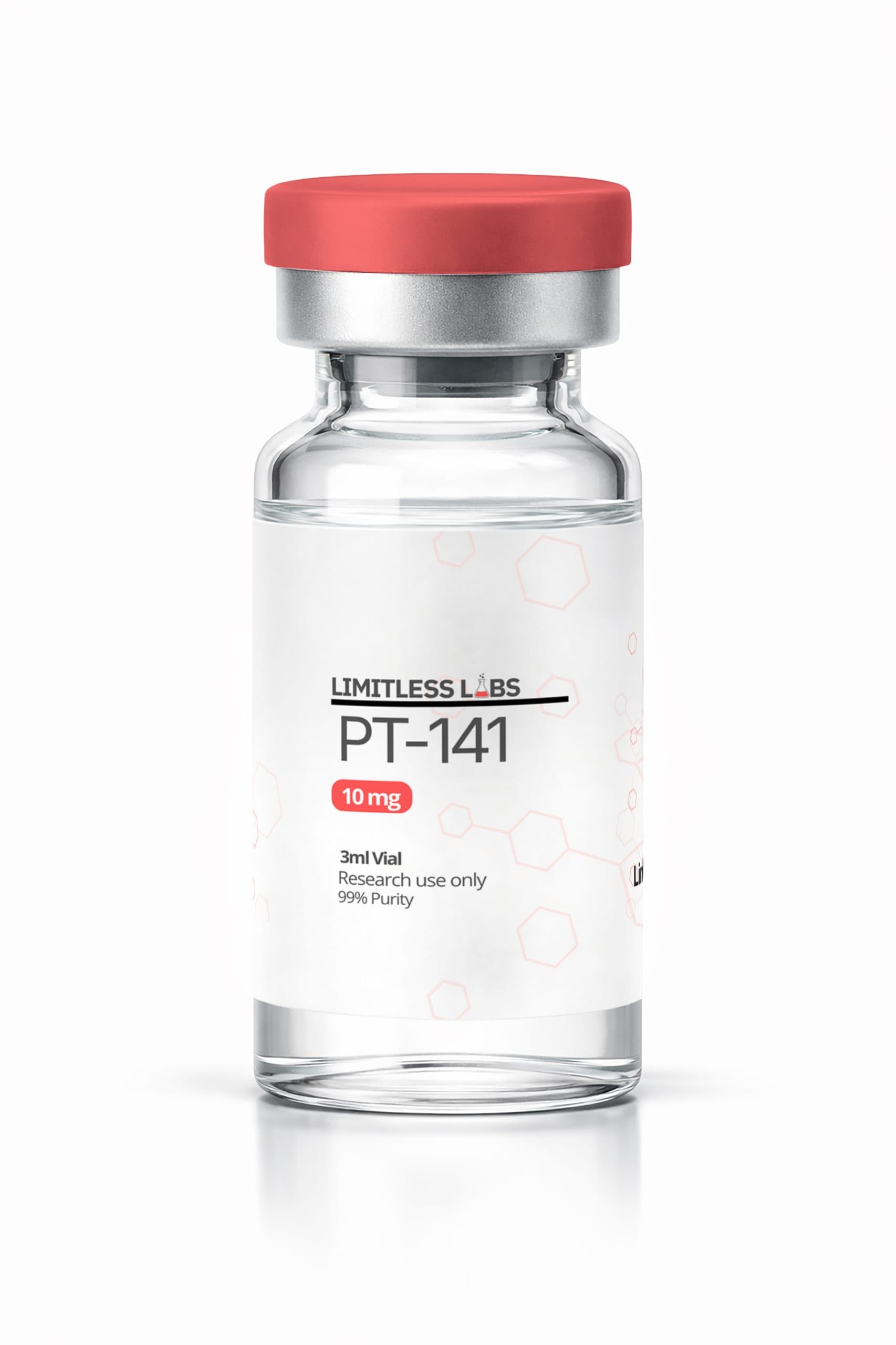
PT-141, now known by its generic name bremelanotide, is a cyclic heptapeptide melanocortin receptor agonist derived as the active metabolite of melanotan II, an earlier tanning-peptide candidate [1]. Unlike most compounds in this research library, bremelanotide is an FDA-approved pharmaceutical: it was approved in June 2019 as Vyleesi for acquired, generalized hypoactive sexual desire disorder (HSDD) in premenopausal women [16][17], following an earlier, ultimately abandoned development program targeting male erectile dysfunction [2][3][4]. In the pivotal RECONNECT phase 3 program, 1,267 women were randomized to bremelanotide or placebo, and the drug produced statistically significant but numerically modest improvements in desire and desire-related distress scores relative to placebo [6]. Independent reanalyses of that same trial data have characterized the effect as small and clinically marginal [15], and in December 2023 Palatin Technologies — the company that originated the molecule — sold the commercial rights to Vyleesi to Cosette Pharmaceuticals, exiting the HSDD marketing business itself while retaining bremelanotide for other research programs [18]. This article summarizes the published scientific and regulatory record; it is not medical guidance.
What Is PT-141?
PT-141 is a synthetic analog of alpha-melanocyte-stimulating hormone (α-MSH) that acts as an agonist at melanocortin receptors, with activity at both MC3R and MC4R, receptors expressed primarily in the central nervous system [1][12]. It emerged directly from work on melanotan II (MT-II), a cyclic α-MSH analog investigated in the 1990s as a sunless-tanning and anti-obesity agent; Palatin Technologies licensed the sexual-dysfunction application and identified PT-141 (later bremelanotide) as MT-II's active metabolite with a more selective receptor profile [1].
Its development history runs through two distinct clinical programs:
- Preclinical and early clinical work (2003–2005). Molinoff and colleagues described PT-141's pharmacology, showing that administration to rats and non-human primates produced penile erections, and that the peptide activated hypothalamic neurons connected to the corpus cavernosum via retrograde tracing [1]. Early-phase studies in men followed, using both intranasal [2] and subcutaneous [3] routes, including a study combining low-dose intranasal PT-141 with sildenafil [4].
- Female HSDD (2010s onward). After the male erectile-dysfunction program stalled (see below), Palatin repositioned bremelanotide for female HSDD. A phase 2b, randomized, placebo-controlled dose-finding trial in premenopausal women with sexual dysfunction established the 1.75 mg subcutaneous dose carried into phase 3 [5]. The RECONNECT program comprised two identically designed phase 3 trials (Studies 301 and 302) [6], a 52-week open-label safety extension [7], a pooled safety analysis across the full clinical development program [8], and prespecified subgroup analyses [9].
- Post-approval and pipeline activity (2019–2026). Following approval, bremelanotide changed commercial hands twice, and Palatin has continued researching the molecule and a related backup compound, PL-6983, alongside newer combination and next-generation melanocortin programs [10][18][19].
Mechanism of Action
Bremelanotide's established pharmacology is receptor-level: it is a nonselective melanocortin receptor agonist with activity at MC3R and MC4R, receptors concentrated in the hypothalamus and other central nervous system regions rather than in peripheral vascular or genital tissue [1][12]. In animal studies, systemic administration increases c-Fos immunoreactivity (a marker of neuronal activation) in the hypothalamus, and neurons in that same region take up retrograde tracer injected into the penis, supporting a central rather than purely local mechanism for its erectogenic effect in males [1].
What is more debated is how this central MC4R activity translates into effects on subjective sexual desire in women, which is the basis of its approved indication. The FDA-approved prescribing information itself states that the mechanism by which bremelanotide improves sexual desire and related distress in HSDD is not established. A 2025 study in female Syrian hamsters mapped MC4R messenger RNA expression to dopamine neurons in the ventral tegmental area (VTA) — a core node of the mesolimbic reward circuit — but found that bremelanotide did not enhance sexual reward in a conditioned place-preference paradigm, and concluded that the drug does not appear to act through the VTA–nucleus accumbens reward pathway, at least in that model [12]. This leaves an open gap between the receptor pharmacology (well characterized) and the behavioral mechanism underlying its clinical effect on desire (not well characterized), a gap broader reviews of the central melanocortin system have also flagged as unresolved even as the receptor class has drawn renewed pharmaceutical interest following bremelanotide's and setmelanotide's approvals [13].
Research Findings by Area
Male erectile dysfunction trials and the blood-pressure signal
The earliest clinical work on PT-141 was in men. A double-blind, placebo-controlled study of intranasal PT-141 in healthy males and men with mild-to-moderate erectile dysfunction found statistically significant erectile responses (measured by RigiScan) at doses above 7 mg, with flushing and nausea as the most common adverse events and no clinically significant changes in vital signs reported in that particular study [2]. A companion study using subcutaneous administration in men with an inadequate response to sildenafil ("Viagra") likewise found statistically significant erectile responses at doses above 1 mg, describing the compound as safe and well tolerated in that trial [3]. A further study examined intranasal PT-141 co-administered with low-dose sildenafil, reporting an enhanced erectile response from the combination [4].
Despite these early positive signals, the intranasal male-ED program did not advance to approval. Larger-scale intranasal dosing produced dose-related, transient increases in blood pressure that were judged unacceptable for an as-needed erectile-dysfunction product, and Palatin discontinued the intranasal route in favor of exploring subcutaneous delivery, which showed a more favorable cardiovascular profile in company-reported data. The male-ED indication was not pursued to a marketed product; Palatin instead pivoted the compound toward female HSDD later in the decade, and as of the mid-2020s the company has restarted a bremelanotide-plus-PDE5-inhibitor clinical program specifically aimed at men who do not respond adequately to PDE5 inhibitors alone, described in a historical sponsor update [19]. That announcement’s projected dates do not establish recruitment, completion or results.
Female HSDD: dose-finding through RECONNECT phase 3
The phase 2b dose-finding study in premenopausal women with sexual dysfunction compared multiple subcutaneous bremelanotide doses against placebo and identified 1.75 mg as the dose carried forward into phase 3 development [5].
RECONNECT comprised two identically designed, randomized, double-blind, placebo-controlled, multicenter phase 3 trials (Study 301 and Study 302), each running 24 weeks, in premenopausal women with HSDD [6]. Of 1,267 women randomized, 1,247 were included in the safety population and 1,202 in the efficacy (modified intent-to-treat) population; participants were predominantly white (85.6%) and enrolled largely at U.S. sites (96.6%), with a mean age of 39 [6]. The co-primary endpoints were change from baseline to end-of-study in the Female Sexual Function Index-desire domain (FSFI-D) score and the Female Sexual Distress Scale-Desire/Arousal/Orgasm (FSDS-DAO) item 13 score, both scored relative to placebo. Bremelanotide produced statistically significant improvements in both: FSFI-D increased by 0.30 in Study 301 (P<.001) and 0.42 in Study 302 (P<.001), with an integrated placebo-adjusted difference of 0.35 (P<.001); FSDS-DAO decreased by −0.37 in Study 301 (P<.001) and −0.29 in Study 302 (P=.005), with an integrated difference of −0.33 (P<.001) [6]. Nausea, flushing, and headache each occurred in 10% or more of bremelanotide-treated participants in both studies [6].
Long-term extension and subgroup analyses
Of 856 patients who completed the 24-week core phase without a serious adverse event, 684 elected to enroll in a 52-week open-label extension, and 272 completed it [7]. Over the full open-label period, patients originally randomized to bremelanotide showed FSFI-D changes from baseline ranging from 1.25 to 1.30 and FSDS-DAO changes from −1.4 to −1.7, compared with 0.70–0.77 and −0.9, respectively, for patients originally randomized to placebo who then received open-label bremelanotide [7]. The most common treatment-related adverse events during the extension were nausea (40.4%), flushing (20.6%), and headache (12.0%), and no new safety signals were identified over the longer observation period [7]. Because the extension was open-label and its analyses were descriptive rather than inferentially controlled, these longer-term numbers cannot be read as an independently confirmed placebo-adjusted effect size.
Prespecified subgroup analyses of the pooled RECONNECT population (n=1,202) found statistically significant improvements in desire and distress across age, weight, and body-mass-index subgroups and across bioavailable-testosterone quartiles, with the improvement in desire reaching significance specifically in women not using hormonal contraception (with a smaller, non-significant numerical advantage in contraceptive users), while the reduction in distress was significant regardless of hormonal contraceptive use [9].
The debate over effect size
The RECONNECT results have drawn sustained scrutiny in the sexual-medicine literature over how clinically meaningful they are. A 2021 reanalysis of the phase 3 data, drawing on the FDA's own New Drug Application review, reported that adverse-event-driven study discontinuation was substantially higher on bremelanotide than placebo (odds ratio 11.98; number needed to harm 6), and that participants were more likely to prefer placebo, as measured by the combination of trial completion and voluntary enrollment in the open-label extension (odds ratio 0.30 favoring placebo; number needed to harm 4) [15]. The trial investigators published a rebuttal disputing the reanalysis's methodology [14]. Separately, a 2021 commentary comparing bremelanotide with the earlier-approved flibanserin (Addyi) argued that flibanserin produced, on average, one additional self-reported "satisfying sexual event" every two months relative to placebo, while bremelanotide produced no comparable measurable increase in sexual events, and questioned whether the surrogate desire and distress scores used as primary endpoints represent clinically meaningful benefit [11]. A 2023 pharmacology review similarly concluded that bremelanotide is moderately safe and reasonably well tolerated but that its "overall clinical benefit appears to be modest," while noting that trials of female sexual dysfunction treatments face structural challenges from large placebo responses and subjective, recall-dependent outcome measures [10].
Safety profile
A pooled safety review spanning the full clinical development program — 3,500 subjects across 43 completed studies — reported the most common adverse events in the integrated double-blind phase 3 population (n=1,247) as nausea (40.0% vs. 1.3% placebo), flushing (20.3% vs. 1.3%), headache (11.3% vs. 1.9%), and injection-site reactions (5.4% vs. 0.5%); nausea was the most common reason for discontinuation [8]. No deaths were reported, and serious adverse events were rare [8]. Focal hyperpigmentation — a known effect of melanocortin receptor agonists more broadly — was described as rare under approved labeling conditions but occurred in more than one-third of subjects following up to 16 consecutive daily doses in dose-finding studies, well beyond the approved as-needed regimen [8]. Ambulatory blood-pressure monitoring detected small but statistically significant transient increases in blood pressure following dosing, and the FDA labeling contraindicates Vyleesi in uncontrolled hypertension or known cardiovascular disease [17]. In the double-blind phase, 70% of the bremelanotide group elected to continue into the open-label extension versus 87% of the placebo group — a differential retention pattern the 2021 reanalysis cited as evidence of a net tolerability disadvantage [8][15].
Approval and post-approval commercial history
The FDA approved Vyleesi (bremelanotide injection) on June 21, 2019, for acquired, generalized HSDD in premenopausal women, describing it as the first as-needed treatment approved for that indication [16][17]. The product was originally commercialized by AMAG Pharmaceuticals under license from Palatin, and prescribing information notes that the mechanism of the desire-related effect is unknown and that a transient increase in blood pressure and decrease in heart rate follows each dose, typically resolving within about 12 hours [17]. In December 2023, Palatin Technologies sold the Vyleesi asset to Cosette Pharmaceuticals for up to $171 million (a $12 million upfront payment plus sales-based milestones), while retaining bremelanotide rights for other indications, including obesity and male erectile dysfunction [18]. As of this writing, Vyleesi remains FDA-approved and is marketed by Cosette Pharmaceuticals rather than by Palatin. Separately, Palatin has continued clinical work on bremelanotide outside the HSDD indication, including a phase 2 study of bremelanotide co-administered with the GLP-1/GIP agent tirzepatide for obesity, and the bremelanotide-plus-PDE5-inhibitor program for erectile dysfunction described above [19]. A related backup compound, PL-6983 — a peptide melanocortin receptor agonist reported in Palatin's own securities filings as a second sexual-dysfunction candidate alongside bremelanotide — remained in early-stage, unpublished development as of the company's public disclosures and has not advanced to a marketed product [20].
Limitations & Open Questions in the Literature
- Effect size remains genuinely contested. The RECONNECT primary endpoints reached statistical significance, but independent reanalysis and critical commentary argue the absolute magnitude is small relative to the tolerability cost, and the trial investigators dispute that characterization [9][11][14][15]. Readers of the primary literature should weigh both the original reports and the published critiques rather than either alone.
- Behavioral mechanism is not established. Receptor pharmacology (MC3R/MC4R agonism, central nervous system localization) is well characterized, but how this translates into a subjective increase in sexual desire in women is not; a 2025 rodent study found no evidence that bremelanotide acts through the mesolimbic dopamine reward circuit, complicating one leading hypothesis [12].
- The male erectile-dysfunction program was never completed to approval. Early trials showed erectogenic activity at multiple doses and routes [2][3][4], but the intranasal program's blood-pressure findings ended that route, and no bremelanotide product for male ED has reached market; a new PDE5-inhibitor-combination program is in earlier-stage development described in a historical sponsor announcement [19].
- Open-label extension data are descriptive, not confirmatory. The 52-week long-term follow-up used no placebo control past week 24, so its point estimates for durability of effect are informative but statistically weaker than the core RECONNECT results [7].
- Cardiovascular labeling matters. Transient blood-pressure increases were observed in the clinical program [8]. Vyleesi labeling contraindicates use in uncontrolled hypertension or known cardiovascular disease [17]. Trial averages should not be used to dismiss those restrictions.
- PL-6983 and other backup or next-generation melanocortin candidates remain largely unpublished. Public detail is limited to company securities filings rather than peer-reviewed trial data [20].
Frequently Asked Questions
What is PT-141, in one sentence? PT-141 is the original development name for bremelanotide, a synthetic nonselective melanocortin receptor agonist derived from melanotan II, approved by the FDA as Vyleesi for hypoactive sexual desire disorder in premenopausal women [1][16].
Is PT-141/bremelanotide FDA-approved? Yes, for one specific indication: acquired, generalized HSDD in premenopausal women, approved June 21, 2019 [16][17]. It was never approved for male erectile dysfunction, despite an earlier clinical program in that indication [2][3][19]. Research-grade material sold as a laboratory reference standard is a separate, non-drug category not intended for human use.
Why was the male erectile-dysfunction program discontinued? Early intranasal and subcutaneous studies showed statistically significant erectile responses [2][3][4], but larger intranasal-dose testing produced dose-related transient blood-pressure increases that were judged unacceptable for that route, ending the intranasal program; Palatin has since restarted male-ED research using bremelanotide combined with a PDE5 inhibitor [19].
What did the RECONNECT phase 3 trials actually show? In 1,202 evaluable women, bremelanotide produced statistically significant, placebo-adjusted improvements of 0.35 points on the FSFI-desire domain and −0.33 points on the FSDS-DAO distress item, integrated across two identical 24-week trials [6]. Whether that magnitude constitutes a clinically meaningful benefit is disputed in the published literature [11][15].
Is bremelanotide still commercially available, and who sells it? Yes. Vyleesi remains FDA-approved. Palatin Technologies, the originating company, sold the Vyleesi commercial rights to Cosette Pharmaceuticals in a deal closing in December 2023, and Cosette has marketed it since [18].
What were the most common adverse events in trials? Nausea (40.0% vs. 1.3% placebo), flushing (20.3% vs. 1.3%), headache (11.3% vs. 1.9%), and injection-site reactions (5.4% vs. 0.5%), based on the pooled phase 3 safety population, plus small transient blood-pressure increases on ambulatory monitoring and focal hyperpigmentation with repeated daily dosing beyond the approved regimen [8].
What major questions remain unanswered? The precise behavioral mechanism linking central MC4R activity to subjective desire [12][13], whether the RECONNECT effect size represents a clinically meaningful benefit [9][11][15], and whether the bremelanotide-plus-PDE5-inhibitor male-ED program (described in historical sponsor disclosures) succeeds where the earlier intranasal program did not [19].
References
- Molinoff PB, Shadiack AM, Earle D, Diamond LE, Quon CY. PT-141: a melanocortin agonist for the treatment of sexual dysfunction. Ann N Y Acad Sci. 2003;994:96–102. doi:10.1111/j.1749-6632.2003.tb03167.x. PMID: 12851303
- Diamond LE, Earle DC, Rosen RC, Willett MS, Molinoff PB. Double-blind, placebo-controlled evaluation of the safety, pharmacokinetic properties and pharmacodynamic effects of intranasal PT-141, a melanocortin receptor agonist, in healthy males and patients with mild-to-moderate erectile dysfunction. Int J Impot Res. 2004;16(1):51–59. doi:10.1038/sj.ijir.3901139. PMID: 14963471
- Rosen RC, Diamond LE, Earle DC, Shadiack AM, Molinoff PB. Evaluation of the safety, pharmacokinetics and pharmacodynamic effects of subcutaneously administered PT-141, a melanocortin receptor agonist, in healthy male subjects and in patients with an inadequate response to Viagra. Int J Impot Res. 2004;16(2):135–142. doi:10.1038/sj.ijir.3901200. PMID: 14999221
- Diamond LE, Earle DC, Garcia WD, Spana C. Co-administration of low doses of intranasal PT-141, a melanocortin receptor agonist, and sildenafil to men with erectile dysfunction results in an enhanced erectile response. Urology. 2005;65(4):755–759. doi:10.1016/j.urology.2004.10.060. PMID: 15833522
- Clayton AH, Althof SE, Kingsberg S, DeRogatis LR, Kroll R, Goldstein I, Kaminetsky J, Spana C, Lucas J, Jordan R, Portman DJ. Bremelanotide for female sexual dysfunctions in premenopausal women: a randomized, placebo-controlled dose-finding trial. Womens Health (Lond). 2016;12(3):325–337. doi:10.2217/whe-2016-0018. PMID: 27181790
- Kingsberg SA, Clayton AH, Portman D, Williams LA, Krop J, Jordan R, Lucas J, Simon JA. Bremelanotide for the Treatment of Hypoactive Sexual Desire Disorder: Two Randomized Phase 3 Trials. Obstet Gynecol. 2019;134(5):899–908. doi:10.1097/AOG.0000000000003500. PMID: 31599840
- Simon JA, Kingsberg SA, Portman D, Williams LA, Krop J, Jordan R, Lucas J, Clayton AH. Long-Term Safety and Efficacy of Bremelanotide for Hypoactive Sexual Desire Disorder. Obstet Gynecol. 2019;134(5):909–917. doi:10.1097/AOG.0000000000003514. PMID: 31599847
- Clayton AH, Kingsberg SA, Portman D, Sadiq A, Krop J, Jordan R, Lucas J, Simon JA. Safety Profile of Bremelanotide Across the Clinical Development Program. J Womens Health (Larchmt). 2022;31(2):171–182. doi:10.1089/jwh.2021.0191. PMID: 35147466
- Simon JA, Kingsberg SA, Portman D, Jordan R, Lucas J, Sadiq A, Krop J, Clayton AH. Prespecified and Integrated Subgroup Analyses from the RECONNECT Phase 3 Studies of Bremelanotide. J Womens Health (Larchmt). 2022;31(3):391–400. doi:10.1089/jwh.2021.0225. PMID: 35230162
- Cipriani S, Alfaroli C, Maseroli E, Vignozzi L. An evaluation of bremelanotide injection for the treatment of hypoactive sexual desire disorder. Expert Opin Pharmacother. 2023;24(1):15–21. doi:10.1080/14656566.2022.2132144. PMID: 36242769
- Mintzes B, Tiefer L, Cosgrove L. Bremelanotide and flibanserin for low sexual desire in women: the fallacy of regulatory precedent. Drug Ther Bull. 2021;59(12):185–188. doi:10.1136/dtb.2021.000020. PMID: 34642243
- Borland JM, Kohut-Jackson AL, Peyla AC, Hall MA, Mermelstein PG, Meisel RL. Female Syrian hamster analyses of bremelanotide, a US FDA approved drug for the treatment of female hypoactive sexual desire disorder. Neuropharmacology. 2025;267:110299. doi:10.1016/j.neuropharm.2025.110299. PMID: 39793696
- Sweeney P, Gimenez LE, Hernandez CC, Cone RD. Targeting the central melanocortin system for the treatment of metabolic disorders. Nat Rev Endocrinol. 2023;19(9):507–519. doi:10.1038/s41574-023-00855-y. PMID: 37365323
- Kingsberg SA, Clayton AH, Portman D, Krop J, Jordan R, Lucas J, Simon JA. Failure of a Meta-analysis: A Commentary on Glen Spielmans's "Re-Analyzing Phase III Bremelanotide Trials for 'Hypoactive Sexual Desire Disorder in Women'". J Sex Res. 2021;58(9):1106–1107. doi:10.1080/00224499.2021.1902926. PMID: 33835907
- Spielmans GI. Re-Analyzing Phase III Bremelanotide Trials for "Hypoactive Sexual Desire Disorder" in Women. J Sex Res. 2021;58(9):1085–1105. doi:10.1080/00224499.2021.1885601. PMID: 33678061
- U.S. Food and Drug Administration. Approval letter, NDA 210557 (VYLEESI, bremelanotide injection), June 21, 2019. https://www.accessdata.fda.gov/drugsatfda_docs/appletter/2019/210557Orig1s000ltr.pdf
- U.S. Food and Drug Administration. VYLEESI (bremelanotide injection) prescribing information, initial U.S. approval 2019. https://www.accessdata.fda.gov/drugsatfda_docs/label/2019/210557s000lbl.pdf
- Palatin Technologies, Inc. Form 8-K, Exhibit 99.1 (asset sale of Vyleesi to Cosette Pharmaceuticals, up to $171 million). Filed with the U.S. Securities and Exchange Commission, January 2024. https://www.sec.gov/Archives/edgar/data/911216/000165495424012549/ptn_ex991.htm
- Palatin Technologies, Inc. Palatin Provides Update on Clinical Programs, Strategic Priorities, and Anticipated Milestones. Press release, 2024. https://www.prnewswire.com/news-releases/palatin-provides-update-on-clinical-programs-strategic-priorities-and-anticipated-milestones-302241614.html
- Palatin Technologies, Inc. Form 10-Q, quarterly report, fiscal year 2010. Filed with the U.S. Securities and Exchange Commission. https://www.sec.gov/Archives/edgar/data/0000911216/000108802010000018/form10q_033110.htm
This article summarizes published scientific and regulatory literature for educational purposes only. Bremelanotide is an FDA-approved prescription medicine (Vyleesi) for a single specific indication, available only through licensed pharmacies under medical supervision; research-grade PT-141/bremelanotide sold as a laboratory reference material is not a drug product, is not approved for male erectile dysfunction or any indication other than the labeled one, and is not for human use. Nothing here constitutes medical advice, and no statement about research materials has been evaluated by the FDA.