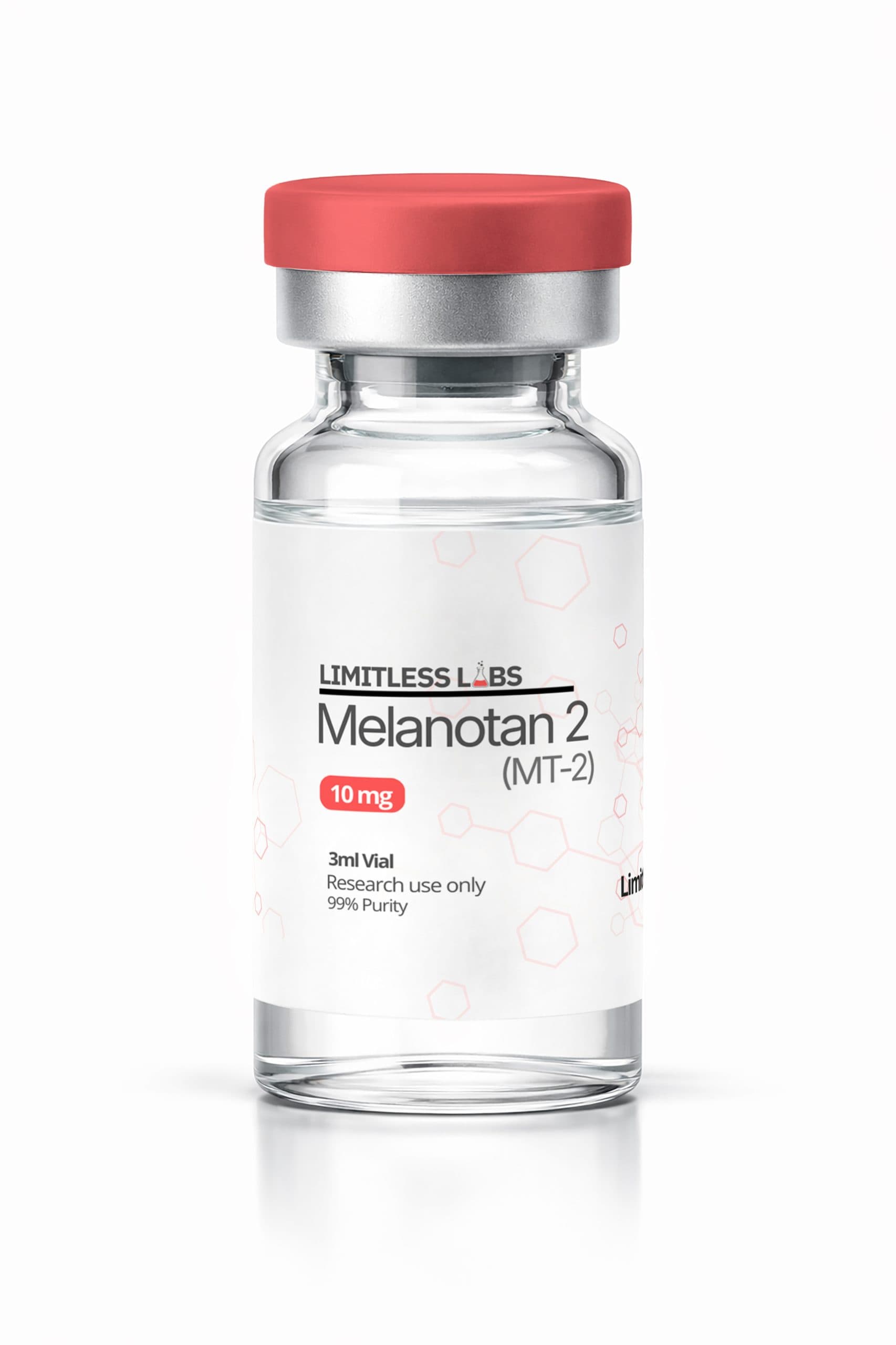
Melanotan II (MT-II) is a synthetic cyclic analog of alpha-melanocyte-stimulating hormone (α-MSH), the endogenous hormone that signals through the melanocortin receptor family to darken skin pigmentation. Unlike many peptides that circulate mainly in gray-market forums, MT-II has an unusually well-documented origin: it was developed at the University of Arizona in the 1980s-90s and carried into a handful of small, published human pilot studies exploring sunless tanning and, unexpectedly, erectile function. Those early findings are historically significant — they directly seeded the discovery pathway for two peptides that are now FDA-approved drugs: bremelanotide (Vyleesi) and afamelanotide (Scenesse). MT-II itself was never approved and never advanced through controlled late-stage trials; today it exists almost exclusively as an unregulated, internet-sourced product. Alongside the tanning and sexual-function data sits a distinct and important body of literature: case reports describing melanoma-adjacent pigmented-lesion changes, priapism, and rhabdomyolysis in people who used unregulated MT-II, plus warnings from multiple national medicines regulators. That safety-signal literature is not a footnote here — it is a central part of the research record, and this page treats it accordingly. Everything below describes published research; none of it is guidance for personal use, and MT-II is not an approved medicine anywhere.
What Is Melanotan II?
MT-II is a cyclic heptapeptide analog of α-MSH, engineered to resist enzymatic degradation and to bind melanocortin receptors with far greater potency than the native hormone. It emerged from a structure-activity program at the University of Arizona led by Victor Hruby and Mac Hadley, whose group also developed the earlier linear analog now known as afamelanotide (then Melanotan I, or NDP-α-MSH) [8]. Where afamelanotide was designed to concentrate activity at the melanocortin-1 receptor (MC1R) — the receptor primarily responsible for pigmentation — MT-II was cyclized into a non-selective agonist across the broader melanocortin receptor family (MC1R, MC3R, MC4R, MC5R) [7,8]. That lack of selectivity is the single most important fact about MT-II: it is why the compound produces skin tanning (an MC1R effect) alongside erectile responses, altered sexual motivation, and appetite suppression (MC3R/MC4R-mediated central effects) in the same dose range [3,8]. Afamelanotide and bremelanotide followed separate clinical development programs. Their approved indications do not establish equivalent efficacy or safety for MT-II.
No sponsor ever advanced MT-II through the multi-phase trial program the FDA requires for approval, and it has never been an approved drug anywhere. The cited academic trials do not verify the composition, manufacturing controls or safety of products subsequently sold under the name Melanotan II.
Mechanism of Action
Melanocortin receptor pharmacology. α-MSH and its synthetic analogs act on a family of five G protein-coupled melanocortin receptors (MC1R-MC5R), which together regulate pigmentation, adrenal steroidogenesis, energy homeostasis, exocrine secretion, and erectile responses [8]. MC1R, expressed on melanocytes, shifts melanin synthesis toward eumelanin (the darker pigment) when activated — the basis of MT-II's tanning effect. MC3R and MC4R, expressed mainly in the CNS, govern food intake, energy expenditure, and sexual arousal [3,8]; MC5R is more broadly distributed. The receptor family includes MC2R, the adrenal ACTH receptor; it should not be included among the MC1R/MC3R/MC4R/MC5R targets listed for MT-II [7,8].
Pigmentation. Activation of MC1R upregulates tyrosinase and shifts melanocyte pigment production toward eumelanin, producing skin darkening independent of UV exposure — the mechanism shared with the MC1R-selective analog afamelanotide, though human pigmentary response varies by baseline skin type and MC1R genotype [7].
Central sexual and appetite circuits. Because MT-II also engages MC3R and MC4R, it activates central circuitry later targeted deliberately by bremelanotide. Human pharmacology studies attributed MT-II's erectile effects to central (rather than local penile) melanocortin receptor activation, distinguishing its mechanism from PDE5 inhibitors, which act peripherally on vascular smooth muscle [2,3]. That same non-selectivity gives MT-II a wider adverse-effect footprint than a receptor-selective agonist carries — an explanation recurring throughout the human research on this compound [3,7,8].
Research Findings by Area
Pigmentation and the original human tanning trials
The foundational human study, published in 1996, was a single-blind, dose-escalation pilot trial in three healthy male volunteers who received subcutaneous MT-II or saline on alternating days for two consecutive weeks [1]. The trial reported dose-dependent skin tanning, alongside dose-limiting nausea, facial flushing, and — notably — spontaneous penile erections that were not the intended endpoint of a tanning study [1]. That incidental observation is the direct origin point of the sexual-function research line described below.
Erectile function, sexual motivation, and the bremelanotide lineage
Following that incidental finding, the same University of Arizona group ran dedicated erectile-function trials. In a 1998 double-blind, placebo-controlled crossover study of 10 men with psychogenic erectile dysfunction, MT-II produced clinically apparent erections in 8 of 10 subjects, with mean duration of RigiScan-measured tip rigidity above 80% of 38.0 minutes versus 3.0 minutes for placebo (p=0.0045) [2]. A subsequent study extended this to 20 men, reporting erections without sexual stimulation in 17 of 20 subjects, a mean of 41 minutes of rigidity above 80%, and increased self-reported sexual desire after 13 of 19 MT-II doses versus 4 of 21 placebo doses; nausea and yawning were the most frequent adverse effects, with severe nausea reported in roughly 13% of subjects at the highest dose studied [3].
These findings led directly to bremelanotide (originally coded PT-141), developed by Palatin Technologies as a metabolite-derived analog of MT-II — differing structurally by a hydroxyl group in place of MT-II's terminal amide [4]. Bremelanotide remains a nonselective melanocortin agonist; its FDA labeling identifies MC1R and MC4R activity as relevant and includes hyperpigmentation among its warnings. Bremelanotide went on to complete two randomized, double-blind, placebo-controlled phase 3 trials (RECONNECT) in premenopausal women with hypoactive sexual desire disorder, showing statistically significant improvement in sexual desire and desire-related distress versus placebo [5]. The FDA approved it in 2019 as Vyleesi for that indication — the first approved drug to emerge from MT-II's clinical pharmacology lineage.
The afamelanotide contrast (MC1R selectivity)
Afamelanotide (the linear analog developed alongside MT-II by the same Arizona group) took the opposite engineering path: rather than broadening receptor engagement, it was optimized to act selectively at MC1R, minimizing the central MC3R/MC4R effects that define MT-II's sexual and appetite profile [7,8]. Its clinical development targeted an entirely different indication — reducing phototoxic reactions in erythropoietic protoporphyria (EPP), a genetic condition causing severe pain on light exposure. In two multicenter, randomized, double-blind, placebo-controlled phase 3 trials, patients receiving subcutaneous afamelanotide implants accumulated substantially more pain-free time in direct sunlight than those on placebo — a median of 69.4 versus 40.8 hours in the US trial, and 6.0 versus 0.8 hours in the EU trial [6]. The FDA approved afamelanotide as Scenesse in 2019. The separate trials and approvals of these molecules should not be used to infer that MT-II is safe or effective.
Adverse-event and safety-signal literature
This is the part of MT-II's research record most relevant to anyone encountering the compound today, because unlike the tanning and erectile-function work above, it describes real-world use of unregulated, internet-sourced product rather than pharmacy-grade material under clinical supervision.
Melanocytic lesions and melanoma. Multiple published case reports describe new or changing pigmented lesions in people using unregulated MT-II: notable changes in pre-existing moles following use of an unlicensed "sun tan jab" (BMJ, 2009) [15]; eruptive dysplastic nevi following MT-II use (Actas Dermo-Sifiliográficas, 2012) [14]; a confirmed melanoma diagnosis, on histology, in a young woman whose suspicious pigmented lesion arose in the context of MT-II use (Dermatology, 2014) [9]; and, most recently, a mucosal malignant melanoma of the anterior maxilla in a woman who had used an MT-II nasal spray, raising the question of whether mucosal tissue is also a site of concern, not just skin (Int J Oral Maxillofac Surg, 2025) [10]. These are case reports — they establish temporal association and biological plausibility (MC1R activation drives melanocyte proliferation), not proven causation, and a 2024 review of chronic MC1R activation notes that pharmacological activation itself has not been associated with a measured increase in melanoma incidence, while emphasizing that dermatologic surveillance remains warranted regardless of exposure [7]. The honest summary: the mechanism is exactly the kind of biology that would raise this concern, the case-report signal recurs across independent publications, and it has not been resolved into a quantified risk estimate.
Priapism. A 2012 case series in Clinical Toxicology documented systemic toxicity in a man who self-injected 6 mg of internet-purchased MT-II — an uncontrolled exposure to an unapproved compound — presenting two hours later with tachycardia (peaking at 146 bpm), mydriasis, diaphoresis, muscle tremors, and rhabdomyolysis, with creatine phosphokinase reaching 2,622 IU/L before improving over a three-day ICU stay [11]. A related 2013 correspondence in the same journal reported a separate case of MT-II overdose associated with priapism [12]. A 2019 case report in BMJ Case Reports described a man who developed acute low-flow priapism after abdominal subcutaneous MT-II injection, managed with cavernosal aspiration, irrigation, and intracavernosal phenylephrine [13]. These reports are consistent with the central erectile-response mechanism established in the formal human trials [2,3] — the same mechanism that produces a controlled effect in supervised dosing can produce a prolonged, painful, medically urgent erection in an uncontrolled one.
Rhabdomyolysis and systemic toxicity. The 2012 Clinical Toxicology case above is the clearest published example of MT-II-associated rhabdomyolysis, occurring alongside a broader sympathomimetic-type toxidrome (tachycardia, hypertension, tremor, diaphoresis) after a substantial overdose of unregulated product [11]. This is distinct from the nausea, flushing, and yawning reported as dose-limiting effects in the controlled academic trials [1,3] — the toxicology-literature cases involve doses and severity well beyond anything observed in the supervised pilot studies.
Regulatory warnings
Regulators in multiple countries have issued public warnings specifically about unlicensed MT-II ("tan jab") products. The FDA issued a warning letter in 2007 to a US distributor for illegal marketing of Melanotan II, advising consumers to stop use and consult a healthcare provider about any suspected adverse effects. The UK's Medicines and Healthcare products Regulatory Agency (MHRA) issued a public warning about melanotan tanning injections and, in a later enforcement action, reported closing dozens of websites supplying unlicensed melanotan products after receiving reports of adverse reactions spanning gastrointestinal, cardiac, hematologic, and ocular effects. Cancer Research UK summarizes the UK position that melanotan products are unlicensed and their safety and content are uncontrolled. No national medicines regulator has approved MT-II for any use.
Limitations and Open Questions
No modern controlled human trials. All of the formal human pharmacology data on MT-II specifically (as opposed to its selective descendants) comes from small, early-stage academic studies conducted in the 1990s, involving a combined total of well under 50 subjects across the cited trials [1,2,3]. No sponsor carried MT-II itself through the larger, controlled trial program required for drug approval — that work was done instead for the two selective analogs it inspired [5,6].
Causality in the safety-signal literature is not established. The melanoma, priapism, and rhabdomyolysis reports are case reports and small case series, not controlled studies. They establish plausible, mechanistically consistent association, not a quantified attributable risk. Readers should not read "case report" as "rare and dismissible": the recurrence of independent melanoma-adjacent reports across more than a decade and multiple countries [9,10,14,15], alongside a coherent mechanism (non-selective MC1R activation drives melanocyte activity) [7,8], is a meaningful research signal even without a denominator.
Product identity and quality. Several toxicity reports describe internet-purchased material [11]. The cited trials cannot establish the identity, purity or contaminant profile of another supplier’s product, and a product name alone does not show equivalence to the experimental material.
Non-selectivity as an unresolved trade-off. MT-II's broad receptor engagement is simultaneously why it produces both a tanning effect and a sexual-arousal effect in the same molecule, and why its safety-signal profile is broader than either receptor-selective successor [3,7,8]. No published research separates these effects within MT-II itself; separation was achieved only by developing entirely different molecules.
Clinical development does not establish long-term safety. The small, early MT-II trials [1][2][3] and subsequent case reports [9][10][11] cannot establish a long-term human safety profile or substitute for a drug-approval program.
Frequently Asked Questions
Was Melanotan II tested in humans? Yes — unusual among research peptides. Academic investigators at the University of Arizona conducted small, published pilot studies of MT-II for sunless tanning and, subsequently, for erectile function, in the 1990s [1,2,3]. These remain the only formal human pharmacology studies of MT-II itself; it was never carried through a full drug-approval trial program.
Is Melanotan II the same as bremelanotide (Vyleesi/PT-141)? No, but they are closely related. Bremelanotide is a metabolite-derived, nonselective melanocortin agonist related to MT-II, and it was developed specifically because of the erectile and sexual-motivation effects observed in MT-II human trials [3,4]. Bremelanotide completed its own phase 3 program and was approved by the FDA in 2019 as Vyleesi for hypoactive sexual desire disorder in women [5].
Is Melanotan II the same as afamelanotide (Scenesse)? No. Afamelanotide is the earlier, linear MC1R-selective analog developed by the same research group, later approved by the FDA in 2019 for erythropoietic protoporphyria [6,7,8]. MT-II is the cyclic, non-selective analog developed afterward; they share an origin but diverged toward different receptors and different approved indications.
Is Melanotan II linked to melanoma? Multiple published case reports describe melanoma or melanoma-adjacent pigmented-lesion changes temporally associated with MT-II use [9,10,14,15], and the mechanism (non-selective melanocortin receptor activation, including MC1R-driven melanocyte stimulation) is biologically consistent with that concern [7,8]. This is a case-report-level signal, not a controlled epidemiological finding, but it recurs across independent reports over more than a decade and is treated seriously by regulators and dermatology literature alike.
What adverse effects have been reported with Melanotan II? In controlled academic trials: nausea, facial flushing, yawning, and spontaneous erections were the most common dose-related effects [1,3]. In the case-report literature describing unregulated product use: priapism [12,13], rhabdomyolysis with systemic sympathomimetic toxicity [11], and melanoma-adjacent pigmented-lesion changes [9,10,14,15] have all been published.
Can athletes use Melanotan II? No. As a non-approved substance, MT-II falls under Section S0 of the WADA Prohibited List, which prohibits any pharmacological substance not approved for human therapeutic use by a government health authority. It is prohibited at all times for athletes subject to anti-doping testing.
Is Melanotan II approved by any regulator? No. It has never been approved as a drug in the United States, European Union, United Kingdom, or Australia. Multiple regulators, including the FDA and the UK's MHRA, have issued public warnings about unlicensed melanotan products specifically.
References
- Dorr RT, Lines R, Levine N, Brooks C, Xiang L, Hruby VJ, Hadley ME. Evaluation of melanotan-II, a superpotent cyclic melanotropic peptide in a pilot phase-I clinical study. Life Sci. 1996;58(20):1777-1784. doi:10.1016/0024-3205(96)00160-9 — PMID: 8637402
- Wessells H, Fuciarelli K, Hansen J, Hadley ME, Hruby VJ, Dorr R, Levine N. Synthetic melanotropic peptide initiates erections in men with psychogenic erectile dysfunction: double-blind, placebo controlled crossover study. J Urol. 1998;160(2):389-393. doi:10.1016/S0022-5347(01)62903-3 — PMID: 9679884
- Wessells H, Levine N, Hadley ME, Dorr R, Hruby V. Melanocortin receptor agonists, penile erection, and sexual motivation: human studies with Melanotan II. Int J Impot Res. 2000;12(Suppl 4):S74-S79. doi:10.1038/sj.ijir.3900582 — PMID: 11035391
- Molinoff PB, Shadiack AM, Earle D, Diamond LE, Quon CY. PT-141: a melanocortin agonist for the treatment of sexual dysfunction. Ann N Y Acad Sci. 2003;994:96-102. doi:10.1111/j.1749-6632.2003.tb03167.x — PMID: 12851303
- Kingsberg SA, Clayton AH, Portman D, Williams LA, Krop J, Jordan R, Lucas J, Simon JA. Bremelanotide for the Treatment of Hypoactive Sexual Desire Disorder: Two Randomized Phase 3 Trials. Obstet Gynecol. 2019;134(5):899-908. doi:10.1097/AOG.0000000000003500 — PMID: 31599840
- Langendonk JG, Balwani M, Anderson KE, et al. Afamelanotide for Erythropoietic Protoporphyria. N Engl J Med. 2015;373(1):48-59. doi:10.1056/NEJMoa1411481 — PMID: 26132941
- Böhm M, Robert C, Malhotra S, Clément K, Farooqi S. An overview of benefits and risks of chronic melanocortin-1 receptor activation. J Eur Acad Dermatol Venereol. 2025;39(1):39-51. doi:10.1111/jdv.20269 — PMID: 39082868
- Cone RD. Studies on the physiological functions of the melanocortin system. Endocr Rev. 2006;27(7):736-749. doi:10.1210/er.2006-0034 — PMID: 17077189
- Hjuler KF, Lorentzen HF. Melanoma associated with the use of melanotan-II. Dermatology. 2014;228(1):34-36. doi:10.1159/000356389 — PMID: 24355990
- Yassin Alsabbagh A, Bhujel N, Singh RP. Melanotan II nasal spray: a possible risk factor for oral mucosal malignant melanoma? Int J Oral Maxillofac Surg. 2025;54(9):806-808. doi:10.1016/j.ijom.2025.03.014 — PMID: 40210573
- Nelson ME, Bryant SM, Aks SE. Melanotan II injection resulting in systemic toxicity and rhabdomyolysis. Clin Toxicol (Phila). 2012;50(10):1169-1173. doi:10.3109/15563650.2012.740637 — PMID: 23121206
- Devlin J, Pomerleau A, Foote J. Melanotan II overdose associated with priapism. Clin Toxicol (Phila). 2013;51(4):383. doi:10.3109/15563650.2013.784775 — PMID: 23537392
- Dreyer BA, Amer T, Fraser M. Melanotan-induced priapism: a hard-earned tan. BMJ Case Rep. 2019;12(2):e227644. doi:10.1136/bcr-2018-227644 — PMID: 30796078
- Hueso-Gabriel L, Mahiques Santos L, Terrádez Mas L, Santonja López N. Eruptive dysplastic nevi following melanotan use. Actas Dermosifiliogr. 2012;103(4):329-331. doi:10.1016/j.ad.2011.10.001 — PMID: 22425244
- Langan EA, Ramlogan D, Jamieson LA, Rhodes LE. Change in moles linked to use of unlicensed "sun tan jab". BMJ. 2009;338:b277. doi:10.1136/bmj.b277 — PMID: 19174439
This article is an educational summary of published research. It is not medical advice, and it does not describe, endorse, or recommend any use of Melanotan II in humans. Melanotan II is not an approved drug and is not licensed by any medicines regulator. Products referenced on this site are sold for laboratory research use only.