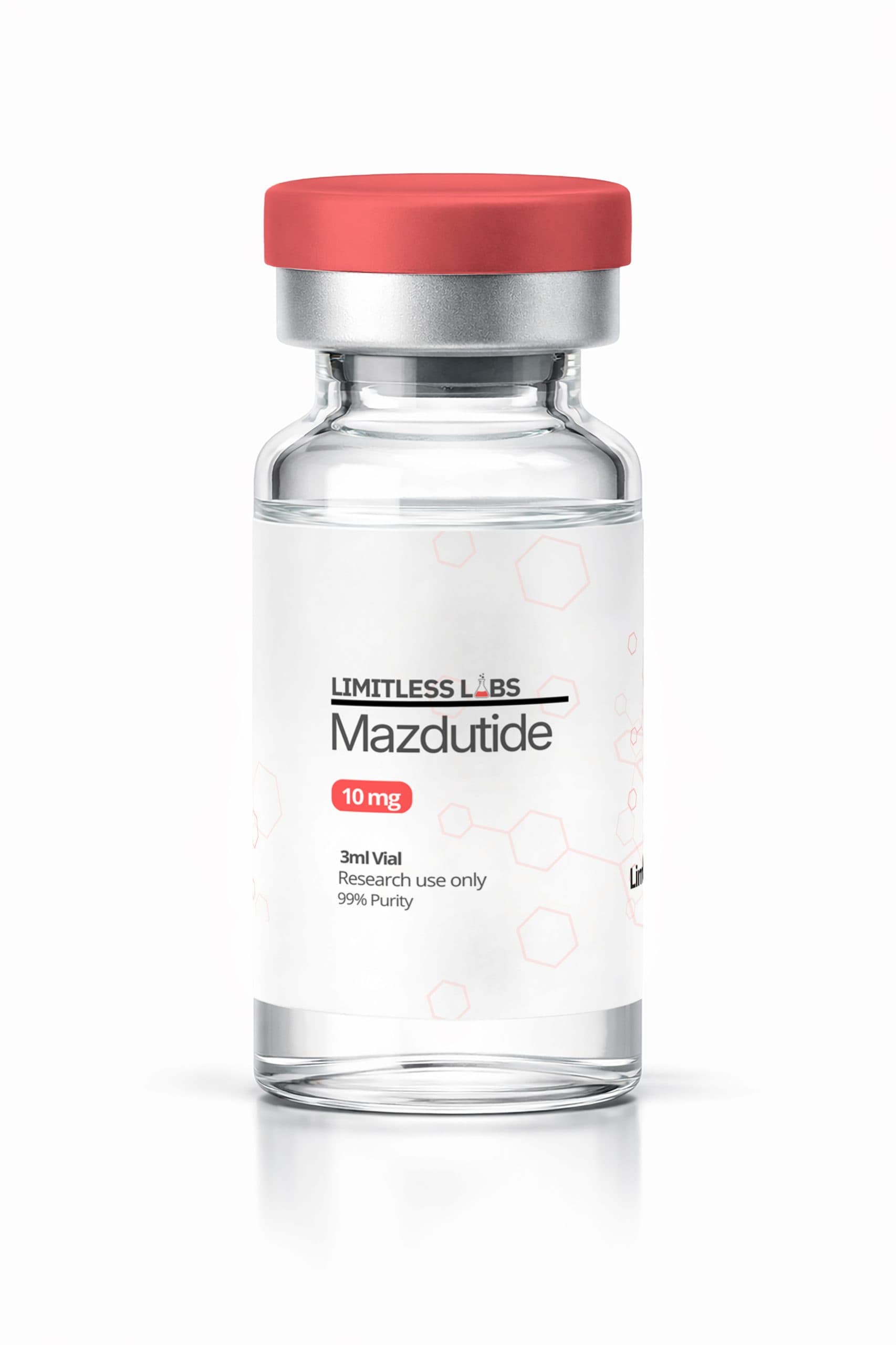
Mazdutide is a synthetic peptide that activates two metabolic hormone receptors at once — the glucagon-like peptide-1 (GLP-1) receptor and the glucagon receptor. It was discovered by Eli Lilly (as LY3305677) and licensed to Innovent Biologics, which developed it through phase 3 in China under the code IBI362 [1]. Its regulatory story is unusual for this class: mazdutide became the world's first dual glucagon/GLP-1 receptor agonist to reach the market anywhere when China's National Medical Products Administration (NMPA) approved it in June 2025 for long-term weight management [2], followed by a second Chinese approval in September 2025 for glycemic control in adults with type 2 diabetes [3]. In the pivotal GLORY-1 trial, the 6 mg dose produced a mean body-weight reduction of 14.01% at 48 weeks [4], and in the DREAMS-1 diabetes trial the same dose lowered HbA1c by 2.15 percentage points at 24 weeks [5]. In the United States, mazdutide remains investigational: it is not approved by the FDA for any use, and this article is a summary of the published scientific literature, not medical guidance.
What Is Mazdutide?
Mazdutide is a fatty-acylated analog of oxyntomodulin (OXM), a natural gut hormone released after meals that activates both the GLP-1 and glucagon receptors. Native oxyntomodulin has a half-life of minutes; mazdutide's engineered modifications, including a fatty-acid side chain that promotes albumin binding, extend its duration of action to support once-weekly subcutaneous injection in clinical trials [1]. In China it is marketed under the brand name Xinermei [1].
The development program has proceeded on two geographic tracks — Innovent's Chinese program (the source of all phase 3 data to date) and Eli Lilly's US program, which is at phase 2:
- Phase 1b (2022). A trial in 43 Chinese patients with type 2 diabetes established the safety profile of IBI362 at doses up to 6 mg, with reductions in HbA1c and fasting glucose over 12 weeks [6]. A parallel multiple-ascending-dose trial in overweight or obesity pushed dosing to 9 mg and 10 mg, reporting 12-week weight reduction of 11.7% in the 9 mg cohort versus 1.8% with placebo [7].
- Phase 2 (2023–2026). Mid-stage trials in Chinese adults with overweight/obesity [8], type 2 diabetes [9], and — in a separately reported high-dose part — obesity with BMI ≥30 treated at 9 mg [10], are detailed below.
- Phase 3 (2024–2026). The GLORY program in obesity (GLORY-1 published in the New England Journal of Medicine [4]; GLORY-2 in JAMA [11]) and the DREAMS program in type 2 diabetes (DREAMS-1 and DREAMS-2 published back-to-back in Nature [5][12]; DREAMS-3, a head-to-head against semaglutide, reported in topline form [13]) form the registrational evidence base.
- Approvals in China (2025). NMPA approval for chronic weight management in adults with a BMI ≥28, or ≥24 with at least one weight-related comorbidity, came in June 2025 [2]; approval for type 2 diabetes followed in September 2025 [3]. A supplementary application for a higher 9 mg dose in moderate-to-severe obesity was accepted for NMPA review in November 2025 [14].
Mechanism of Action
Mazdutide is a "dual agonist," and its two receptor targets pull on different levers of energy balance:
- GLP-1 receptor. Activation enhances glucose-dependent insulin secretion, suppresses inappropriate glucagon release, slows gastric emptying, and reduces appetite — the mechanism shared with semaglutide and the incretin arm of tirzepatide.
- Glucagon receptor. Glucagon receptor agonism increases hepatic energy expenditure, lipolysis, and fatty-acid oxidation, adding an "energy-output" mechanism on top of GLP-1's "energy-input" suppression. It is also the leading explanation for the large liver-fat reductions and serum uric acid changes observed in mazdutide trials, though chronic glucagon receptor activation raises questions — hepatic glucose output, amino-acid metabolism, heart-rate effects — still being worked out in the pharmacology literature [15]. The molecule's incretin activity is designed to counterbalance glucagon's glucose-raising effect [1].
The design differs from tirzepatide (GLP-1 + GIP) and overlaps with two-thirds of retatrutide (GLP-1 + GIP + glucagon). Because oxyntomodulin is itself a natural dual agonist, mazdutide is often described as a pharmacologically optimized version of a hormone the body already makes [1][15].
Research Findings by Area
Weight in participants without diabetes
The phase 2 trial randomized 248 Chinese adults with overweight or obesity to once-weekly mazdutide 3 mg, 4.5 mg, 6 mg, or placebo. Mean weight change at 24 weeks was −6.7%, −10.4%, and −11.3% across the three doses versus +1.0% with placebo (all p<0.0001) [8]. The high-dose part of the same study randomized 80 adults with BMI ≥30 to 9 mg or placebo: weight change at 24 weeks was −12.78% versus +1.80%, a treatment difference of −14.58 percentage points, with 81.7% of mazdutide participants losing at least 5% of body weight versus none on placebo [10].
GLORY-1 (NCT05607680), the first phase 3 trial, randomized 610 Chinese adults (mean baseline weight 87.2 kg, BMI 31.1) to mazdutide 4 mg, 6 mg, or placebo for 48 weeks. At week 32 (the primary timepoint), mean weight change was −10.09% (4 mg) and −12.55% (6 mg) versus +0.45% with placebo; at week 48 it reached −11.00% and −14.01% versus +0.30%. At 48 weeks, 35.7% (4 mg) and 49.5% (6 mg) of participants had lost at least 15% of body weight, versus 2.0% on placebo. Discontinuation due to adverse events was low: 1.5%, 0.5%, and 1.0% respectively [4].
GLORY-2 (NCT06164873) tested the higher 9 mg dose in 461 treated Chinese adults with moderate-to-severe obesity (mean BMI 34.3) over 60 weeks. In the treatment-policy analysis, mean weight change was −16.65% with mazdutide versus −1.50% with placebo (difference −15.15 percentage points; p<0.001), and 84.3% versus 33.1% achieved at least 5% weight reduction [11]. The company's announcement reported weight reduction of up to 20.1% in the efficacy (on-treatment) analysis [16]. Gastrointestinal events were markedly more common at this dose — vomiting in 53.1% versus 1.3% on placebo, nausea 46.9% versus 3.2%, diarrhea 39.4% versus 6.5% — though mostly mild to moderate, with 2.9% discontinuing treatment for adverse events [11].
Two Lilly-run studies extend the picture outside China. A US-based phase 2 trial (NCT06124807; 179 adults with obesity or overweight, without diabetes) tested doses up to 16 mg: least-squares mean weight change at 32 weeks was −7.3% (3–6 mg), −15.6% (10 mg), and −18.1% (16 mg) versus −0.9% with placebo, with additional reduction accruing through 48 weeks; 20% of the 16 mg group discontinued for adverse events, primarily gastrointestinal [17]. A high-dose phase 1 trial reported mean weight reduction of 20–21% at week 20 with titration to 16 mg [18].
Glycemic outcomes in type 2 diabetes
The phase 2 diabetes trial randomized 250 Chinese patients to mazdutide (3, 4.5, or 6 mg), open-label dulaglutide 1.5 mg, or placebo for 20 weeks. HbA1c fell by 1.41–1.67 percentage points with mazdutide versus 1.35 with dulaglutide and essentially no change with placebo; weight fell by up to 7.1% with mazdutide versus 2.7% with dulaglutide [9].
DREAMS-1, a phase 3 monotherapy trial, randomized 320 Chinese adults with type 2 diabetes (mean baseline HbA1c 8.24%) to mazdutide 4 mg, 6 mg, or placebo for 24 weeks. HbA1c fell 1.57 (4 mg) and 2.15 (6 mg) percentage points versus 0.14 with placebo (both p<0.0001), with weight reductions of 5.61% and 7.81% versus 1.26% [5]. DREAMS-2 randomized 731 adults on background oral therapy to mazdutide 4 mg, 6 mg, or dulaglutide 1.5 mg for 28 weeks; both mazdutide doses were superior to dulaglutide on HbA1c (treatment differences −0.24 and −0.30 percentage points) and on weight (−3.78 and −5.76 percentage points) [12].
DREAMS-3 (NCT06184568) is the head-to-head that draws the most attention: 349 Chinese adults with early type 2 diabetes and obesity randomized to mazdutide 6 mg or semaglutide 1 mg for 32 weeks. Per the October 2025 topline announcement, 48.0% of mazdutide participants versus 21.0% on semaglutide achieved the composite of HbA1c below 7.0% plus at least 10% weight reduction (p<0.0001); mean HbA1c change was −2.03 versus −1.84 percentage points and mean weight change −10.29% versus −6.00% [13]. Full publication is pending, and the comparator was semaglutide's 1 mg diabetes dose, not the higher weight-management dose.
Liver and metabolic findings
In GLORY-1, prespecified analyses in participants with elevated baseline liver fat showed large imaging-based reductions at 48 weeks: among those with baseline liver-fat content ≥10%, relative reduction averaged 65.85% (4 mg) and 80.24% (6 mg) versus 5.27% with placebo; in the ≥5% subgroup, reductions were 63.26% and 73.18% versus an 8.20% increase on placebo [19]. Waist circumference fell by 9.48 cm and 10.96 cm versus 1.48 cm with placebo, and trials across the program have reported improvements in blood pressure, triglycerides, transaminases, and serum uric acid — the last being a repeated, distinctive observation in mazdutide studies attributed to the glucagon arm of its mechanism [4][8][19]. Mean heart rate increased by about 2.6 beats per minute in both GLORY-1 mazdutide groups [19]. Innovent has stated that mazdutide is also under study for metabolic dysfunction-associated fatty liver disease, obstructive sleep apnea, and alcohol use disorder [1]; those trials have not read out in the peer-reviewed literature.
Regulatory geography
Mazdutide's approvals are, so far, Chinese only. The NMPA approved it for chronic weight management in June 2025 [2] and for type 2 diabetes in September 2025 [3], with the 9 mg obesity dose under review as of late 2025 [14]. The FDA has not approved mazdutide for any indication; the US program, run by Eli Lilly, is at phase 2, and no US phase 3 results have been published at the time of writing [17].
Limitations & Open Questions in the Literature
- Population generalizability. All phase 3 data come from Chinese participants, whose baseline BMI ran lower than in Western obesity trials (GLORY-1 mean 31.1 [4]); the single published US trial is phase 2 with 179 participants [17]. How efficacy translates across populations is not settled.
- Regulatory asymmetry. Approved in China for two indications [2][3]; investigational everywhere else. Chinese approval does not imply FDA review of the same data.
- Estimand differences. Headline figures depend on the analysis: GLORY-2's treatment-policy estimate was −16.65% while the on-treatment figure was up to −20.1% [11][16].
- Topline-only results. DREAMS-3 exists, at this writing, as a company announcement without a full peer-reviewed dataset [13].
- Tolerability at higher doses. Gastrointestinal adverse events scale with dose — vomiting reached 53.1% at 9 mg in GLORY-2 [11], and 20% of 16 mg participants in the US phase 2 discontinued for adverse events [17]. Heart-rate increases of roughly 2–3 beats per minute were observed [19].
- No outcomes trial. No cardiovascular or kidney outcomes trial has been reported; effects on hard endpoints are unknown.
- Durability. Trials extend to 60 weeks [11]; trajectories after discontinuation have not been characterized.
- Liver endpoints are imaging-based. The liver-fat findings use MRI-derived fat content, not biopsy-confirmed steatohepatitis or fibrosis outcomes [19].
- Comparator gaps. The semaglutide head-to-head used the 1 mg dose [13]; no head-to-head against tirzepatide or higher-dose semaglutide has been published.
Frequently Asked Questions
What is mazdutide, in one sentence? A once-weekly oxyntomodulin-analog peptide that activates both the GLP-1 and glucagon receptors, developed by Innovent Biologics under license from Eli Lilly and studied for obesity and type 2 diabetes [1].
Is mazdutide approved anywhere? Yes — in China, for chronic weight management (June 2025) and for type 2 diabetes (September 2025) [2][3]. It is not approved by the FDA.
How does it differ from semaglutide and tirzepatide? Semaglutide targets GLP-1 alone and tirzepatide pairs GLP-1 with GIP; mazdutide instead pairs GLP-1 with glucagon receptor agonism — an energy-expenditure and liver-directed mechanism rather than a second incretin [1][15].
How much weight change has been reported in trials? Mean reductions of 14.01% at 48 weeks at 6 mg in GLORY-1 [4], 16.65% at 60 weeks at 9 mg in GLORY-2 (up to 20.1% on treatment) [11][16], and 18.1% at 32 weeks at 16 mg in a US phase 2 trial [17].
How did it compare with semaglutide head-to-head? In topline DREAMS-3 results, mazdutide 6 mg was superior to semaglutide 1 mg on a composite of glycemic control plus ≥10% weight reduction (48.0% vs 21.0% of participants) — caveats being that the data are not yet peer-reviewed and the comparator was semaglutide's diabetes dose [13].
What were the most common adverse events in trials? Dose-related gastrointestinal effects — nausea, vomiting, diarrhea, decreased appetite — mostly mild to moderate, plus small mean heart-rate increases [4][8][11][19].
What did the liver research show? In GLORY-1 participants with baseline liver fat of 10% or more, the 6 mg dose reduced liver-fat content by an average of about 80% at 48 weeks on imaging, alongside improvements in transaminases and serum uric acid [19].
What major questions remain unanswered? Efficacy in non-Chinese populations at phase 3 scale, cardiovascular and kidney outcomes, post-discontinuation durability, biopsy-confirmed liver effects, and performance against tirzepatide or high-dose semaglutide [11][13][17][19].
References
- Shirley M. Mazdutide: First Approval. Drugs. 2025;85(12):1621–1627. doi:10.1007/s40265-025-02249-y. PMID: 41028652
- Innovent Biologics. Innovent Announces Mazdutide, First Dual GCG/GLP-1 Receptor Agonist, Received Approval from China's NMPA for Chronic Weight Management. Press release, June 27, 2025. https://www.prnewswire.com/news-releases/innovent-announces-mazdutide-first-dual-gcgglp-1-receptor-agonist-received-approval-from-chinas-nmpa-for-chronic-weight-management-302493152.html
- Innovent Biologics. Innovent Announces Mazdutide Received Approval from China's NMPA for Glycemic Control in Adults with Type 2 Diabetes. Press release, September 2025. https://www.prnewswire.com/news-releases/innovent-announces-mazdutide-received-approval-from-chinas-nmpa-for-glycemic-control-in-adults-with-type-2-diabetes-302561434.html
- Ji L, et al. Once-Weekly Mazdutide in Chinese Adults with Obesity or Overweight (GLORY-1). N Engl J Med. 2025;392(22):2215–2225. doi:10.1056/NEJMoa2411528. PMID: 40421736
- Zhu D, et al. Mazdutide versus placebo in Chinese adults with type 2 diabetes (DREAMS-1). Nature. 2026;652(8108):174–180. doi:10.1038/s41586-025-10026-w. PMID: 41407859
- Jiang H, et al. A phase 1b randomised controlled trial of a glucagon-like peptide-1 and glucagon receptor dual agonist IBI362 (LY3305677) in Chinese patients with type 2 diabetes. Nat Commun. 2022;13(1):3613. doi:10.1038/s41467-022-31328-x. PMID: 35750681
- Ji L, et al. Safety and efficacy of a GLP-1 and glucagon receptor dual agonist mazdutide (IBI362) 9 mg and 10 mg in Chinese adults with overweight or obesity: A randomised, placebo-controlled, multiple-ascending-dose phase 1b trial. EClinicalMedicine. 2022;54:101691. doi:10.1016/j.eclinm.2022.101691. PMID: 36247927
- Ji L, et al. A phase 2 randomised controlled trial of mazdutide in Chinese overweight adults or adults with obesity. Nat Commun. 2023;14(1):8289. doi:10.1038/s41467-023-44067-4. PMID: 38092790
- Zhang B, et al. Efficacy and Safety of Mazdutide in Chinese Patients With Type 2 Diabetes: A Randomized, Double-Blind, Placebo-Controlled Phase 2 Trial. Diabetes Care. 2024;47(1):160–168. doi:10.2337/dc23-1287. PMID: 37943529
- Ji L, et al. Mazdutide 9 mg in Chinese adults with a body mass index ≥30 kg/m² but without diabetes: A phase 2 randomized controlled trial. Med. 2026;7(5):101063. doi:10.1016/j.medj.2026.101063. PMID: 41875890
- Gao L, et al. Treatment With 9-mg Mazdutide for Weight Reduction in Chinese Adults With Obesity: The GLORY-2 Randomized Clinical Trial. JAMA. 2026;336(5):377–388. doi:10.1001/jama.2026.8142. PMID: 42251595
- Guo L, et al. Mazdutide versus dulaglutide in Chinese adults with type 2 diabetes (DREAMS-2). Nature. 2026;652(8108):181–188. doi:10.1038/s41586-025-10031-z. PMID: 41407860
- Innovent Biologics. Innovent's Mazdutide Shows Superiority in Glycemic Control with Weight Loss over Semaglutide in a Head-to-head Phase 3 Clinical Trial DREAMS-3. Press release, October 26, 2025. https://www.prnewswire.com/news-releases/innovents-mazdutide-shows-superiority-in-glycemic-control-with-weight-loss-over-semaglutide-in-a-head-to-head-phase-3-clinical-trial-dreams-3-302594633.html
- Innovent Biologics. Mazdutide 9mg Supplementary Application Accepted for Review by China's NMPA. Press release, November 2025. https://www.prnewswire.com/news-releases/mazdutide-9mg-supplementary-application-accepted-for-review-by-chinas-nmpa-potentially-offering-a-novel-drug-option-for-moderate-to-severe-obese-population-302625421.html
- Elmendorf AJ, et al. IUPHAR review: From foe to friend: Repurposing glucagon to treat obesity and type 2 diabetes. Pharmacol Res. 2026;223:108077. doi:10.1016/j.phrs.2025.108077. PMID: 41478576
- Innovent Biologics. Mazdutide 9 mg Achieves Up to 20.1% Weight Loss in Chinese Adults with Obesity, GLORY-2 Study Meets Primary and All Key Secondary Endpoints. Press release, November 2025. https://www.prnewswire.com/news-releases/mazdutide-9-mg-achieves-up-to-20-1-weight-loss-in-chinese-adults-with-obesity-glory-2-study-meets-primary-and-all-key-secondary-endpoints-302620471.html
- Hsia SH, et al. Efficacy and safety of mazdutide in adults with obesity or overweight: a US-based, multicentre, phase 2, randomised, placebo-controlled clinical trial. Lancet Diabetes Endocrinol. 2026. doi:10.1016/S2213-8587(26)00160-9. PMID: 42628555
- Bhattachar SN, et al. Mazdutide reduces body weight in adults with overweight or obesity: A high-dose Phase 1 trial. Diabetes Obes Metab. 2025;27(11):6460–6469. doi:10.1111/dom.70040. PMID: 40832785
- Innovent Biologics. Phase 3 Clinical Study of Mazdutide in Chinese Adults with Overweight or Obesity (GLORY-1) Published in The New England Journal of Medicine. Press release, May 2025. https://www.prnewswire.com/news-releases/phase-3-clinical-study-of-mazdutide-in-chinese-adults-with-overweight-or-obesity-glory-1-published-in-the-new-england-journal-of-medicine-nejm-302464859.html
This article summarizes published scientific literature for educational purposes only. Mazdutide is approved in China for chronic weight management and type 2 diabetes; in the United States it is an investigational compound that is not approved by the FDA for any use. Nothing here constitutes medical advice, and no statement has been evaluated by the FDA.