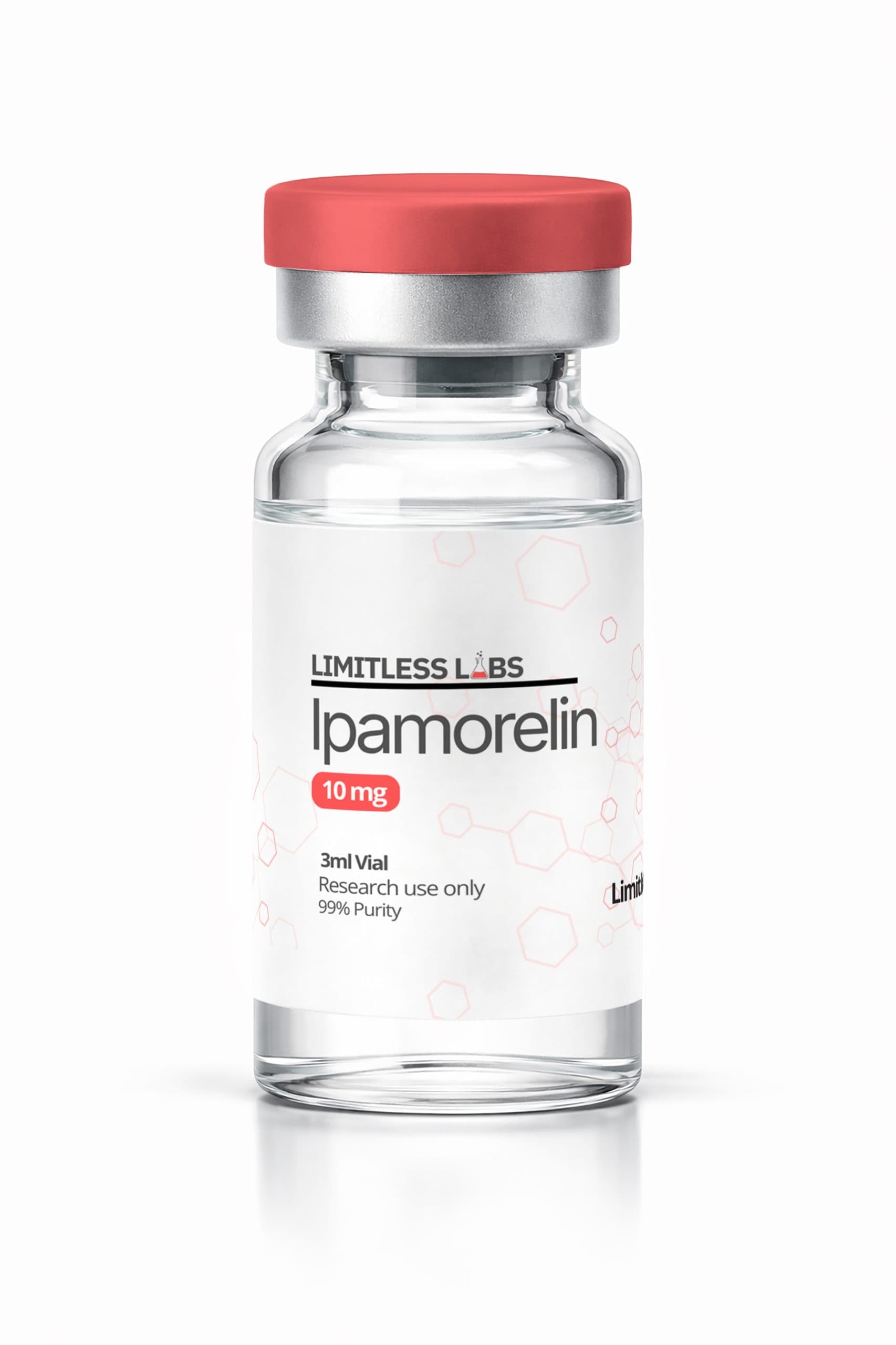
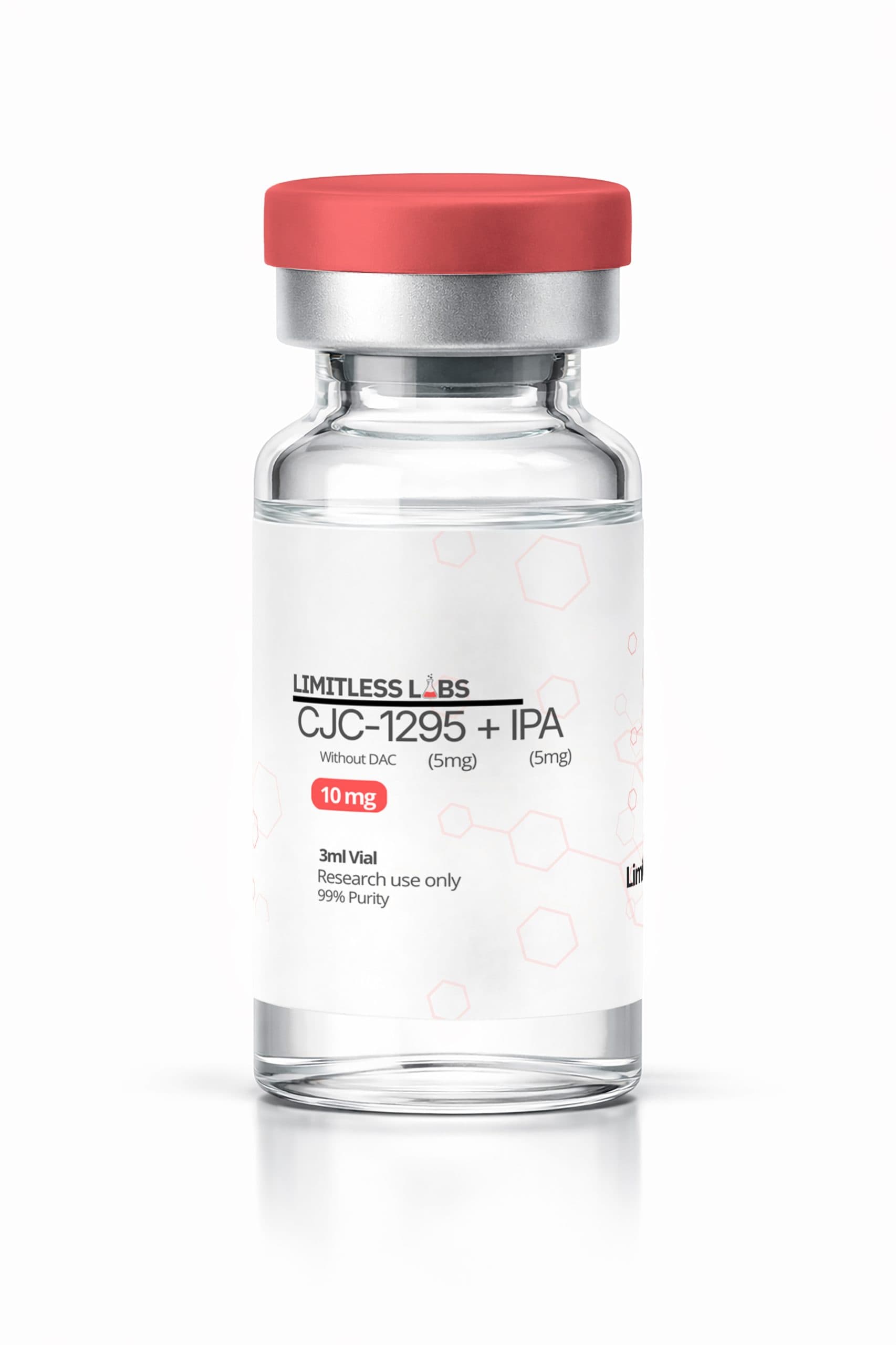
Ipamorelin is a synthetic five-amino-acid peptide (Aib-His-D-2-Nal-D-Phe-Lys-NH2) developed in the 1990s by Novo Nordisk as a growth hormone secretagogue — a molecule that stimulates the pituitary gland to release growth hormone (GH) by acting on the ghrelin receptor. It is best known in the scientific literature for one specific finding: unlike the older growth-hormone-releasing peptides (GHRPs) it was derived from, ipamorelin released GH in animal studies without meaningfully raising cortisol, ACTH, or prolactin — a selectivity profile that made it a notable research tool and a one-time clinical candidate. The evidence base here is smaller and more mixed than for many other research peptides: there is a real, if dated, human pharmacokinetic study, a completed phase 2 clinical trial that did not meet its efficacy endpoint, and a moderate rodent and cell-culture literature on bone and glucocorticoid-induced catabolic states. Readers should note plainly that ipamorelin has no approved medical use, that its one publicly documented human efficacy trial was negative, and that its clinical development program appears to have been discontinued. Everything summarized below should be read as a description of what has been published, not as evidence of any effect in humans generally.
What Is Ipamorelin?
Ipamorelin belongs to a class of compounds called growth hormone-releasing peptides (GHRPs), synthetic molecules unrelated in structure to growth hormone-releasing hormone (GHRH) that nonetheless stimulate GH secretion. It was identified by Novo Nordisk researchers during a chemistry program that removed the central Ala-Trp dipeptide from an earlier GHRP-1 scaffold, and its pharmacology was first described in a 1998 paper by Raun and colleagues [3]. It is chemically and pharmacologically distinct from the endogenous hormone ghrelin, which was isolated and characterized the following year [1], though both act at the same receptor.
Ipamorelin was studied through the late 1990s and 2000s largely by the Novo Nordisk group and a small number of academic collaborators in Denmark, with additional work from independent groups in the United States investigating gastrointestinal motility. Its most consequential clinical use case was as a candidate treatment for postoperative ileus (temporary bowel paralysis after abdominal surgery), a program that reached a randomized phase 2 human trial before appearing to end without further published development [6].
Mechanism of Action
The ghrelin receptor (GHS-R1a). Growth hormone secretagogues like ipamorelin act on the growth hormone secretagogue receptor, a G-protein-coupled receptor identified in the pituitary and hypothalamus by Howard and colleagues in 1996 [2]. The receptor's natural ligand, ghrelin — an acylated peptide produced mainly in the stomach — was isolated three years later [1]. Ipamorelin functions as a synthetic agonist at this receptor, using a pharmacological pathway that is mechanistically distinct from the GHRH receptor pathway used by GHRH analogs such as sermorelin, tesamorelin, or CJC-1295.
The defining selectivity finding. The central pharmacological claim about ipamorelin comes from the original 1998 characterization study. Raun and colleagues compared ipamorelin against GHRP-6 and GHRP-2 in rat pituitary cell cultures, anesthetized rats, and conscious pigs. In vitro, ipamorelin released GH with potency and efficacy similar to GHRP-6; in vivo in pigs, its GH-releasing dose-response curve was also comparable to GHRP-6, while GHRP-2 was more potent but less efficacious. The distinguishing result was in the hormone specificity testing: administration of GHRP-6 and GHRP-2 in pigs raised plasma ACTH and cortisol, but ipamorelin did not raise these hormones to a level significantly different from GHRH stimulation alone — even at doses more than 200-fold above the dose needed for half-maximal GH release. None of the three compounds affected FSH, LH, prolactin, or TSH. The authors concluded that ipamorelin was "the first GHRP-receptor agonist with a selectivity for GH release similar to that displayed by GHRH" [3]. This single study is the source of essentially every subsequent reference to ipamorelin's "selectivity," and it has not been substantially repeated by an independent laboratory in the published literature located for this article.
Why it is often discussed alongside GHRH analogs. Because GHS-R1a and the GHRH receptor are separate receptors operating through different intracellular signaling pathways, the broader GHRP class has a documented history of interacting with GHRH pharmacologically. A widely cited 1997 review of growth hormone-releasing peptides concluded that "the GH-releasing activity of GHRPs is synergistic with that of GHRH" — a class-level finding drawn from studies of earlier GHRPs (principally GHRP-6), not ipamorelin specifically [4]. This is the mechanistic basis researchers cite for pairing a ghrelin-receptor agonist with a GHRH analog: two distinct receptor systems converging on the same downstream output (pituitary GH release). It is worth being precise about what is and is not established here — the class-level synergy finding is published, but no controlled study identified for this article has directly tested and reported a synergistic interaction between ipamorelin and a specific GHRH analog such as CJC-1295. The pairing rationale is mechanistic and inferred from adjacent literature, not a demonstrated combination effect for this specific pair.
Research Findings by Area
Growth hormone release and endocrine specificity
Beyond the original selectivity study [3], a smaller follow-up line of work examined the pituitary cell population itself. In young female rats given ipamorelin for 21 days, chronic treatment increased the volume density of GH secretory granules in somatotroph cells and altered how somatotroph cells responded to acute ipamorelin, GHRP-6, or GHRH challenge in vitro, without changing the overall proportion of somatotroph cells in culture [14]. This is cell-biology characterization work, not a demonstration of any downstream physiological effect.
Human pharmacokinetics and pharmacodynamics
The only published human dataset on ipamorelin's disposition and hormone response comes from a 1999 dose-escalation study in 40 healthy male volunteers (eight per dose group), using five intravenous infusion rates from 4.21 to 140.45 nmol/kg over 15 minutes. Ipamorelin showed dose-proportional pharmacokinetics with a short terminal half-life of about 2 hours, a clearance of 0.078 L/h/kg, and a steady-state volume of distribution of 0.22 L/kg. GH release followed each dose as a single, self-limited pulse peaking around 40 minutes post-infusion and returning to baseline within a few hours; a population PK/PD model estimated the plasma concentration needed for half-maximal GH stimulation at 214 nmol/L [5]. No published study identified for this article has followed up with repeat-dose human PK/PD data, dosing in women, or characterization outside this single healthy-volunteer cohort.
The postoperative ileus program — including its failure
This is the compound's most complete pipeline from bench to bedside, and the outcome is a useful, honest data point. Two rodent studies established the preclinical rationale. Venkova and colleagues (2009) found that in a rat surgical model of postoperative ileus, a single intravenous dose of ipamorelin (or GHRP-6) shortened the time to the first postsurgical bowel movement, while a repeated dosing schedule over two days additionally increased cumulative fecal output, food intake, and weight gain [7]. A 2012 study by Greenwood-Van Meerveld and colleagues — co-authored with Helsinn Healthcare SA, the company that would go on to sponsor the human trial — found that intravenous ipamorelin accelerated gastric emptying in a rat model of postsurgical gastroparesis and reversed the surgery-induced suppression of gastric smooth-muscle contractility in isolated tissue [8].
That preclinical signal supported a phase 2 human trial. Beck and colleagues, reporting for the "Ipamorelin 201 Study Group" (ClinicalTrials.gov NCT00672074), ran a multicenter, double-blind, placebo-controlled study in 117 adults undergoing open or laparoscopic bowel resection. Patients received intravenous ipamorelin or placebo twice daily from the first postoperative day through day 7 or discharge. The trial was well tolerated — adverse event rates were similar between groups (87.5% ipamorelin vs. 94.8% placebo) — but it did not meet its efficacy goal. The primary endpoint, time to tolerance of a solid meal, was numerically shorter with ipamorelin (median 25.3 hours vs. 32.6 hours with placebo) but the difference was not statistically significant (p = 0.15), and the authors reported no significant differences on secondary efficacy measures either [6]. No subsequent phase 3 trial or regulatory filing for this indication appears in the published literature or trial registries reviewed for this article; the program appears to have ended at this proof-of-concept stage.
Bone
A cluster of rodent studies from the late 1990s and 2000s examined ipamorelin's relationship to skeletal growth and remodeling. In adult female rats dosed subcutaneously for 15 days, ipamorelin dose-dependently increased longitudinal bone growth rate at the tibial growth plate (measured by tetracycline labeling) and increased body weight gain, without changing total IGF-I levels or standard serum markers of bone formation and resorption [9]. In a separate 12-week study using continuous subcutaneous infusion in adult female rats, both ipamorelin and GHRP-6 increased bone mineral content measured by DXA, comparable to a GH-treated group; follow-up analysis attributed this to increased bone size and cross-sectional area rather than a change in volumetric bone mineral density [10]. In a rat model of glucocorticoid-induced bone loss, three months of ipamorelin co-administration with methylprednisolone was associated with a four-fold increase in periosteal bone formation rate compared with glucocorticoid alone, alongside improved calf muscle tetanic tension [11].
Catabolic and glucocorticoid-treated states
Related rodent work examined whether ipamorelin could offset the muscle-wasting and nitrogen-wasting effects of glucocorticoid treatment — a rationale for studying GH secretagogues in catabolic states generally. In rats given methylprednisolone, co-administration of ipamorelin was associated with reduced surgical-recovery weight loss and increased circulating IGF-I compared with glucocorticoid alone [12]. In a separate prednisolone-treated rat model, ipamorelin partially reversed the glucocorticoid-driven increase in hepatic urea-nitrogen synthesis and improved whole-body nitrogen balance, though the effect was smaller than that produced by growth hormone itself at the doses tested [13].
Gastrointestinal motility and weight loss beyond postoperative ileus
A more recent (2024) study extended ghrelin-receptor agonism to chemotherapy-associated weight loss. In ferrets given cisplatin, both ipamorelin and the related GHS-R1a agonist anamorelin attenuated the delayed-phase weight loss associated with chemotherapy by roughly a quarter, and ipamorelin reversed cisplatin-associated impairment of ileal smooth-muscle contraction in isolated tissue; unlike anamorelin, ipamorelin showed no effect on chemotherapy-induced nausea/vomiting behavior in this model [15]. This is a single preclinical study and has not been followed by a published human trial in oncology populations.
Limitations & Open Questions
Its one human efficacy trial did not succeed. The phase 2 postoperative ileus study is the only controlled human efficacy trial for ipamorelin identified in the published literature, and it did not demonstrate a statistically significant benefit on its primary or secondary endpoints [6]. No further clinical trials in this or any other indication appear to have followed. Any claim that ipamorelin "works" in humans for a specific outcome is not supported by the available controlled evidence.
Human data are otherwise limited to one small pharmacokinetic study. The 1999 dose-escalation study characterized disposition and acute GH response in 40 healthy men and has not, as far as this review could establish, been repeated or extended to other populations [5]. There is no published long-term human safety, immunogenicity, or repeat-dosing data.
The evidence base is preclinical and concentrated among a small number of laboratories. Most of what is known about ipamorelin's effects on bone, catabolic states, and endocrine selectivity comes from the originating Novo Nordisk group and a handful of Danish academic collaborators, using rodent or porcine models. Independent replication outside this network is thin, and the 2012–2024 gastrointestinal work involving Helsinn Healthcare represents the main exception [7,8,15].
The GHRH-pairing rationale is inferred, not demonstrated for this specific combination. The mechanistic case for combining a ghrelin-receptor agonist with a GHRH analog rests on class-level synergy data collected with older GHRPs such as GHRP-6, described in reviews from the 1990s [4]. No controlled study located for this article has directly tested ipamorelin paired with a specific GHRH analog and reported the combined outcome.
Regulatory and market status. Ipamorelin is not an approved drug for any indication anywhere. The FDA’s safety-risk page distinguishes the withdrawn 503A nomination from the separate 503B Category 2 listing for ipamorelin acetate. Withdrawal of a nomination is not drug approval or a safety clearance. In sport, ipamorelin falls under Section S2 (Peptide Hormones, Growth Factors, Related Substances and Mimetics) of the WADA Prohibited List as a growth hormone secretagogue, prohibited at all times, in and out of competition. A 2026 narrative review notes that ipamorelin and related GH secretagogues circulate widely as unregulated "research compounds" outside any clinical or regulatory framework, with reported adverse effects across the class including endocrine disturbances, fluid retention, and musculoskeletal symptoms in people self-administering these substances outside of research settings [16].
Frequently Asked Questions
Has ipamorelin been tested in humans? Yes, in two published contexts: a 1999 pharmacokinetic/pharmacodynamic dose-escalation study in 40 healthy male volunteers [5], and a phase 2 randomized, placebo-controlled trial in 117 patients recovering from bowel surgery, which did not meet its primary or secondary efficacy endpoints [6]. No other published controlled human studies were identified.
What made ipamorelin different from earlier growth hormone-releasing peptides? In its original 1998 characterization, ipamorelin released growth hormone with potency similar to GHRP-6 but, unlike GHRP-6 and GHRP-2, did not significantly raise ACTH or cortisol at doses far above what was needed for GH release [3]. This selectivity — not raising the stress-hormone axis alongside GH — is the compound's defining pharmacological finding.
What happened to ipamorelin's clinical development? It was studied by Helsinn Healthcare as a candidate treatment for postoperative ileus, supported by rodent GI-motility data [7,8]. A phase 2 proof-of-concept trial in bowel-resection patients was completed and published in 2014; it found no statistically significant difference from placebo on time to tolerating a solid meal [6]. No subsequent trial or regulatory filing for this or any other indication has been published.
Is ipamorelin approved by the FDA? No. It has never been approved as a drug for any indication. The withdrawn 503A nomination and separate 503B Category 2 listing should not be conflated; neither establishes drug approval.
Can athletes use ipamorelin? No. It is classified under Section S2 of the WADA Prohibited List as a growth hormone secretagogue and is prohibited at all times.
Why is ipamorelin often discussed alongside GHRH analogs like CJC-1295? Because ghrelin-receptor agonists and GHRH analogs act through two distinct receptors that converge on the same pituitary output, and a 1997 review reported that the wider GHRP class shows GH-release synergy with GHRH [4]. That is a mechanistic and class-level rationale, not a demonstrated result for ipamorelin combined with any specific GHRH analog.
Is ipamorelin the same as ghrelin? No. Ghrelin is the endogenous hormone that activates the GHS-R1a receptor naturally [1]; ipamorelin is a synthetic pentapeptide designed to activate the same receptor with a different selectivity profile. They are related by receptor target, not by structure.
References
- Kojima M, Hosoda H, Date Y, Nakazato M, Matsuo H, Kangawa K. Ghrelin is a growth-hormone-releasing acylated peptide from stomach. Nature. 1999;402(6762):656-660. doi:10.1038/45230 — PMID: 10604470
- Howard AD, Feighner SD, Cully DF, et al. A receptor in pituitary and hypothalamus that functions in growth hormone release. Science. 1996;273(5277):974-977. doi:10.1126/science.273.5277.974 — PMID: 8688086
- Raun K, Hansen BS, Johansen NL, et al. Ipamorelin, the first selective growth hormone secretagogue. Eur J Endocrinol. 1998;139(5):552-561. doi:10.1530/eje.0.1390552 — PMID: 9849822
- Ghigo E, Arvat E, Muccioli G, Camanni F. Growth hormone-releasing peptides. Eur J Endocrinol. 1997;136(5):445-460. doi:10.1530/eje.0.1360445 — PMID: 9186261
- Gobburu JV, Agersø H, Jusko WJ, Ynddal L. Pharmacokinetic-pharmacodynamic modeling of ipamorelin, a growth hormone releasing peptide, in human volunteers. Pharm Res. 1999;16(9):1412-1416. doi:10.1023/a:1018955126402 — PMID: 10496658
- Beck DE, Sweeney WB, McCarter MD; Ipamorelin 201 Study Group. Prospective, randomized, controlled, proof-of-concept study of the Ghrelin mimetic ipamorelin for the management of postoperative ileus in bowel resection patients. Int J Colorectal Dis. 2014;29(12):1527-1534. doi:10.1007/s00384-014-2030-8 — PMID: 25331030
- Venkova K, Mann W, Nelson R, Greenwood-Van Meerveld B. Efficacy of ipamorelin, a novel ghrelin mimetic, in a rodent model of postoperative ileus. J Pharmacol Exp Ther. 2009;329(3):1110-1116. doi:10.1124/jpet.108.149211 — PMID: 19289567
- Greenwood-Van Meerveld B, Tyler K, Mohammadi E, Pietra C. Efficacy of ipamorelin, a ghrelin mimetic, on gastric dysmotility in a rodent model of postoperative ileus. J Exp Pharmacol. 2012;4:149-155. doi:10.2147/JEP.S35396 — PMID: 27186127
- Johansen PB, Nowak J, Skjaerbaek C, Flyvbjerg A, Andreassen TT, Wilken M, Orskov H. Ipamorelin, a new growth-hormone-releasing peptide, induces longitudinal bone growth in rats. Growth Horm IGF Res. 1999;9(2):106-113. doi:10.1054/ghir.1999.9998 — PMID: 10373343
- Svensson J, Lall S, Dickson SL, et al. The GH secretagogues ipamorelin and GH-releasing peptide-6 increase bone mineral content in adult female rats. J Endocrinol. 2000;165(3):569-577. doi:10.1677/joe.0.1650569 — PMID: 10828840
- Andersen NB, Malmlöf K, Johansen PB, Andreassen TT, Ørtoft G, Oxlund H. The growth hormone secretagogue ipamorelin counteracts glucocorticoid-induced decrease in bone formation of adult rats. Growth Horm IGF Res. 2001;11(5):266-272. doi:10.1054/ghir.2001.0239 — PMID: 11735244
- Malmlöf K, Johansen PB, Haahr PM, Wilken M, Oxlund H. Methylprednisolone does not inhibit the release of growth hormone after intravenous injection of a novel growth hormone secretagogue in rats. Growth Horm IGF Res. 1999;9(6):445-450. doi:10.1054/ghir.1999.0128 — PMID: 10629165
- Aagaard NK, Grøfte T, Greisen J, Malmlöf K, Johansen PB, Grønbaek H, Ørskov H, Tygstrup N, Vilstrup H. Growth hormone and growth hormone secretagogue effects on nitrogen balance and urea synthesis in steroid treated rats. Growth Horm IGF Res. 2009;19(5):426-431. doi:10.1016/j.ghir.2009.01.001 — PMID: 19231263
- Jiménez-Reina L, Cañete R, de la Torre MJ, Bernal G. Influence of chronic treatment with the growth hormone secretagogue Ipamorelin, in young female rats: somatotroph response in vitro. Histol Histopathol. 2002;17(3):707-714. doi:10.14670/HH-17.707 — PMID: 12168778
- Lu Z, Ngan MP, Liu JYH, Yang L, Tu L, Chan SW, Giuliano C, Lovati E, Pietra C, Rudd JA. The growth hormone secretagogue receptor 1a agonists, anamorelin and ipamorelin, inhibit cisplatin-induced weight loss in ferrets: Anamorelin also exhibits anti-emetic effects via a central mechanism. Physiol Behav. 2024;284:114644. doi:10.1016/j.physbeh.2024.114644 — PMID: 39043357
- Dominikowski A, Rękoś Z, Olejarz M, Szczepanek-Parulska E, Domin R, Ruchała M. The emerging landscape of performance-enhancing peptides modulating GH-IGF1 axis: bridging the gap between clinical evidence and patient self-administration. Front Endocrinol (Lausanne). 2026;17:1822475. doi:10.3389/fendo.2026.1822475 — PMID: 42395176
This article is an educational summary of published research. It is not medical advice, and it does not describe, endorse, or recommend any use of Ipamorelin in humans. Ipamorelin is not an approved drug, and its one published clinical efficacy trial did not meet its endpoints. Products referenced on this site are sold for laboratory research use only.