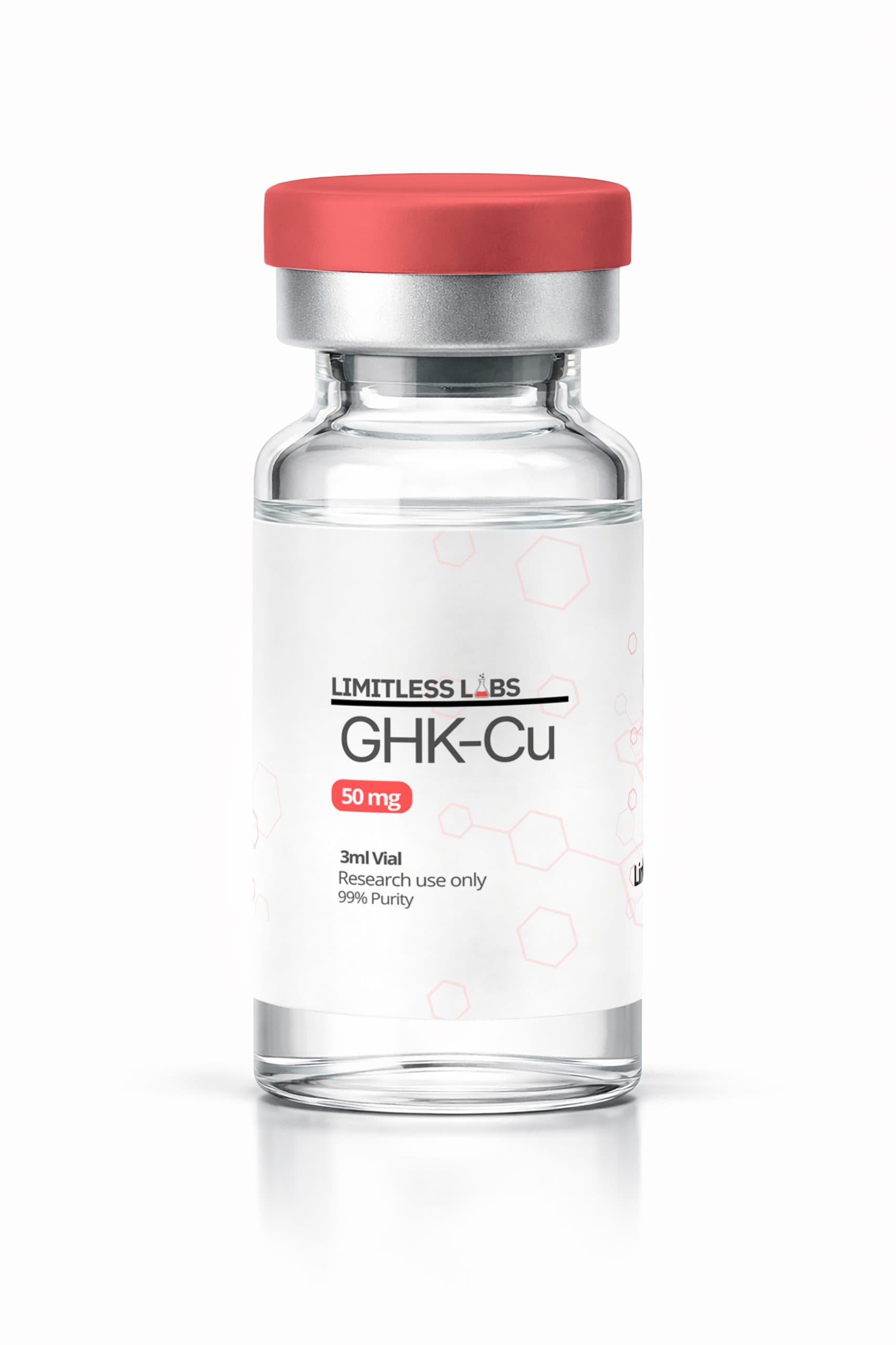
GHK-Cu is the copper(II) complex of glycyl-L-histidyl-L-lysine (GHK), a three-amino-acid peptide first isolated from human plasma in 1973. It has one of the longer research histories of any peptide discussed in the research community — more than fifty years spanning biochemistry, dermatology, wound-model, and gene-expression literature. The shape of that evidence base matters more than its size. The strongest and most reproducible findings are in vitro: GHK-Cu's copper chemistry and its effects on collagen synthesis and matrix-remodeling enzymes in cultured cells are well characterized. The next tier is animal wound and inflammation models. The human data are almost entirely topical and cosmetic — small facial studies, many of them industry-conducted and published outside indexed journals — and a 2026 systematic review could locate only two randomized controlled trials of GHK-Cu for aesthetic applications [17]. The frequently repeated claim that GHK "resets" thousands of genes rests on computational transcriptomics and the interpretive reviews of the peptide's discoverer, not on controlled outcome trials [7,18]. There are no published controlled human trials of systemically administered GHK-Cu for any indication, and GHK-Cu is not an approved drug anywhere. Everything below should be read with those distinctions in view.
What is GHK-Cu?
GHK is a tripeptide — glycine, histidine, lysine — that Loren Pickart and Michael Thaler reported isolating from human serum in 1973, initially as a factor that prolonged the survival of normal liver cells in culture [1]. Subsequent work by Pickart's group and others established that the peptide circulates in human plasma and also appears in saliva and urine, and that it binds copper(II) ions avidly; the copper complex, GHK-Cu, is the form most studied in tissue-repair research [2].
One widely cited quantitative claim traces to the originating group: that plasma GHK levels are around 200 µg/L in people in their twenties and decline to roughly 80 µg/L by age 60 [2]. This age-related decline underlies most of the "longevity-adjacent" framing around the peptide, but readers should know that the measurement comes from the discoverer's own early work, repeated across his reviews, rather than from large independent population studies.
The copper chemistry is the best-established part of the story. In careful solution-equilibrium work published in 1981, Lau and Sarkar characterized the Cu(II)–GHK complexes across pH 3.5–10.6, showed that the lysine side chain enhances the complex's stability relative to simpler dipeptides, and demonstrated that GHK can compete with albumin — the main copper carrier in blood — for Cu(II): at equimolar concentrations, about 42% of copper was bound to the peptide [3]. This supports the standard hypothesis for what GHK-Cu physically is: a small, exchange-active copper carrier that may participate in moving copper between blood and tissue. A GHK sequence also occurs in the alpha-2 chain of type I collagen, which led to the proposal that the peptide is released by proteases at injury sites — a plausible origin story that remains a hypothesis [4].
In commerce, GHK-Cu has been a cosmetic ingredient since the 1990s (in creams marketed under names like Iamin and various "copper peptide" serums). Cosmetic-ingredient status involves no efficacy approval; it should not be mistaken for regulatory endorsement of any biological claim.
Mechanism of action (proposed)
Collagen and matrix synthesis. The foundational cell-culture finding is from Maquart and colleagues (1988): GHK-Cu stimulated collagen synthesis in fibroblast cultures, with effects beginning between 10⁻¹² and 10⁻¹¹ M and maximizing at 10⁻⁹ M, independent of changes in cell number [4]. Later reviews compile additional in vitro observations of increased glycosaminoglycans, dermatan sulfate, chondroitin sulfate, and the small proteoglycan decorin [2].
MMP/TIMP modulation. GHK-Cu does not simply push matrix production in one direction; it appears to modulate both synthesis and breakdown. In cultured dermal fibroblasts, GHK-Cu increased secretion of matrix metalloproteinase-2 (MMP-2) and of its inhibitors TIMP-1 and TIMP-2 — and notably, the MMP-2 effect was reproduced by copper ions alone but not by copper-free GHK, pointing to copper delivery as the operative element [6]. In a rat wound-chamber model, serial GHK-Cu injections altered the timing of MMP-2 and MMP-9 expression during healing [5]. The composite picture from these studies is of a remodeling modulator rather than a pure anabolic signal.
Gene-expression "resetting" claims. The most expansive claims about GHK come from transcriptomics. In a 2012 Genome Medicine study, Boston University researchers profiled 64 lung-tissue samples across regions of varying emphysema severity, identified a 127-gene signature of emphysematous destruction, and used the Broad Institute's Connectivity Map to search for compounds predicted to reverse that signature — GHK emerged as a hit, and in follow-up experiments GHK treatment of fibroblasts from COPD lungs restored collagen contraction and remodeling in vitro [8]. Pickart's group subsequently built on Connectivity Map profiling to argue that GHK up- or down-regulates on the order of 4,000 human genes, "resetting" gene expression toward a healthier state [7,18]. The evidence level here deserves precision: the underlying data are computational signature-matching plus cell-culture follow-up. No controlled trial has tested whether these transcriptional patterns translate into clinical outcomes in any tissue, and the broad "genome resetting" interpretation comes primarily from the discoverer's own review articles [7,18].
Antioxidant and anti-inflammatory signaling. Animal and cell studies have associated GHK-Cu with reduced reactive-oxygen-species production, increased superoxide dismutase activity, and suppression of NF-κB p65 and p38 MAPK signaling [12]; a 2024 study identified peroxiredoxin-6 as a direct binding target in a silicosis model [13].
Research findings by area
The findings below are grouped by the type of evidence — topical-cosmetic human studies, animal models, or in vitro work — because for GHK-Cu that distinction is the whole story.
Skin remodeling and photoaging (topical, human — the largest but weakest-published area)
Small human facial studies of GHK-Cu creams, mostly conducted in the late 1990s and early 2000s, reported increased skin density and firmness, reduced fine lines and wrinkle depth, and improved appearance of photodamaged skin [2]. The honest caveat: most of these studies were industry-run, presented at dermatology conferences, and never published in full in indexed, peer-reviewed journals — they survive mainly as summaries inside review articles from the originating group [2]. A 2026 systematic review of GHK-Cu in aesthetic medicine searched PubMed, Embase, and Cochrane CENTRAL from inception through March 2026 and found 20 eligible studies, of which 18 were preclinical and only 2 were randomized controlled trials; the clinical data it did locate reported reduced wrinkle volume and depth versus controls and improved patient-reported satisfaction after laser resurfacing, while flagging methodological variability and the shortage of well-designed trials [17]. A 2025 pharmaceutics review reached a blunter verdict: despite GHK-Cu's ubiquity in "anti-wrinkle" products, there is a surprising absence of published clinical studies on the marketed complex forms, and the peptide's hydrophilicity makes passive skin penetration poor [16]. Microneedle work quantifies that delivery problem: across 9 hours, 134 ± 12 nanomoles of peptide permeated microneedle-pretreated human skin in vitro, versus almost none through intact skin [15].
Wound healing (animal models)
In a controlled rat study of ischemic open wounds, a topical 2% GHK tripeptide-copper gel was associated with a 64.5% reduction in wound area by day 13, versus 45.6% with vehicle and 28.2% with no treatment; treated wounds also contained significantly lower concentrations of TNF-α, MMP-2, and MMP-9 than controls [9]. Rat wound-chamber experiments showed GHK-Cu modulating the expression and activation of gelatinases (MMP-2, MMP-9) across the phases of healing [5]. Reviews from the originating group additionally describe wound-model findings in mice, pigs, and dogs, including reports of "systemic" wound-healing effects — acceleration at wound sites distant from the administration site — though these older studies vary widely in design and reporting quality [2,7].
Hair follicle research (in vitro and animal, partly analog-based)
The hair literature is thinner than marketing suggests, and part of it concerns analogs rather than GHK-Cu itself. In primate and rodent alopecia work at the Wisconsin Primate Research Center, a copper-binding peptide (designated PC1031) enlarged hair follicles on the back skin of fuzzy rats, an effect the authors described as similar to topical minoxidil [10]. A 2007 Korean study often cited for "copper peptide hair growth" actually tested AHK-Cu — alanyl-histidyl-lysine-copper, a related but distinct tripeptide complex — and reported elongation of human hair follicles ex vivo and dermal papilla cell proliferation at 10⁻¹² to 10⁻⁹ M [11]. No controlled human trial of GHK-Cu for hair loss has been published.
Lung and gene-expression research (computational and animal)
The COPD/emphysema work described under mechanisms [8] is the most scientifically interesting GHK finding of the past two decades, in part because it came from a group with no connection to the peptide's discoverer and emerged from an unbiased computational screen. It remains hypothesis-generating: the reversal was of a gene signature in tissue samples and cultured fibroblasts, not of disease in patients. In animal models, GHK-Cu administration was associated with reduced lung inflammation in LPS-induced acute lung injury in mice, with lower TNF-α and IL-6 and suppressed NF-κB/p38 signaling [12], and with attenuated lung inflammation and fibrosis in a silicosis mouse model, where the authors identified peroxiredoxin-6 as a binding target [13].
Other models
A 2025 study in a mouse dextran-sulfate colitis model reported that GHK-Cu administration was associated with reduced disease-activity scores, suppressed inflammatory cytokines, and improved epithelial barrier protein expression, with mechanistic work implicating SIRT1/STAT3 signaling [14]. The originating group's reviews describe additional reported areas — bone, stomach and intestinal lining, nerve outgrowth, stem-cell biology — that largely rest on older or in vitro work compiled in [2,7,18].
Limitations and open questions
Almost no controlled human data beyond small cosmetic studies. This is the decisive limitation. Fifty years of literature have produced two randomized controlled trials identified by systematic review, both in topical aesthetic contexts [17]. For systemic administration — the use pattern implied by research-peptide commerce — there are no published human trials at all: no pharmacokinetics, no dose-ranging, no safety monitoring, no efficacy outcomes.
Publication venue and independence problems. A large share of the human cosmetic data was industry-generated and never fully published [2,16]. A large share of the interpretive literature — including the "gene resetting" and plasma-decline claims — comes from the peptide's discoverer and his company's review articles [2,7,18]. Independent anchors exist (the Lau–Sarkar chemistry [3], the Reims collagen and MMP work [4,5,6], the Boston University COPD screen [8]), but the field's center of gravity is not independent.
Topical findings do not transfer. Evidence that a cream altered skin density or that microneedles improved skin permeation says nothing about what injected or otherwise systemic GHK-Cu does in a human body. The delivery literature exists precisely because the peptide penetrates intact skin poorly [15,16].
Copper is not a footnote. GHK-Cu's cell-culture effects often track the copper, not the peptide — the MMP-2 finding was reproduced by copper ions alone [6]. Copper is redox-active and homeostatically regulated; the biology of delivering exchangeable copper to tissues at scale is an open question, not a solved one.
Safety data are shallow. Reported tolerability in topical cosmetic studies has been good, with low irritation — including no observed irritation when applied after microneedle pretreatment in vitro and in animal models [15], and reviews describe the peptide as non-toxic at cosmetic concentrations [2,17]. But "well tolerated in face creams" is not a systemic safety profile. Long-term, controlled human safety data for non-topical administration do not exist.
Regulatory status. GHK-Cu is not an approved drug for any indication in any jurisdiction. Its presence in cosmetics reflects cosmetic-ingredient rules, which do not evaluate or endorse biological efficacy claims.
Frequently asked questions
Has GHK-Cu been tested in humans? Only topically, in small cosmetic studies of creams and post-procedure applications — a 2026 systematic review found just two randomized controlled trials, both in aesthetic contexts [17]. No controlled human trial of systemic GHK-Cu has been published for any indication.
Is the "resets 4,000 genes" claim real? It is a claim about transcriptional profiling data, principally from Connectivity Map-style computational analyses, amplified in reviews written by the peptide's discoverer [7,18]. The most credible independent version of the idea is the 2012 COPD study, where GHK reversed an emphysema gene signature in tissue-derived data and restored fibroblast function in vitro [8]. Whether any of this changes health outcomes in a living human has never been tested.
Why is copper part of the molecule? GHK binds copper(II) with high affinity — strongly enough to compete with albumin for copper in solution [3]. Many of the complex's cell-culture effects appear to depend on the copper rather than the peptide alone [6], and the standard hypothesis treats GHK as a physiological copper shuttle involved in tissue remodeling [2].
Does GHK-Cu regrow hair? Unknown. The animal finding (follicle enlargement in fuzzy rats, described as minoxidil-like) used a copper-binding peptide designated PC1031 [10], and the widely cited human-follicle study used AHK-Cu, a different tripeptide complex, in ex vivo culture [11]. There are no controlled human trials of GHK-Cu for hair loss.
What happened with GHK and COPD? A computational drug-repositioning screen identified GHK as a compound predicted to reverse the gene-expression signature of emphysematous lung destruction, and cell-culture follow-up supported the prediction [8]. Mouse studies have since reported reduced lung inflammation in acute lung injury and silicosis models [12,13]. No human respiratory trial has followed as of this writing.
Does GHK-Cu decline with age? The originating group reports plasma GHK of roughly 200 µg/L in young adults falling to about 80 µg/L by age 60 [2]. The figure is plausible but rests on the discoverer's own measurements rather than independent population data — and a declining plasma level is not, by itself, evidence that restoring it does anything.
Is GHK-Cu approved by the FDA? No. It is not an approved drug for any indication. It appears in cosmetics as an ingredient, a status that involves no efficacy review.
References
- Pickart L, Thaler MM. Tripeptide in human serum which prolongs survival of normal liver cells and stimulates growth in neoplastic liver. Nat New Biol. 1973;243(124):85-87. PMID: 4349963
- Pickart L, Vasquez-Soltero JM, Margolina A. GHK Peptide as a Natural Modulator of Multiple Cellular Pathways in Skin Regeneration. Biomed Res Int. 2015;2015:648108. doi:10.1155/2015/648108 — PMID: 26236730
- Lau SJ, Sarkar B. The interaction of copper(II) and glycyl-L-histidyl-L-lysine, a growth-modulating tripeptide from plasma. Biochem J. 1981;199(3):649-656. doi:10.1042/bj1990649 — PMID: 7340824
- Maquart FX, Pickart L, Laurent M, Gillery P, Monboisse JC, Borel JP. Stimulation of collagen synthesis in fibroblast cultures by the tripeptide-copper complex glycyl-L-histidyl-L-lysine-Cu2+. FEBS Lett. 1988;238(2):343-346. doi:10.1016/0014-5793(88)80509-x — PMID: 3169264
- Siméon A, Monier F, Emonard H, et al. Expression and activation of matrix metalloproteinases in wounds: modulation by the tripeptide-copper complex glycyl-L-histidyl-L-lysine-Cu2+. J Invest Dermatol. 1999;112(6):957-964. doi:10.1046/j.1523-1747.1999.00606.x — PMID: 10383745
- Siméon A, Emonard H, Hornebeck W, Maquart FX. The tripeptide-copper complex glycyl-L-histidyl-L-lysine-Cu2+ stimulates matrix metalloproteinase-2 expression by fibroblast cultures. Life Sci. 2000;67(18):2257-2265. doi:10.1016/s0024-3205(00)00803-1 — PMID: 11045606
- Pickart L, Vasquez-Soltero JM, Margolina A. GHK and DNA: resetting the human genome to health. Biomed Res Int. 2014;2014:151479. doi:10.1155/2014/151479 — PMID: 25302294
- Campbell JD, McDonough JE, Zeskind JE, et al. A gene expression signature of emphysema-related lung destruction and its reversal by the tripeptide GHK. Genome Med. 2012;4(8):67. doi:10.1186/gm367 — PMID: 22937864
- Canapp SO Jr, Farese JP, Schultz GS, et al. The effect of topical tripeptide-copper complex on healing of ischemic open wounds. Vet Surg. 2003;32(6):515-523. doi:10.1111/j.1532-950x.2003.00515.x — PMID: 14648529
- Uno H, Kurata S. Chemical agents and peptides affect hair growth. J Invest Dermatol. 1993;101(1 Suppl):143S-147S. doi:10.1111/1523-1747.ep12363275 — PMID: 8326148
- Pyo HK, Yoo HG, Won CH, et al. The effect of tripeptide-copper complex on human hair growth in vitro. Arch Pharm Res. 2007;30(7):834-839. doi:10.1007/BF02978833 — PMID: 17703734
- Park JR, Lee H, Kim SI, Yang SR. The tri-peptide GHK-Cu complex ameliorates lipopolysaccharide-induced acute lung injury in mice. Oncotarget. 2016;7(36):58405-58417. doi:10.18632/oncotarget.11168 — PMID: 27517151
- Bian Y, Deng M, Liu J, et al. The glycyl-l-histidyl-l-lysine-Cu2+ tripeptide complex attenuates lung inflammation and fibrosis in silicosis by targeting peroxiredoxin 6. Redox Biol. 2024;75:103237. doi:10.1016/j.redox.2024.103237 — PMID: 38879894
- Mao S, Huang J, Li J, et al. Exploring the beneficial effects of GHK-Cu on an experimental model of colitis and the underlying mechanisms. Front Pharmacol. 2025;16:1551843. doi:10.3389/fphar.2025.1551843 — PMID: 40672369
- Li H, Low YS, Chong HP, et al. Microneedle-Mediated Delivery of Copper Peptide Through Skin. Pharm Res. 2015;32(8):2678-2689. doi:10.1007/s11095-015-1652-z — PMID: 25690343
- Mortazavi SM, Mohammadi Vadoud SA, Moghimi HR. Topically applied GHK as an anti-wrinkle peptide: Advantages, problems and prospective. Bioimpacts. 2025;15:30071. doi:10.34172/bi.30071 — PMID: 39963574
- Mokhtar J, Mohamad B, Haddad J, et al. The Regenerative Potential of GHK-Cu in Aesthetic Medicine. Aesthet Surg J. 2026:sjag169. doi:10.1093/asj/sjag169 — PMID: 42619529
- Pickart L, Margolina A. Regenerative and Protective Actions of the GHK-Cu Peptide in the Light of the New Gene Data. Int J Mol Sci. 2018;19(7):1987. doi:10.3390/ijms19071987 — PMID: 29986520
This article is an educational summary of published research. It is not medical advice, and it does not describe, endorse, or recommend any use of GHK-Cu in humans. GHK-Cu is not an approved drug. Products referenced on this site are sold for laboratory research use only.