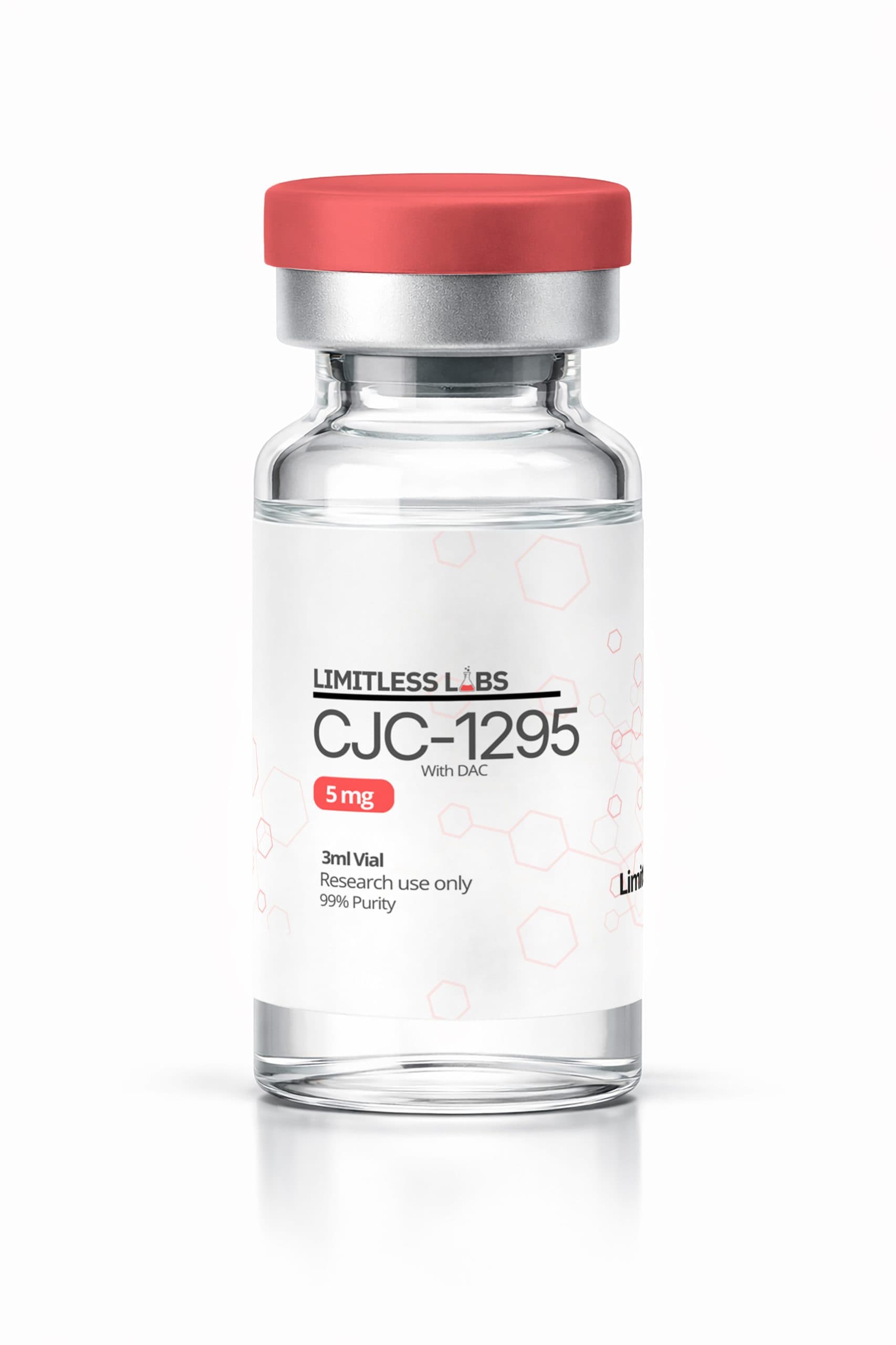
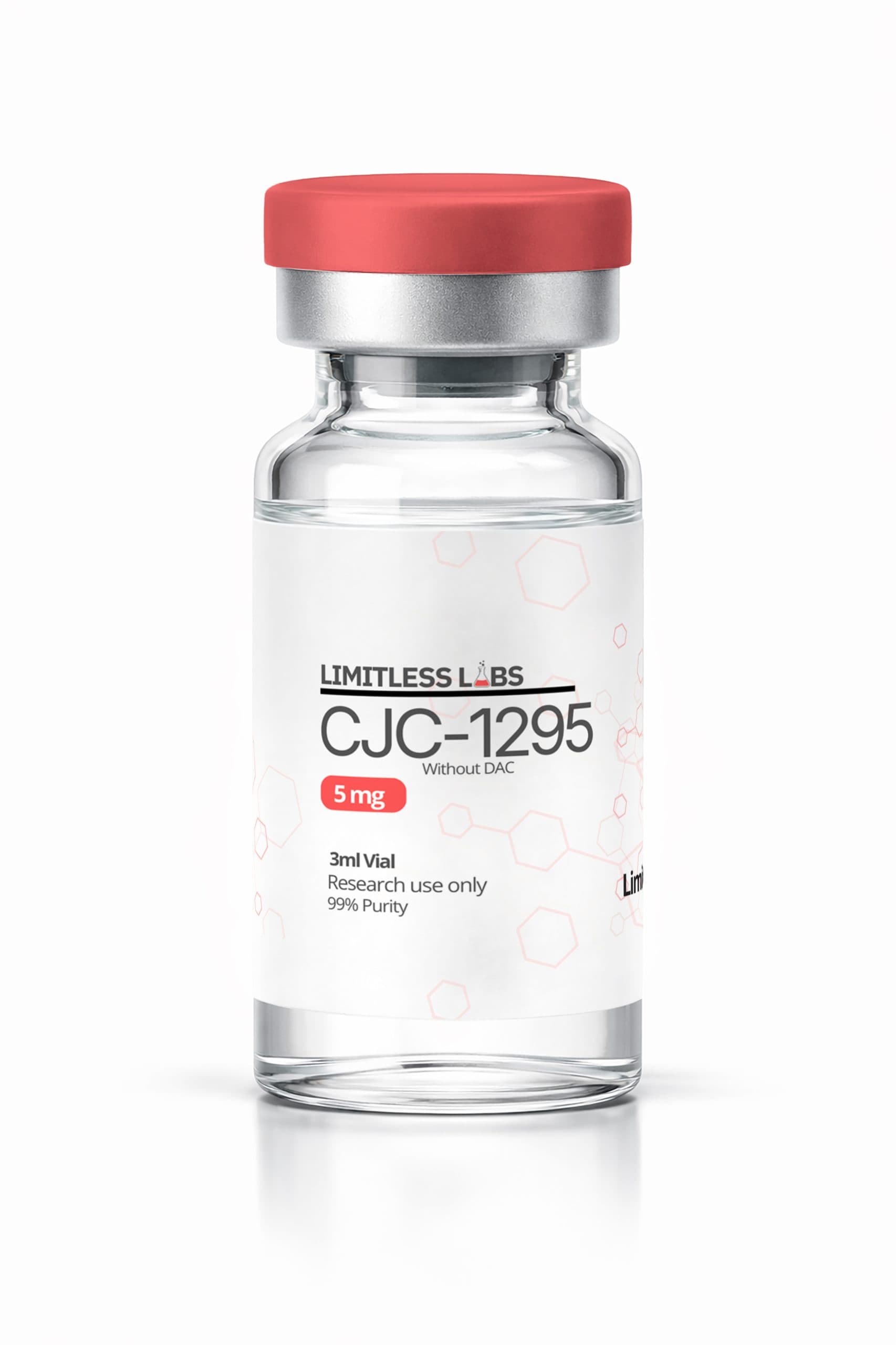
"CJC-1295" is used in the research-peptide market to describe two related but pharmacologically distinct compounds that are routinely confused. Both start from the same modified fragment of growth hormone-releasing hormone (GHRH). One version — properly called CJC-1295 with DAC, or DAC:GRF — has a large molecule called a Drug Affinity Complex (DAC) attached to it, which binds covalently to circulating albumin and stretches its duration of action from minutes to days. The other — marketed as "CJC-1295 no DAC" but referred to in the published literature as modified GRF(1-29) or tetrasubstituted GRF(1-29) — lacks that attachment and behaves much more like a conventional short-acting GHRH analog. This naming split matters: nearly everything known from controlled human research on this molecule comes from studies of the DAC-bound form, not the no-DAC version sold under the same brand name. Readers should also know upfront that the compound's clinical development history includes a 2006 trial in which a participant died, after which the developer halted the program as a precaution; development was never resumed, and neither form has been approved by any regulatory authority for any use.
What is CJC-1295?
Growth hormone-releasing hormone (GHRH) is the hypothalamic signal that tells the pituitary gland to synthesize and release growth hormone (GH). The full native hormone is 44 amino acids long, but the first 29 residues — GRF(1-29), commercially known as sermorelin — retain full biological activity. The problem, described in foundational endocrinology literature, is that native GRF(1-29) is degraded within minutes in circulation, chiefly by the enzyme dipeptidyl peptidase-4 (DPP-4) and other plasma proteases, giving it a functional half-life of well under ten minutes and making it impractical as a sustained therapeutic signal [1].
Researchers at ConjuChem Biotechnologies addressed this in two steps, described in the 2005 publication that first identified CJC-1295 [2]. First, they introduced four amino acid substitutions into the GRF(1-29) backbone — a D-alanine at position 2, a glutamine at position 8, an alanine at position 15, and a leucine at position 27 — producing "tetrasubstituted GRF(1-29)," later termed modified GRF(1-29). The D-Ala2 substitution blocks the primary DPP-4 cleavage site; the Gln8 substitution prevents asparagine deamidation, a chemical instability pathway; the Ala15 substitution was selected to preserve or enhance receptor bioactivity; and the Leu27 substitution prevents oxidation of the native methionine residue. Together these changes conferred meaningfully greater resistance to enzymatic degradation than native GRF(1-29), though the resulting molecule still had a comparatively short duration of action [2].
Second, ConjuChem's researchers attached a maleimide-bearing linker — the Drug Affinity Complex, or DAC — to the C-terminus of the modified peptide via an added lysine residue. The maleimide group reacts with the single free cysteine thiol (Cys34) on human serum albumin, forming a permanent covalent thioether bond. Because the peptide is now physically part of a much larger albumin molecule, it is shielded from peptidase attack and rapid kidney filtration, both of which normally clear small peptides quickly. The resulting bioconjugate — the molecule the 2005 paper designated CJC-1295 — showed markedly prolonged residence time in the bloodstream, tracking closer to albumin's own multi-day circulating lifespan [2]. This is the mechanistic basis of the central difference between the two products sold under the CJC-1295 name: the DAC-bound form persists for days, while the "no DAC" form — despite its own DPP-4-resistant substitutions — lacks the albumin anchor; the cited studies do not establish its human half-life.
ConjuChem carried the DAC-bound molecule into human trials for two indications: general GH-secretion applications in healthy adults, and — sometimes referred to in trial documentation as DAC:GRF — HIV-associated lipodystrophy, a condition marked by abnormal fat redistribution in patients on antiretroviral therapy. Only the healthy-volunteer studies were published in full before the lipodystrophy program was discontinued.
Mechanism of action
CJC-1295 (the DAC-bound form) acts on the same receptor as native GHRH: the growth hormone-releasing hormone receptor (GHRH-R), a G-protein-coupled receptor expressed on pituitary somatotrope cells. Receptor binding activates a Gs-adenylyl cyclase-cAMP-PKA signaling cascade that stimulates both GH gene transcription and pulsatile GH secretion; a 2025 review of GHRH-R biology situates CJC-1295 within this broader receptor-signaling framework as one of several long-acting analogs designed to sustain that stimulus [3].
Two mechanistic features are central to CJC-1295's proposed research relevance, and both were explicitly tested in human subjects:
Preserved pulsatility. GH secretion under normal physiology occurs in discrete pulses rather than as a steady baseline, and this pattern is itself thought to matter for downstream signaling. In a dedicated study, healthy men received a single subcutaneous dose of CJC-1295, with overnight 12-hour GH sampling performed before dosing and again roughly a week later. Despite the drug's continuous receptor engagement over that week-long window, GH secretion remained pulsatile — pulse frequency and magnitude were unchanged, while basal (trough) GH increased [4]. GHRH-receptor stimulation recruits endogenous GH secretion. These pulse measurements do not establish a clinical safety advantage over exogenous GH, which also participates in endocrine feedback.
Secretagogue, not GH substitute. Because CJC-1295 works upstream of GH release, at the level of the hypothalamic-pituitary signal rather than as GH itself, research generally treats it as a secretagogue rather than a hormone-replacement agent — relevant to how its effects were measured in the trials below (GH and IGF-1 concentration over time, not a clinical outcome).
Animal pharmacology work provided independent support for a GHRH-receptor-mediated mechanism: in GHRH-knockout mice, which cannot produce endogenous GHRH and consequently show stunted growth, once-daily administration of CJC-1295 normalized their growth trajectory over the observation period, demonstrating that the molecule's effects require and act through the GHRH receptor pathway rather than some off-target route [5].
Research findings by area
Human pharmacokinetics and pharmacodynamics (CJC-1295 with DAC)
The only published controlled human data on either form of CJC-1295 come from two randomized, placebo-controlled, double-blind, ascending-dose trials in healthy adults, lasting 28 and 49 days, reported together in 2006 [6]. A single injection of CJC-1295 increased mean plasma GH concentrations 2- to 10-fold, sustained for six days or longer, and increased mean plasma IGF-1 concentrations 1.5- to 3-fold, sustained for nine to eleven days. With repeated administration, IGF-1 elevation was maintained for up to 28 days of dosing. The authors reported the pharmacokinetic profile as consistent with a multi-day apparent half-life, in line with the albumin-binding mechanism described above, and characterized the safety profile across the ascending-dose ranges tested as generally tolerated in this short-term healthy-adult population [6]. It is worth being precise about what this trial did and did not show: it measured hormone concentrations over time in healthy volunteers, not any clinical outcome, and it was not powered or designed to detect rare or long-term adverse events.
Preserved pulsatility
Covered in the mechanism section above, the Ionescu and Frohman 2006 study is also a research finding in its own right: it is one of the few instances in the GHRH-analog literature where deep-phenotyping (repeated overnight sampling to characterize pulse architecture, not just trough or peak concentrations) was used to test whether a long-acting analog preserves physiological secretory dynamics, and it reported that CJC-1295 did [4].
Animal pharmacology
The GHRH-knockout mouse study describes normalized growth over a defined observation period with once-daily dosing, providing supportive evidence for receptor-mediated mechanism but — as an animal model of complete GHRH deficiency — it does not directly translate to expected effects in humans with normal endogenous GHRH signaling [5].
The "no DAC" / modified GRF(1-29) form specifically
This is the least-studied part of the CJC-1295 story in the published literature. The four-substitution chemistry that defines modified GRF(1-29) was characterized primarily for its improved in vitro protease resistance and pituitary-cell bioactivity in the 2005 identification paper [2]; no dedicated, published human pharmacokinetic or pharmacodynamic trial of the non-DAC peptide (under either the "modified GRF(1-29)" or "CJC-1295 no DAC" name) appears in the peer-reviewed record. Everything published about human GH and IGF-1 responses to injectable CJC-1295 — the numbers cited above — describes the DAC-bound molecule. Claims about the no-DAC form's effects in humans are therefore extrapolations from its chemistry and from the DAC form's data, not direct findings.
GHRH analogs as a drug class
CJC-1295 sits within a broader family of engineered GHRH analogs that researchers have pursued for applications well beyond the compound's own discontinued program. A 2025 review surveys GHRH agonist and antagonist analogs investigated across oncology, regenerative medicine, and metabolic disease, situating half-life-extension strategies like DAC-conjugation alongside other approaches (including other chemical modifications of GHRH analogs) as parallel solutions to the same core stability problem [7]. This class-level context is useful for understanding why CJC-1295 was engineered the way it was, but it does not substitute for compound-specific efficacy or safety data, which for CJC-1295 remain limited to the small trials described above.
Limitations and open questions
The 2006 trial discontinuation. ConjuChem's most advanced clinical program for the DAC-bound molecule was a multicenter, randomized, placebo-controlled, double-blind Phase II trial in approximately 192 participants with HIV-associated visceral fat redistribution (lipodystrophy). The trial was halted in July 2006 after a participant died of an acute myocardial infarction approximately two hours after receiving an eleventh injection of study drug. Reporting at the time indicated the attending physician's assessment was that the death most likely reflected pre-existing, previously asymptomatic coronary artery disease with plaque rupture, and judged it unrelated to the study drug; ConjuChem nonetheless terminated the trial as a precautionary measure [8]. The program was never resumed, no controlled efficacy results from it were ever published, and no other CJC-1295 indication advanced past small early-phase studies in healthy volunteers. This history should be stated plainly rather than minimized: it is the reason a promising pharmacokinetic profile in healthy adults never became an approved or even fully trialed therapy.
No completed Phase 2/3 program, no approval anywhere. Beyond the two small ascending-dose studies in healthy adults, no Phase 2 or Phase 3 controlled efficacy or safety trial of CJC-1295 (with or without DAC) has been completed and published for any indication in any population. Neither form is an approved drug in the United States or elsewhere.
U.S. regulatory posture: a gray zone, not a clearance. CJC-1295-related substances sat in Category 2 of FDA's interim policy on bulk drug substances for Section 503A pharmacy compounding until that nomination was withdrawn and the substances were removed from Category 2 in September 2024. FDA then referred five specific CJC-1295-related substances (free base, acetate, and three DAC salt forms) to its Pharmacy Compounding Advisory Committee, which took up permanent 503A Bulks List inclusion at its December 4, 2024 meeting — where FDA's own stated position was that none of the five should be added [9]. Removal from a "significant safety risk" category is not equivalent to a safety clearance — it reflects a procedural withdrawal and an unresolved committee review, not an approval.
Prohibited in sport. CJC-1295 is explicitly named as a prohibited GHRH analog under Section S2 (Peptide Hormones, Growth Factors, Related Substances, and Mimetics) of the World Anti-Doping Agency's Prohibited List, banned at all times, in and out of competition [10].
Naming confusion in the research-peptide market. Because "CJC-1295 no DAC" is a market name rather than a term drawn from the peptide's original characterization, and because the underlying chemistry (modified GRF(1-29)) is sometimes conflated with unrelated short-acting GHRH analogs like sermorelin, researchers evaluating vendor-sourced material should not assume that product labeling reliably identifies which molecule, or which literature, actually applies.
Concentrated evidence base. The human data described in this article come almost entirely from one clinical research group (Teichman, Frohman, and ConjuChem-affiliated co-authors) publishing in two related papers. Independent replication of the human PK/PD findings by unaffiliated laboratories does not appear in the published record. The chemistry and animal pharmacology work is similarly concentrated among a small set of overlapping author groups.
Theoretical, unquantified safety concerns. Because CJC-1295 raises GH and IGF-1 through the same axis targeted by other GH-elevating therapies, mechanism-based concerns — supraphysiological IGF-1 exposure, insulin resistance, fluid-retention-related effects — are plausible for sustained use. These are drawn from general GH/IGF-1 axis pharmacology, not from a CJC-1295-specific long-term safety trial, none of which exists; they are hypotheses for future controlled study, not established, quantified risks for this molecule.
Frequently asked questions
Is CJC-1295 with DAC the same molecule as CJC-1295 no DAC? No. They share the same tetrasubstituted GRF(1-29) backbone, but the DAC form has an additional albumin-binding linker attached, which is what gives it a multi-day duration of action in the published human trial. The no-DAC form — which the scientific literature calls modified GRF(1-29) — lacks that linker and behaves like a short-acting GHRH analog [2].
Has CJC-1295 been tested in humans? The DAC-bound form was tested in two small, short (28- and 49-day) randomized, placebo-controlled trials in healthy adults, which measured GH and IGF-1 concentrations over time [6], plus a dedicated pulsatility study [4]. No published controlled human trial exists specifically for the no-DAC/modified GRF(1-29) form. A larger Phase II trial of the DAC form in HIV-associated lipodystrophy was terminated early after a participant death and never completed or published [8].
Why was CJC-1295's clinical development discontinued? A Phase II trial in HIV-associated lipodystrophy was halted in July 2006 after a study participant died of a heart attack shortly after an injection. The attending physician's assessment attributed the death to pre-existing coronary disease rather than the study drug, but the sponsor discontinued the program as a precaution, and it was never resumed [8].
Is CJC-1295 approved by the FDA? No, in either form. It has also moved through a specific compounding-regulation process: it sat in FDA's Category 2 bulk-substance list (signaling possible significant safety risk) until that nomination was withdrawn in September 2024, after which FDA referred it to its Pharmacy Compounding Advisory Committee — which reviewed it in December 2024 with FDA recommending against permanent inclusion on the 503A Bulks List [9]. That is an unresolved regulatory question, not a safety clearance.
Can athletes use CJC-1295? No. It is explicitly named as a prohibited GHRH analog under WADA's Prohibited List, Section S2, banned at all times [10].
What's the actual half-life difference between the two forms, and why? Native GRF(1-29) is degraded within minutes by circulating peptidases. The modified backbone and albumin-linking strategy address degradation, but the cited human pharmacokinetic results apply to the DAC form, not a measured no-DAC half-life. Attaching the DAC linker covalently binds the peptide to serum albumin — shielding it from peptidase degradation and kidney filtration — which is what stretches the DAC form's effective duration to multiple days [1,2].
Is CJC-1295 the same as sermorelin, tesamorelin, or ipamorelin? No, though all are related in the growth-hormone-secretagogue space. Sermorelin is unmodified GRF(1-29) itself. Tesamorelin is a separate, FDA-approved GHRH analog (for excess abdominal fat in HIV-associated lipodystrophy) that uses a different chemical strategy — an N-terminal trans-3-hexenoyl modification — to extend its half-life, and it has its own distinct clinical trial record [3,7]. Ipamorelin is not a GHRH analog at all; it acts on a different receptor (the ghrelin/GHS receptor) via a separate signaling pathway, which is why research combinations sometimes pair a GHRH analog with a ghrelin-receptor agonist to engage both mechanisms.
References
- Frohman LA, Jansson JO. Growth hormone-releasing hormone. Endocr Rev. 1986;7(3):223-253. doi:10.1210/edrv-7-3-223 — PMID: 2874984
- Jetté L, Léger R, Thibaudeau K, et al. Human growth hormone-releasing factor (hGRF)1-29-albumin bioconjugates activate the GRF receptor on the anterior pituitary in rats: identification of CJC-1295 as a long-lasting GRF analog. Endocrinology. 2005;146(7):3052-3058. doi:10.1210/en.2004-1286 — PMID: 15817669
- Halmos G, Szabo Z, Dobos N, Juhasz E, Schally AV. Growth hormone-releasing hormone receptor (GHRH-R) and its signaling. Rev Endocr Metab Disord. 2025;26(3):343-352. doi:10.1007/s11154-025-09952-x — PMID: 39934495
- Ionescu M, Frohman LA. Pulsatile secretion of growth hormone (GH) persists during continuous stimulation by CJC-1295, a long-acting GH-releasing hormone analog. J Clin Endocrinol Metab. 2006;91(12):4792-4797. doi:10.1210/jc.2006-1702 — PMID: 17018654
- Alba M, Fintini D, Sagazio A, Lawrence B, Castaigne JP, Frohman LA, Salvatori R. Once-daily administration of CJC-1295, a long-acting growth hormone-releasing hormone (GHRH) analog, normalizes growth in the GHRH knockout mouse. Am J Physiol Endocrinol Metab. 2006;291(6):E1290-1294. doi:10.1152/ajpendo.00201.2006 — PMID: 16822960
- Teichman SL, Neale A, Lawrence B, Gagnon C, Castaigne JP, Frohman LA. Prolonged stimulation of growth hormone (GH) and insulin-like growth factor I secretion by CJC-1295, a long-acting analog of GH-releasing hormone, in healthy adults. J Clin Endocrinol Metab. 2006;91(3):799-805. doi:10.1210/jc.2005-1536 — PMID: 16352683
- Schally AV, Cai R, Zhang X, Sha W, Wangpaichitr M. The development of growth hormone-releasing hormone analogs: Therapeutic advances in cancer, regenerative medicine, and metabolic disorders. Rev Endocr Metab Disord. 2025;26(3):385-396. doi:10.1007/s11154-024-09929-2 — PMID: 39592529
- Lipodystrophy study halted after patient death. aidsmap, July 2006. Available at: aidsmap.com
- U.S. Food and Drug Administration. FDA Briefing Document: Pharmacy Compounding Advisory Committee (PCAC) Meeting, December 4, 2024 (CJC-1295-related bulk drug substances). Available at: fda.gov/media/183583/download
- World Anti-Doping Agency. The Prohibited List — Section S2, Peptide Hormones, Growth Factors, Related Substances, and Mimetics. Available at: wada-ama.org/en/prohibited-list
This article is an educational summary of published research. It is not medical advice, and it does not describe, endorse, or recommend any use of CJC-1295 in humans. Neither CJC-1295 with DAC nor CJC-1295 no DAC (modified GRF(1-29)) is an approved drug. Products referenced on this site are sold for laboratory research use only.