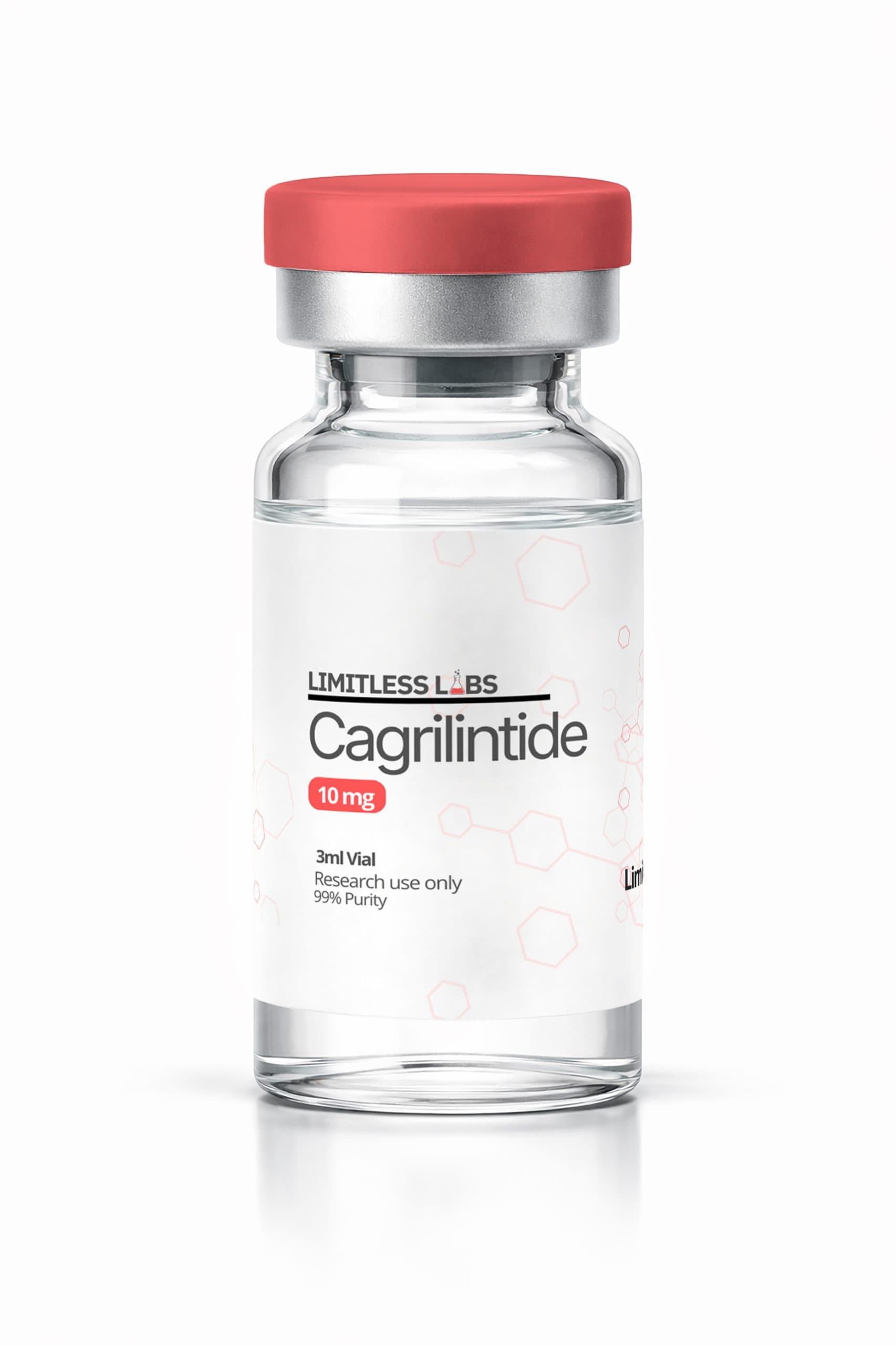
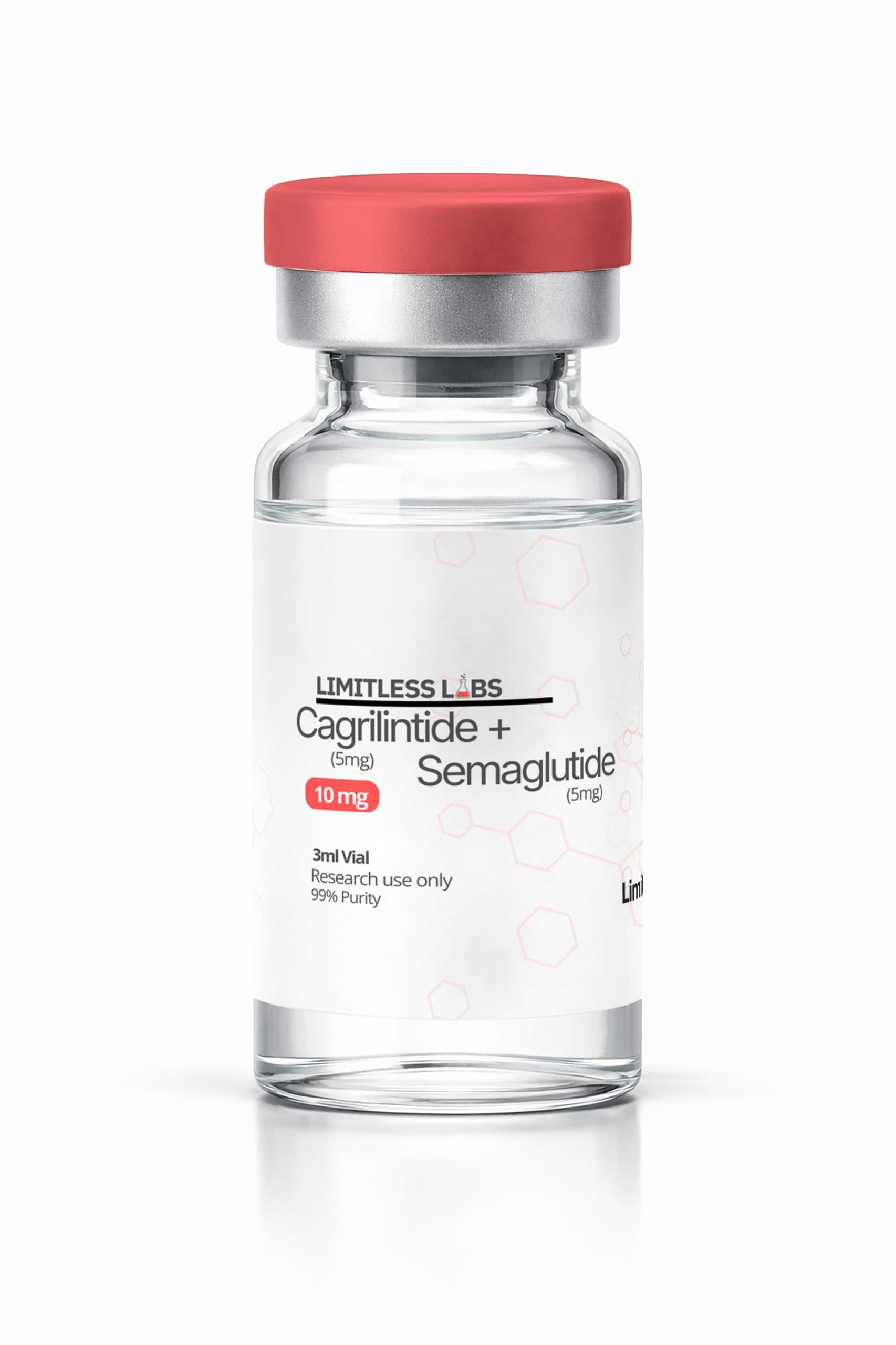
Cagrilintide is an investigational long-acting analog of amylin, a pancreatic hormone involved in satiation, developed by Novo Nordisk. It is the first amylin-based molecule engineered for once-weekly administration, and it occupies an unusual position in the metabolic-research landscape: it has meaningful activity on its own — 10.8% mean weight reduction over 26 weeks at the highest dose in its phase 2 monotherapy trial [3] — but most of the scientific attention now centers on its fixed combination with semaglutide, known as CagriSema. In the 68-week REDEFINE 1 phase 3 trial, CagriSema produced an estimated mean body-weight change of −20.4% versus −3.0% with placebo [6], and Novo Nordisk filed the combination with the FDA in December 2025 [8]. Cagrilintide remains an investigational compound: neither it nor CagriSema is approved by the FDA for any use, and this article is a summary of the published scientific literature, not medical guidance.
What Is Cagrilintide?
Cagrilintide, known in early development as AM833 (NNC0174-0833), is a 37-amino-acid peptide analog of human amylin. Native amylin — also called islet amyloid polypeptide — is co-secreted with insulin by pancreatic beta cells and signals meal-related satiation to the brainstem [1]. The natural hormone is unstable in solution and prone to forming amyloid aggregates, which is why the first clinical amylin analog, pramlintide, required substitutions to remain soluble and still had to be injected at each meal. Cagrilintide takes the engineering further: Novo Nordisk's medicinal-chemistry team combined stabilizing backbone substitutions with a lipidation strategy (a fatty-diacid moiety that promotes albumin binding), producing a soluble, aggregation-resistant molecule with a half-life long enough to support once-weekly subcutaneous dosing in trials [2].
Its development timeline, in brief:
- Molecular design (published 2021). Kruse and colleagues described the discovery chemistry in the Journal of Medicinal Chemistry, characterizing cagrilintide's receptor pharmacology and the modifications that solved amylin's stability problem [2].
- Phase 1b combination trial (2021). A 20-week trial in The Lancet tested multiple doses of cagrilintide given alongside semaglutide 2.4 mg, establishing the safety and pharmacokinetic basis for the combination [4].
- Phase 2 monotherapy (2021). A 706-participant dose-finding trial in The Lancet, detailed below [3].
- Phase 2 combination in type 2 diabetes (2023). A 92-participant trial of CagriSema versus each component alone [5].
- Phase 3 (2025–2026). The REDEFINE program in weight management read out its two pivotal trials in 2025, both published in the New England Journal of Medicine [6][7], followed by an FDA filing in December 2025 [8] and a head-to-head trial against tirzepatide reported in February 2026 [9]. A cardiovascular outcomes trial (REDEFINE 3) and a separate type 2 diabetes program (REIMAGINE) are ongoing [8][10].
Mechanism of Action
Amylin acts on receptors that are themselves a piece of unusual biology: an amylin receptor is a calcitonin receptor core complexed with one of three receptor activity-modifying proteins (RAMP1–3), yielding the AMY1, AMY2, and AMY3 receptor subtypes [1]. Because cagrilintide activates both these amylin receptors and the calcitonin receptor itself, it is often described in the pharmacology literature as a dual amylin and calcitonin receptor agonist, or DACRA [2].
Functionally, amylin signaling differs from the GLP-1 pathway in where and how it acts:
- Satiation signaling via the hindbrain. Amylin acts on the area postrema and downstream brainstem-hypothalamic circuits to promote meal-ending satiation — reducing meal size rather than primarily suppressing between-meal appetite [1]. This anatomical separation from GLP-1 receptor circuits is the core rationale for combining the two mechanisms.
- Slowed gastric emptying. Like GLP-1 receptor agonists, amylin delays gastric emptying, flattening postprandial glucose excursions [1].
- Postprandial glucagon suppression. Amylin inhibits inappropriate glucagon secretion after meals, a complementary glycemic effect [1].
- Possible effects on weight-loss defense. Preclinical work has suggested amylin agonism may influence the counter-regulatory responses that resist weight loss, one hypothesis for why amylin-plus-incretin combinations outperform either class alone; this remains an active research question rather than an established mechanism [1][2].
In the CagriSema combination, cagrilintide 2.4 mg and semaglutide 2.4 mg are co-administered once weekly by subcutaneous injection, pairing amylin-receptor agonism with GLP-1 receptor agonism [6].
Research Findings by Area
Monotherapy weight outcomes
The phase 2 dose-finding trial (NCT03856047) randomized 706 adults without diabetes — BMI ≥30, or ≥27 with hypertension or dyslipidemia — to once-weekly cagrilintide (0.3, 0.6, 1.2, 2.4, or 4.5 mg), once-daily liraglutide 3.0 mg, or placebo for 26 weeks [3]. Mean weight reductions were dose-dependent, ranging from 6.0% to 10.8% across the cagrilintide arms versus 3.0% with placebo (p<0.001 for all doses). At 4.5 mg, cagrilintide also produced greater weight reduction than liraglutide 3.0 mg (10.8% vs 9.0%; estimated treatment difference 1.8%, p=0.03), and weight had not plateaued by week 26 [3]. The most frequent adverse events were gastrointestinal (nausea in 20–47% across doses versus 18% with placebo) and administration-site reactions; treatment discontinuation was similar across groups at about 10% [3]. The trial provided phase 2 evidence for cagrilintide monotherapy. REDEFINE 1 subsequently included a cagrilintide-alone arm followed for 68 weeks, alongside semaglutide alone, the combination, and placebo [6].
Early combination data with semaglutide
A phase 1b trial published in The Lancet in 2021 assessed multiple ascending doses of cagrilintide (0.16–4.5 mg) co-administered with semaglutide 2.4 mg in 96 adults with overweight or obesity over 20 weeks [4]. The design was built for safety and pharmacokinetics, but the exploratory weight data drew attention: participants receiving cagrilintide 2.4 mg with semaglutide 2.4 mg lost a mean of 17.1% of body weight in 20 weeks, versus 9.8% with placebo plus semaglutide 2.4 mg — an early signal that the two mechanisms were additive [4]. Co-administration did not meaningfully alter the pharmacokinetics of either compound, and the tolerability profile was dominated by mild-to-moderate gastrointestinal events [4].
CagriSema in type 2 diabetes — phase 2
A 32-week phase 2 trial (NCT04982575) randomized 92 adults with type 2 diabetes and BMI ≥27 on metformin (with or without an SGLT2 inhibitor) to CagriSema, semaglutide 2.4 mg alone, or cagrilintide 2.4 mg alone [5]. HbA1c fell by 2.2 percentage points with CagriSema versus 1.8 with semaglutide and 0.9 with cagrilintide; the difference was statistically significant versus cagrilintide but not versus semaglutide. Body weight told a sharper story: −15.6% with CagriSema versus −5.1% with semaglutide and −8.1% with cagrilintide (p<0.0001 for both comparisons). Continuous glucose monitoring time-in-range improved from 45.9% to 88.9% in the CagriSema arm, and no level 2 or 3 hypoglycemia was reported [5].
The REDEFINE phase 3 program
REDEFINE 1 (NCT05567796) was the pivotal obesity trial: 3,417 adults without diabetes (BMI ≥30, or ≥27 with at least one obesity-related complication) randomized 21:3:3:7 to CagriSema, semaglutide 2.4 mg, cagrilintide 2.4 mg, or placebo for 68 weeks, all with lifestyle intervention [6]. Under the treatment-policy estimand (intention-to-treat), estimated mean weight change was −20.4% with CagriSema versus −3.0% with placebo; the semaglutide and cagrilintide monotherapy arms came in at approximately −14.9% and −11.5% respectively [6]. In company-reported analyses assuming full adherence, mean weight reduction reached 22.7%, with 40.4% of CagriSema participants losing at least 25% of body weight; 91.9% achieved at least 5% weight reduction versus 31.5% with placebo [6]. Gastrointestinal adverse events affected 79.6% of the CagriSema group versus 39.9% with placebo, and were mainly transient and mild-to-moderate [6]. The trial allowed flexible dose escalation, so not all participants remained on the maximum dose. Analyses that assume adherence and those that include discontinuation answer different questions [6].
REDEFINE 2 (NCT05394519) enrolled 1,206 adults with type 2 diabetes and BMI ≥27, randomized 3:1 to CagriSema or placebo for 68 weeks [7]. Estimated mean weight change was −13.7% versus −3.4% with placebo (estimated difference −10.4 percentage points; p<0.001). On the glycemic side, 73.5% of CagriSema-treated patients reached an HbA1c of 6.5% or below, versus 15.9% with placebo. Gastrointestinal adverse events were reported by 72.5% versus 34.4% [7]. The smaller weight change relative to REDEFINE 1 mirrors a pattern seen across the incretin literature: participants with type 2 diabetes consistently lose less weight than those without.
Regulatory status. On the strength of REDEFINE 1 and 2, Novo Nordisk submitted a New Drug Application to the FDA in December 2025 for CagriSema as a once-weekly treatment candidate in chronic weight management, with a decision anticipated during 2026 [8]. As of this writing, no approval has been announced.
REDEFINE 4 — head-to-head versus tirzepatide (February 2026). In an open-label, 84-week trial of 809 adults with obesity and at least one comorbidity, CagriSema produced 20.2% mean weight loss versus 23.6% with tirzepatide 15 mg under the treatment-regimen estimand (23.0% vs 25.5% assuming adherence). The trial did not meet its primary endpoint of non-inferiority to tirzepatide [9]. The announced noninferiority failure does not by itself establish superiority under a separate statistical test.
Ongoing outcomes work. REDEFINE 3 (NCT05669755) is testing CagriSema against placebo for major cardiovascular events in people with established cardiovascular disease over roughly 4.5 years [10], and the REIMAGINE program is studying the combination in type 2 diabetes [8].
Comparison context
Cross-trial comparisons are inherently unreliable — different populations, durations, and estimands — but the published numbers frame where cagrilintide-based therapy sits. REDEFINE 1 included semaglutide and cagrilintide component arms [6]. The separately announced REDEFINE 4 comparison reported numerically greater weight reduction with tirzepatide and did not meet its noninferiority objective for CagriSema [9]. Cagrilintide monotherapy evidence includes the 26-week phase 2 dose-finding trial [3], a 32-week component arm in type 2 diabetes [5], and a 68-week component arm in REDEFINE 1 [6]. These differ in population, duration, and study design; they should not be treated as interchangeable effect estimates.
Limitations & Open Questions in the Literature
- No approved indication. Cagrilintide and CagriSema are investigational. The FDA filing was submitted in December 2025 and no regulatory decision had been announced at the time of writing [8]. All efficacy figures come from supervised clinical-trial settings.
- Monotherapy evidence extends beyond phase 2. The dedicated dose-finding trial ran 26 weeks [3], but cagrilintide-alone arms also appear in the 32-week diabetes trial [5] and 68-week REDEFINE 1 trial [6]. Those component arms were included to assess the combination; they do not establish multi-year durability or post-discontinuation outcomes for cagrilintide alone.
- The head-to-head miss. REDEFINE 4 failed to show non-inferiority versus tirzepatide [9]. Full peer-reviewed publication of that trial, including secondary endpoints and tolerability comparisons, is still pending.
- Dose-escalation questions. REDEFINE 1's flexible protocol meant a substantial fraction of participants did not remain at the maximum dose, complicating interpretation of the ceiling of effect [6][9].
- Tolerability. Gastrointestinal adverse events were the dominant finding in every trial — up to 79.6% of CagriSema participants in REDEFINE 1 [6] — and, while mostly transient and mild-to-moderate, they drive discontinuation in this drug class.
- Hard outcomes unknown. Whether CagriSema reduces cardiovascular events is the question assigned to REDEFINE 3, which runs for several more years [10].
- Durability and lean mass. Post-discontinuation weight trajectories and body-composition effects (fat versus lean mass) have not been characterized in the published cagrilintide literature — open questions for the amylin class as a whole [1].
Frequently Asked Questions
What is cagrilintide, in one sentence? An investigational once-weekly analog of the pancreatic hormone amylin, developed by Novo Nordisk, that activates amylin and calcitonin receptors and is studied for weight management alone and combined with semaglutide [2][3].
How is it different from semaglutide and other GLP-1 drugs? It works through an entirely different receptor system — amylin receptors in the brainstem that signal meal-ending satiation — rather than the GLP-1 receptor pathway, which is why researchers combined the two mechanisms into CagriSema [1][6].
What is CagriSema? A fixed combination of cagrilintide 2.4 mg and semaglutide 2.4 mg given once weekly, studied in the phase 3 REDEFINE program [6][7].
How much weight change was reported in trials? Cagrilintide alone: up to 10.8% over 26 weeks in the phase 2 dose-finding trial [3], and approximately −11.5% in the 68-week REDEFINE 1 component arm [6]. CagriSema: −20.4% at 68 weeks versus −3.0% with placebo in adults without diabetes [6], and −13.7% versus −3.4% in adults with type 2 diabetes [7].
Is cagrilintide or CagriSema FDA-approved? No. CagriSema was filed with the FDA in December 2025 and remains under review; cagrilintide alone has not been filed for approval [8].
How did CagriSema compare with tirzepatide? In the open-label REDEFINE 4 trial, CagriSema's 20.2% weight loss at 84 weeks did not achieve non-inferiority against tirzepatide's 23.6% [9].
What were the most common adverse events in trials? Gastrointestinal events — nausea, vomiting, diarrhea, constipation — mostly transient and mild-to-moderate, plus administration-site reactions in the monotherapy trial [3][6][7].
What major questions remain unanswered? Long-term durability, post-discontinuation effects, body-composition detail, the full REDEFINE 4 dataset, and cardiovascular outcomes, which are being tested in REDEFINE 3 through the late 2020s [9][10].
Corrections
2026-09-09: The limitations and FAQ now include the 68-week cagrilintide-alone arm of REDEFINE 1. The previous text incorrectly stated that monotherapy evidence stopped at 26 weeks.
References
- Hay DL, Chen S, Lutz TA, Parkes DG, Roth JD. Amylin: Pharmacology, Physiology, and Clinical Potential. Pharmacol Rev. 2015;67(3):564–600. doi:10.1124/pr.115.010629. PMID: 26071095
- Kruse T, et al. Development of Cagrilintide, a Long-Acting Amylin Analogue. J Med Chem. 2021;64(15):11183–11194. doi:10.1021/acs.jmedchem.1c00565. PMID: 34288673
- Lau DCW, et al. Once-weekly cagrilintide for weight management in people with overweight and obesity: a multicentre, randomised, double-blind, placebo-controlled and active-controlled, dose-finding phase 2 trial. Lancet. 2021;398(10317):2160–2172. doi:10.1016/S0140-6736(21)01751-7. PMID: 34798060
- Enebo LB, et al. Safety, tolerability, pharmacokinetics, and pharmacodynamics of concomitant administration of multiple doses of cagrilintide with semaglutide 2·4 mg for weight management: a randomised, controlled, phase 1b trial. Lancet. 2021;397(10286):1736–1748. doi:10.1016/S0140-6736(21)00845-X. PMID: 33894838
- Frias JP, et al. Efficacy and safety of co-administered once-weekly cagrilintide 2·4 mg with once-weekly semaglutide 2·4 mg in type 2 diabetes: a multicentre, randomised, double-blind, active-controlled, phase 2 trial. Lancet. 2023;402(10403):720–730. doi:10.1016/S0140-6736(23)01163-7. PMID: 37364590
- Garvey WT, et al. Coadministered Cagrilintide and Semaglutide in Adults with Overweight or Obesity (REDEFINE 1). N Engl J Med. 2025;393(7):635–647. doi:10.1056/NEJMoa2502081. PMID: 40544433
- Davies MJ, et al. Cagrilintide–Semaglutide in Adults with Overweight or Obesity and Type 2 Diabetes (REDEFINE 2). N Engl J Med. 2025;393(7):648–659. doi:10.1056/NEJMoa2502082. PMID: 40544432
- Novo Nordisk A/S. Novo Nordisk files for FDA approval of CagriSema, the first once-weekly combination of GLP-1 and amylin analogues for weight management. Press release, December 2025. https://www.prnewswire.com/news-releases/novo-nordisk-files-for-fda-approval-of-cagrisema-the-first-once-weekly-combination-of-glp1-and-amylin-analogues-for-weight-management-302645862.html
- Novo Nordisk A/S. CagriSema demonstrated 23% weight loss in an open-label head-to-head REDEFINE 4 trial in people with obesity; the primary endpoint was not achieved. Press release, February 2026. https://www.biospace.com/press-releases/novo-nordisk-a-s-cagrisema-demonstrated-23-weight-loss-in-an-open-label-head-to-head-redefine-4-trial-in-people-with-obesity-the-primary-endpoint-was-not-achieved
- ClinicalTrials.gov. REDEFINE 3: A Research Study to See the Effects of CagriSema in People Living With Diseases in the Heart and Blood Vessels. NCT05669755. https://clinicaltrials.gov/study/NCT05669755
This article summarizes published scientific literature for educational purposes only. Cagrilintide and CagriSema are investigational compounds not approved for human use. Nothing here constitutes medical advice, and no statement has been evaluated by the FDA.